
For context, I’m creating an ‘academic English’ syllabus for Year 7 EAL learners.
So, I currently have:
- About 45 core skill areas for learners to develop across 5 areas: reading/viewing, speaking/oracy, listening, writing, plurilingual competencies (see Part 1). These are broken down into nearly 200 subskills (Part 3)
- A core vocabulary bank of 50 Tier 2 word families to recycle throughout the units, plus around 200 or so possible Tier 3 terms to include at grade level and 100 ‘likely prior knowledge’ terms to help with Tier 3 access (See Part 2)
The above is our core coverage. While the Tier 3 vocab has a ‘select, not cover’ approach to make sure it is addressed with relevance, we are very likely to cover it across the units somehow.
Why am I leaving the language coverage hanging?!
I’ve deliberately left the rest of our language coverage light at this stage. This is because the bulk of the academic language, beyond subject keywords, is bound up in functions and features – language for comparison/contrast; language for introducing evidence; expanded noun phrases for details, etc. You know the type of WIDA lists (like the one below, under ‘Argue: Grades 6-8’) where everything is spun in a meaning-making way rather than thinking just about structures (present simple this, past simple that)…
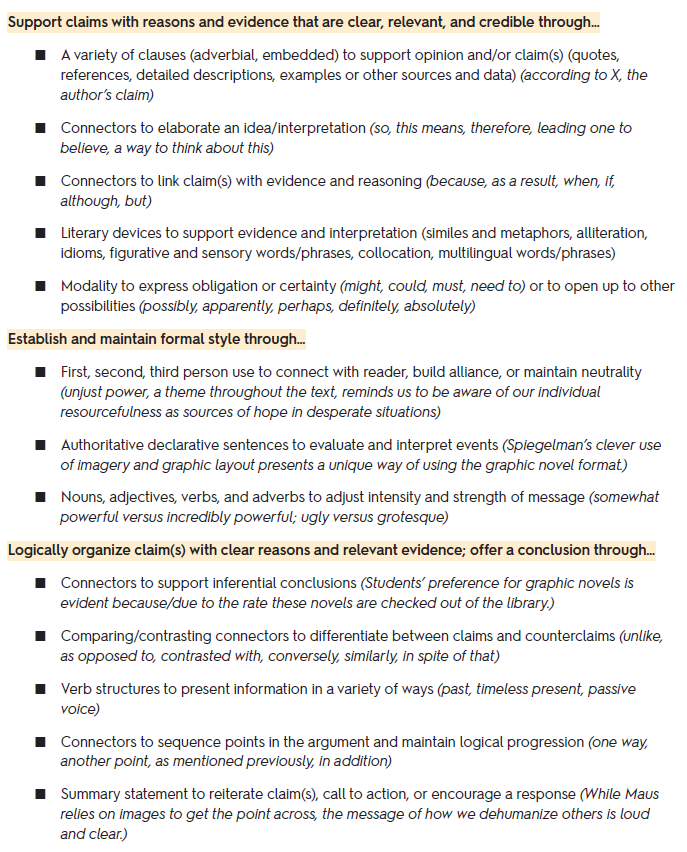
Anyhow, I was happy to predict skills coverage prior to syllabus mapping as it’s, well, quite predictable in parts anyway. Language features could be as well for a syllabus like this, but I guess you have a choice. Build the whole syllabus around prescribed language development targets, or draw the target language out from the authentic tasks. In this case, there is already one prescribed vocab list, so I’d rather build the remaining language development bank in response to our chosen tasks.
Establishing the right context for the tasks
So, I can’t build the language bank without the tasks, and I can’t build the tasks without the context. In this case, the overriding context is ‘enabling access and participation in a full academic curriculum’. One way to approach this is to say ‘okay, let’s cover science-related content with science-related tasks in Unit A, then maths-related content with… etc.’ And that’s what you often get:
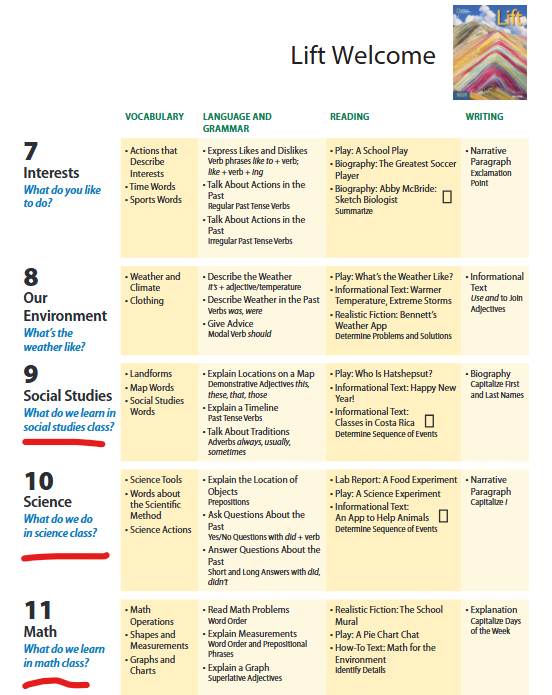
That is one approach, but I prefer to think of skills/acts/functions in a cross-curricular sense. What do learners actually need to do across the board? That means multiple subject areas can then be covered within one unit. That ups the incidental/implicit learning opportunities IMO.
Another reason. If Bob in Year 7 hates science, and I’m about to make him do a 3 week science-focussed unit as a vehicle for language development in our English support class… Bob sleeps. Whereas if I’m like ‘okay, we’re going to practice a similar task to this tomorrow, but related to history! Because, BOB, I know you love history…’ then we can give Bob the chance to see the bigger picture – how do all these skills you’re developing and tasks you’re doing, however boring sometimes, help you across subject areas?’.
Choosing the units based on cross-curricular context
End of Bob ramble – let’s choose some unit topics.
| Unit | General unit focus | Guiding question | Lessons |
| U1 | School Ready | How can we become ready to learn and succeed at school? | 15 |
| U2 | Patterns and Data | What can data reveal? | 12 |
| U3 | Evidence and the Past | How do we know what really happened? | 12 |
| U4 | Change and Systems | How do changes in one part of a system affect another? | 12 |
| U5 | Meaning and Interpretation | How can the same thing have different meanings? | 12 |
| U6 | Problems and Solutions | How can different approaches lead to different solutions? | 12 |
| U7 | Perspective and Experience | What shapes the way we see and understand the world? | 12 |
| U8 | Knowledge and Understanding | What does it mean to really understand something? | 12 |
| U9 | Argument and Persuasion | What makes an argument convincing? | 12 |
| U10 | Research and Showcase | How can research help us answer questions that matter? | 12 |
WordPress dot com formatting sucks.
Okay, so Unit 1 seems the exception. We do need an intro unit that basically sets us up. We need GTKY, community building, and learner training – especially on academic tasks (What should I look/listen for in task instructions? What is the command asking us to do? How do I ask if I’m unsure?). Also in language development (how do I record/investigate new vocab effectively?) and… in training towards various plurilingual competencies. Unit 1 is a chance to set the tone for asset-based approaches, so let’s take it.
As for the other units, you see what I mean about a broader focus area? Data and patterns – science, geog, maths, we can cover various subject areas there. Anyhow, the guiding questions… They are an anchor for the thematic content at least. I might change these…
I was happy with these unit topics overall, but they were just titles. We need to know what they cover, and some tangible outcomes:
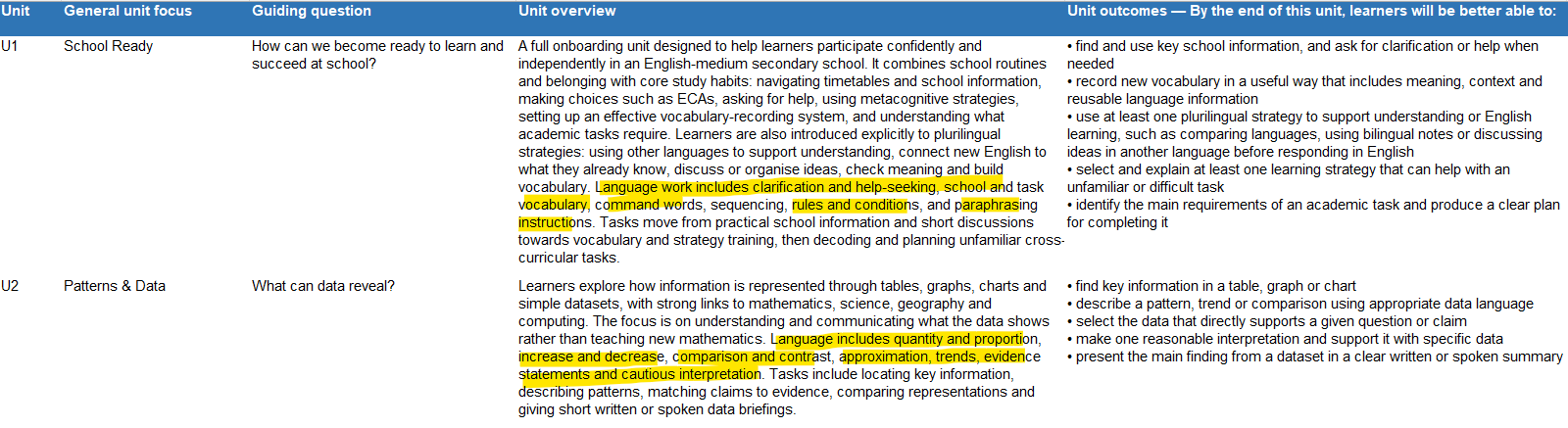
And (see highlighted) that’s why I left the bulk of the language coverage until after this stage. Anyhow, you might be reading this overview to Unit 2 thinking ‘that’s pretty complex for intensive English learners at loosely A2 level’. I hear you – but this will be scaffolded as needed, task-graded to an extent but not inauthentic. If I’m honest, I could see the whole unit overview being used for Year 8 but with content changes, increases in task complexity, broader Tier 2 and 3 vocab sets, wider language repertoires explored.
End of unit tasks
Anyhow, the unit outcomes vary in their level of challenge. I like what we have, but what I like more is the task-driven assessments we added:

These are totally my thing. Unit tasks that:
- Are practical
- Are real-world relevant (if you take ‘real-world’ for the learners being ‘academic tasks!’)
- Curriculum relevant
- Scope for personalisation
- Scope to genuinely demonstrate skills learnt across the unit
- Likely clear content and language requirements
They’ll really help when it comes to building the rest of the unit. And a few deliberate adds:
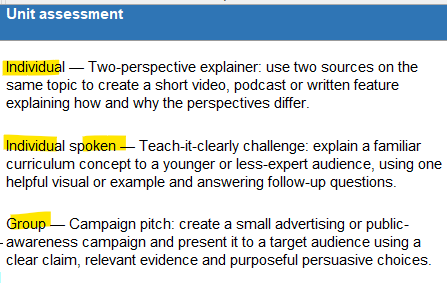
- A mix of spoken and written outcomes.
- A mix of individual and group assessments so collaboration is built in.
- Relevant to vertical integration in schools – explaining curricular content or concepts to young audiences.
- Potentially fun and engaging, like the campaign pitch above
Can you argue that critical thinking is embedded? You know what, I’d argue it anyway. It’s a great marketing term – but I’m not actually marketing this am I! Yeah, sure. Critical thinking.
Oh, and a big end – celebrating learners achievements and success in a final unit showcase:
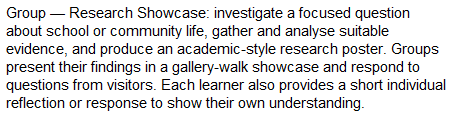
Similar to what we did here at St Joseph’s.
Next up
And so…
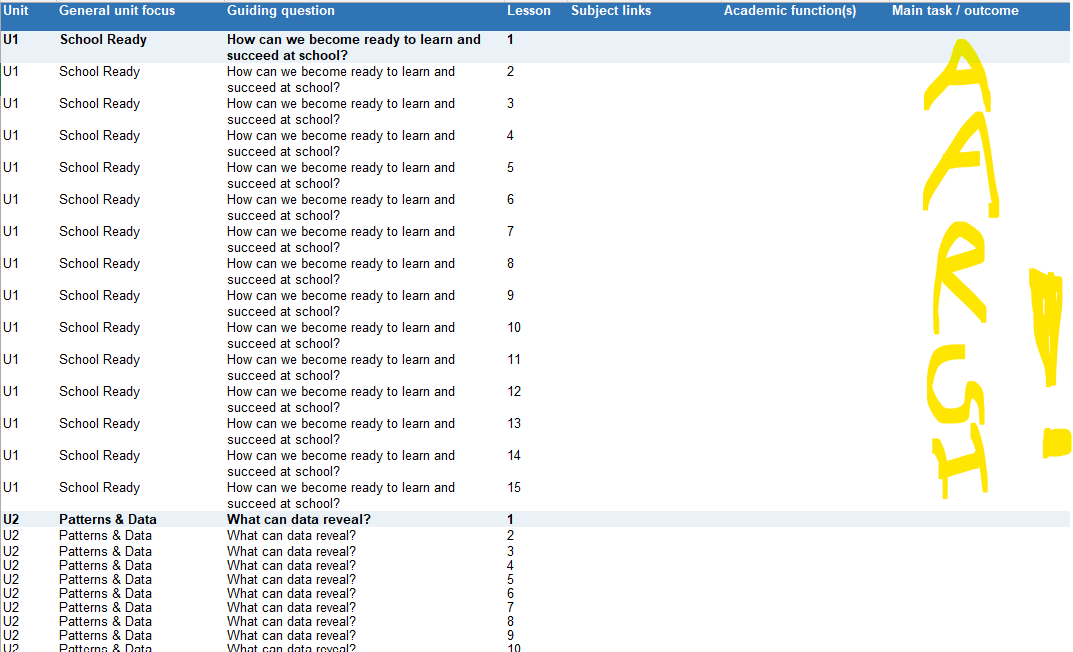
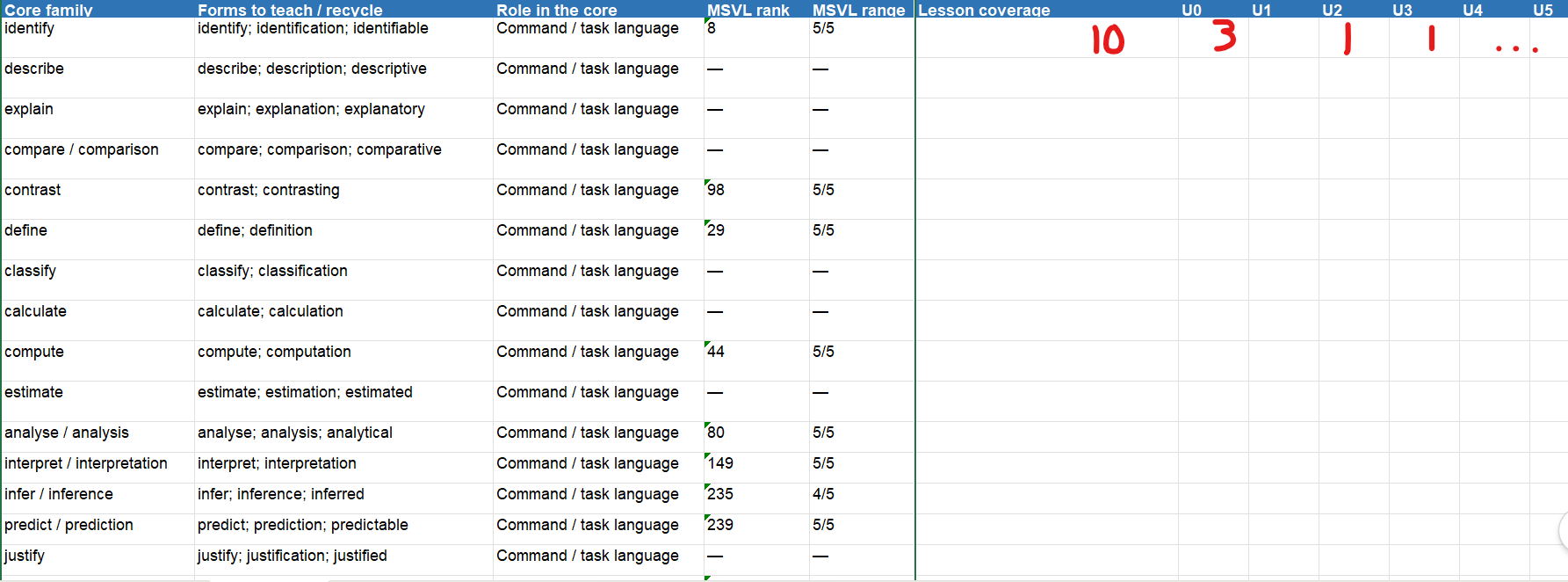
Now things are starting to get real. Main tasks needed for individual lessons. Possible skills focus in each.Ensuring coverage – blergh! Possible Tier 2 and Tier 3 vocab coverage in each unit. Drawing out language functions and features related to the tasks…
Making sure whatever is added is mapped, especially the vocab to recycled…
What is it about this stage that makes the curriculum BETTER than existing coursebooks?
Yes, I know that was my aim, but let’s just say ‘it’s an alternative’, right? It’ll have its flaws. However – I can say that the organisation of the syllabus does seem more cross-curricular. So, let’s list what we’ve done so far to ‘try to make a better offer than ESL-style coursebooks for EAL provision’:
- We’ve led from the outset with genuine academic context and challenges in mind.
- We’ve built learning outcomes based on a synthesis of curriculum-informed EAL assessment frameworks (Bell, WIDA), and established language development frameworks (CEFR). We have not restricted our targets to one level across each of these tools, as this is not a realistic approach
- We’ve embedded plurilingual competencies by design
- We’ve developed subskills that have been derived from the target curriculum framework where possible, and from a range of informed sources (beyond just the CEFR) where needed. This was done purposefully from the outset, and correlations are planned rather than happening by chance
- We have created a core bank of academic language not just to teach, but to recycle throughout the resource, and a grade-level, highly relevant set of Tier 3 vocabulary to cover across the units.
- We’ve held back on prescribing full language coverage until we can shape it around genuinely relevant tasks
- We’ve deliberately organised the resource to address cross-curricular threads in each unit, not as unit-by-unit subject-related input.
- End of unit assessments are task-driven. Tasks encourage application of unit content/skills/language in relevant academic contexts. They’re not just a language test or something like that!
Importantly – there is nothing I have done so far in this process that publishers cannot do. I’m not saying my process is *right* and it’s probably riddled with errors at this stage, but I think some steps or suggestions offer a +1 on what we currently have.
Next up, lesson tasks; dual objectives.
Photo by perfectpics . on Unsplash
Categories: General, materials writing, teacher development


Leave a comment