
Many international schools in Thailand are choosing to shape their tiered EAL support around a coursebook. That’s one way to do things, and I can’t say whether it meets the needs of learners in every context.
Personally, I think there are much better options than coursebooks in principle, it’s just that in practice these are hard to implement. They require knowledge, expertise, and time to create; understanding from SLT and a commitment to innovation; clear messaging to stakeholders on why such provision is more suitable, blah blah. That is already sounding like a lot of effort, especially when there is no guarantee of better outcomes!
I’m interested in thinking through the alternatives to current coursebook-led provision. I can’t seem to find anyone who is interested in musing over this with (admittedly quite boring) me, so I’m currently stuck with AI as a drafting partner. We all know the dangers with that!
Anyway, here is Post 1 in a series that charts my ongoing AI musings on ‘The EAL syllabus’
What’s in a name?
I don’t like the concept of a separate syllabus for EAL learners in their English classes – whether they are on a reduced timetable, having intensive pull-out provision, etc. However, that’s a pathway that many schools opt for, so I want to improve it. I’d rather it were pitched as something like English for Academic Success. They used that branding for a coursebook-led provision in my previous school – I’ll use it as a working title.
What’s the context?
Well, I’ve mainly worked in English National Curriculum contexts, and I’m mainly looking at high school provision at the moment. I’m thinking ‘What’s the best way to provide learners at Key Stage 3 with the skills/language they need to access and thrive in the mainstream?’ I’m starting off with a scenario like this:
A Year 7 learner joins your school. They’re assessed as A2 level on entry; they join the EAL register and they’re deemed to need intensive provision. Intensive courses follow an ESL coursebook called Global English, which follows a typical 4-skills-2-systems grammar-led syllabus. By Year 8, they’re assessed as working at B1, but they’re not demonstrating the ability to access curriculum tasks in mainstream classes without support. The school put them in ‘academic booster’ classes, which basically consist of studying more English after school…’
These are the sort of broken systems I’m talking about, when learners are expected to develop academic skills/language in spite of, rather than with, the pull-out support offered. The ESL approach to intensive provision can be a huge blocker, so let’s work on it.
Why the CEFR references there?
Just for global familiarity. And also to show that this is not a ‘new-to-English’ type musing just yet. I’m pitching at Bell B/C/D, WiDA 2/3/4, presenting CEFR A2, etc. A ‘foundational-English’ syllabus to come after – we have to start somewhere.
So how long would this syllabus be designed for?
It’s a one-year syllabus for Year 7, and I’ll devise Year 8-9 ones too. The underlying architecture will be the same, but we are looking for grade-age level content changes, and potentially broadening the Tier 2 vocab list at later years. Let me just see how the Year 7 offer shapes up, and I’ll work out if this is more of a ‘Key Stage 3 course’ where you can dip in and out of units – that might be possible. Slightly organic on that one…
What are some key design principles?
These are the type of principles I want to protect:
- The goal is mainstream access, not a generic ESL coursebook: learning should prepare multilingual learners to participate in age-appropriate secondary curriculum learning
- Academic purposes and functions drive the course: learners repeatedly describe, compare, classify, explain, interpret, use evidence, discuss, etc.
- Subject contexts are vehicles for language and literacy development. They should be authentic and age-appropriate, but teachable by an EAL specialist rather than requiring subject-specialist instruction.
- Reading and viewing, listening, speaking/oracy and writing develop together
- Progression is spiral rather than mechanically linear.
- Rolling entry remains possible, so units are necessarily prerequisites for each other (that’s a tough one…)
- Can-dos are evidence targets, not one-off lesson objectives – learners have multiple opportunities to demonstrate them throughout the learning
- Language systems, functional phrases and vocabulary must serve genuine tasks.
- A small core of high-utility academic vocabulary will be deliberately recycled
- Unit-relevant academic and Tier 3 vocabulary will be selected only where the task/context genuinely requires it.
- Multilingual development is an explicit course asset: learners should be taught to draw strategically on their full linguistic and cultural repertoires
I don’t know. A bold starting point maybe. Or not. Part of the problem with the current ESL coursebook model is it doesn’t seem to lead with some of these key principles in mind. For example, Global English (which I’m clearly picking on here) talks about how it develops academic vocabulary. Maybe it does, but to what practical end? Which selection principles? Where are the clear attempts to spiral? Where are the clear real-world applications? And so on.
What to lead with: Tasks? Skills? Content? Language?
During my first think-through of this idea, I started by listing tasks learners needed to perform in the mainstream. This seemed logical, it’s just that it was a) huge, and b) demanding, c) and many were not necessarily accessible to learners without specific skills/language development – hence the point re: why ESL curricula are so inadequate. Besides, organisations like Bell have done huge academic task recces like that before, and shaped their action-oriented frameworks around it, so I probably didn’t need to reinvent the wheel.
I opted for the following process:
- Define the general skills learners needed to acquire/develop to enable access across the curriculum, reviewing multiple sources.
- Outline the language that would support or enable learners to that same end, again drawing on multiple sources
- Devise relevant and authentic classroom tasks to help learners develop said skills/language.
So I guess we were going with prescribed skills/language coverage based on knowledge of curricular contexts, with authentic academic tasks as a vehicle for instruction…?!
My first focus was on relevant skills coverage
I want this syllabus to be underpinned by a range of EAL specific assessment tools. These link to mainstream curricula, as they are designed to be representative of the skills/strategies required to best access the learning.
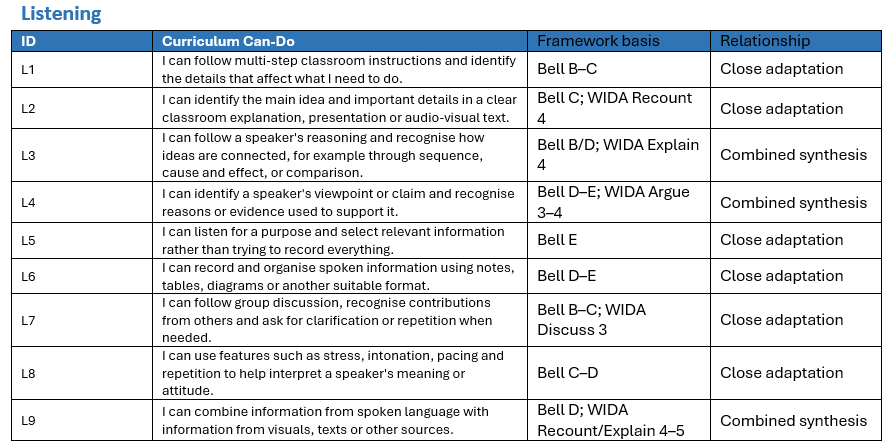
I fed Bell and WiDA criteria in, and we started to shape hybrid criteria based on these. To give you a better idea of what I mean, here’s our take on whether the criteria are coming for Bell, WiDA, or are a synthesis:
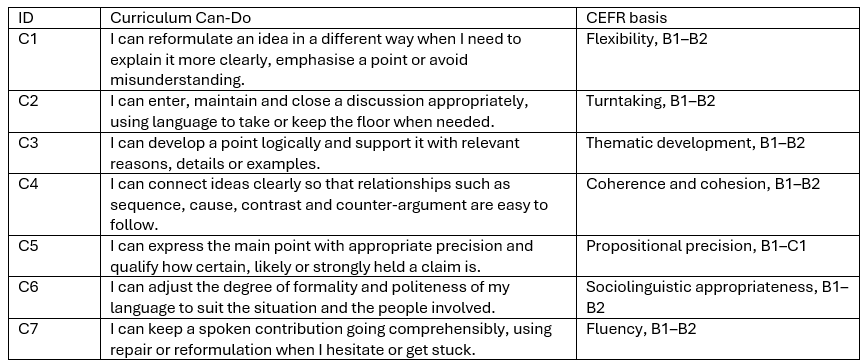
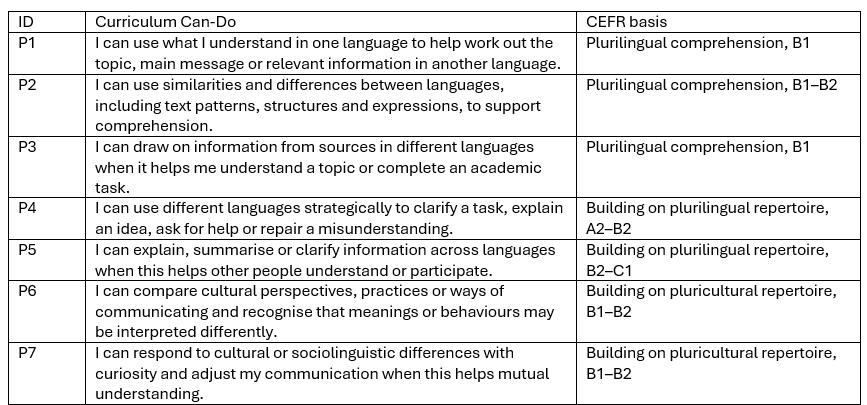
But I’ve also fed CEFR descriptors into the mix. You may know my thinking on the CEFR already – it’s misused, it’s been a springboard for creation of frameworks like Bell anyway, and aspects of it are ignored. In this instance, I felt the communicative competencies and plurilingual competencies needed feeding in. I have these as separate descriptor lists like this:
And this:
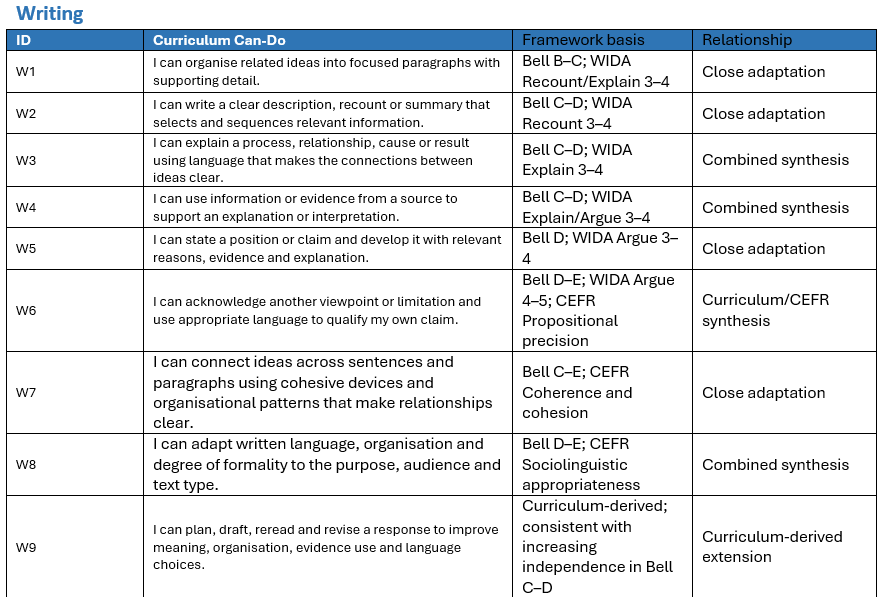
Some of the communicative competencies descriptors have then been synthesised with the Bell/WiDA can-dos, so when you look at our descriptors for Writing then CEFR gets a look in:
And the pluricultural/lingual descriptors are most relevant (fundamental, even) for overriding strategy development and principles for materials design at later steps.
It’s quite interesting trying to thrash this out with the help of AI. It’s a good drafting tool in some ways, but as you might notice, you need to start digging into the original sources alot yourself to check where it is coming from at times. Good for upskilling. I’d say the Can-Do statements have started out ‘okay’ as part of the overall course architecture, but then I’m relying on existing tools more than I am genuine task audits. That’s on the assumption that Bell, WiDA, etc have done these audits vigorously already….
So, we have the basis of our general skills coverage there, which will be recycled throughout the course rather than stand in isolation. I realise things are getting rambly and all we’ve got to are basically:
- Pete wants a viable alternative to current coursebooks for EAL
- Pete has some design principles in mind
- Pete is synthesising existing tools for the skills coverage…
So, I’ll take a break. In Post 2, I’ll talk about selecting relevant Tier 2 and Tier 3 language. Meanwhile, I’ll keep thrashing things out with the support of AI. I’m currently at ‘populating the scope and sequence stage, so lots to cover there.
Categories: General, materials writing, teacher development


Leave a Reply