
For context, I’m attempting to build an ‘academic English syllabus’ for an international school. I initially set out to create suitable alternatives to coursebook-driven provision, or to at least suggest enhancements to that model. Am I getting anywhere, or am I suddenly drifting towards coursebooky modelling anyway? Hmmm – such is the danger when you’re a coursebook author yourself I guess!
Today’s focus is on subskills. In Part 1, I mentioned how I’d devised a set of core Can-Do descriptors for the syllabus. These were taken directly or synthesised from three main sources: The Bell Framework of Assessment, WIDA, and CEFR. I created this for the four typical skills, plus communicative competencies and, importantly, plurilingual competencies.
A snapshot of one descriptor list for reading:
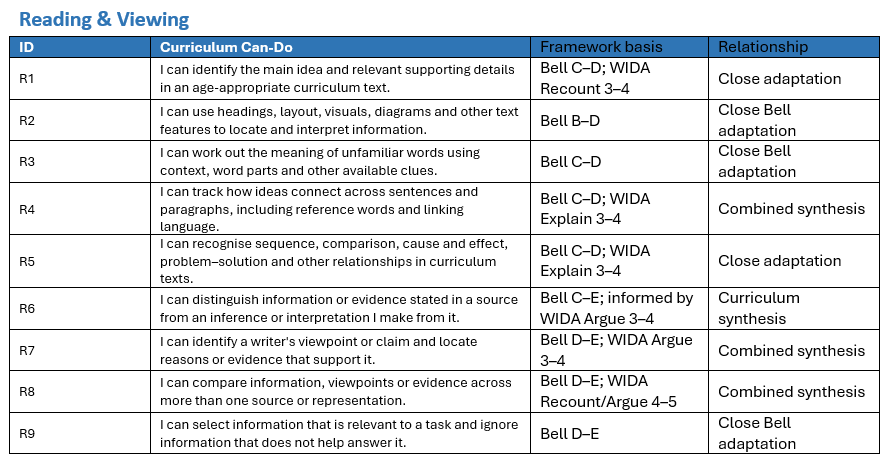
When it comes to actually mapping a syllabus, these overriding descriptors aren’t enough. They are a broad capability that learners will demonstrate, but they are not a set of specific skills that need to be developed in order to demonstrate those capabilities. Sorry if obvious, but just for clarity:
Overall capability: recognising main ideas
Sub-skill: recognising essential and non-essential info, noticing and understanding discourse markers, etc
The tasks/learning sequences we derive for the syllabus will enable learners to develop those sub-skills, and in turn the capability as a whole.
What was the starting point for defining the subskills?
Well, first we need to look at the framework of the overriding curriculum, and assess what the phase-level goals are (with focus on language development). That meant reviewing this document:
Note: in case you are unfamiliar with Key Stages in England
- Key Stage 2: ages 7-11, school years 3-6
- Key Stage 3: ages 11-14, school year 7-9
While it’s not the first time I’ve looked at this doc and thought ‘hmmm…’, trying to use this framework for syllabus design was double ‘hmmm’. The level of granularity in it fluctuates so much across key stages. The level of detail for KS2 English is pretty good, and there are even target word lists in it, and I’ll factor the Year 5 and 6 one into the mix for our vocab coverage. For KS3 though, the guidance feels more general, and is bulked out by a huge glossary of linguistic terms everyone needs to know.
With AI-assistance I tried to draw out some tangible subskills from this doc and some accompanying rubrics, but I hit stumbling blocks:
- It was much easier to derive subskills from KS2 criteria, but I’m pitching the syllabus at KS3
- The KS3 guidance was fine for matching with my general set of Can-Do statements, but I felt on my own for developing subskills
- This was hugely the case when considering listening development. Look at this guidance:
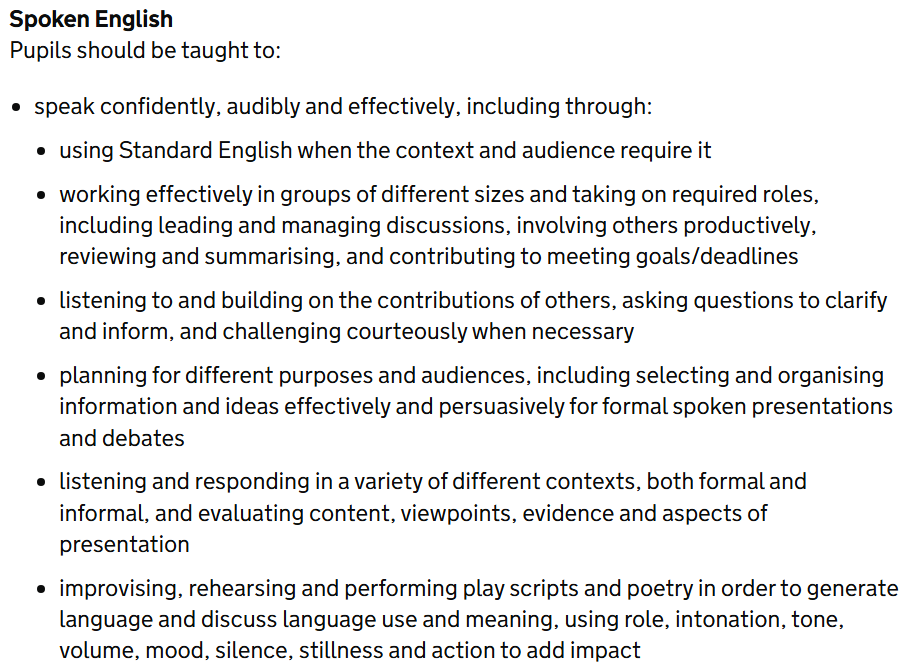
I mean, it assumes teachers know how to teach listening skills, and doesn’t really dig into more granular listening skills development. The other day I was ranting about the lack of listening focus in these oracy drives in international schools. Well, I’m not surprised after reviewing this framework doc tbh. Overall it’s just a bit general, and there are a lot of implicit assumptions made, put it that way. Feeding in some subject-specific guidance from schools helped I think.
Anyhow, I ended up leaning more on KS2 than I’d expected. I justified this by suggesting that in this context they were foundational. Whoa – AI went for me on that! It seems to have built up a pretty good picture of my views on multilingualism, and started calling me out on the deficit-sounding nature of that term. Fair play, AI. But still, we did consider the KS2 criteria for the subskill architecture on the basis that KS3 would be building on that.
The amount of gaps though. AI really started to hallucinate when I was building listening subskills as it had nothing to go on. I had a meltdown, and was like ‘right! I’ve had enough! We need something more tangible than this woolly guidance!’. AI softly muttered ‘how about following a coursebook syllabus?’ So I closed the tab for an hour.
Where did I go from there?
Then I contemplated leading with tasks and backwards-defining my subskills. I scrapped that as the subskills did feel somewhat predictable – I just hadn’t given AI the right guidance yet.
I decided that we needed to layer in some principles of genre-based approaches, especially for the writing descriptors. I didn’t want these to be all about structure, which was what happened alot when I pulled from the Curriculum Framework only. We devised criteria from summaries of sources like Rose and Martin (2012) on SFL. For speaking, I fed in the Voice 21 framework and some broader guidance that we’d sourced on that.
Things started to look up, and the subskills we were shaping started to read much better to me (in principle). However, it felt like they needed a proper audit against an established language development framework. You know where I’m going with this…
The audit
I bit the bullet and used the CEFR companion volume full descriptor list. I audited our devised list of subskills against CEFR, and planned to use it to plug gaps in the listening set. Things became A LOT EASIER. But something else became apparent.
The relevant sub-skills we’d been defining were now based on these sources:
– DfE KS2, DfE KS3, Voice 21, SLF influenced ideas, user-own guidance…
And they often aligned with existing CEFR descriptors, IF audited for semantic similarity:
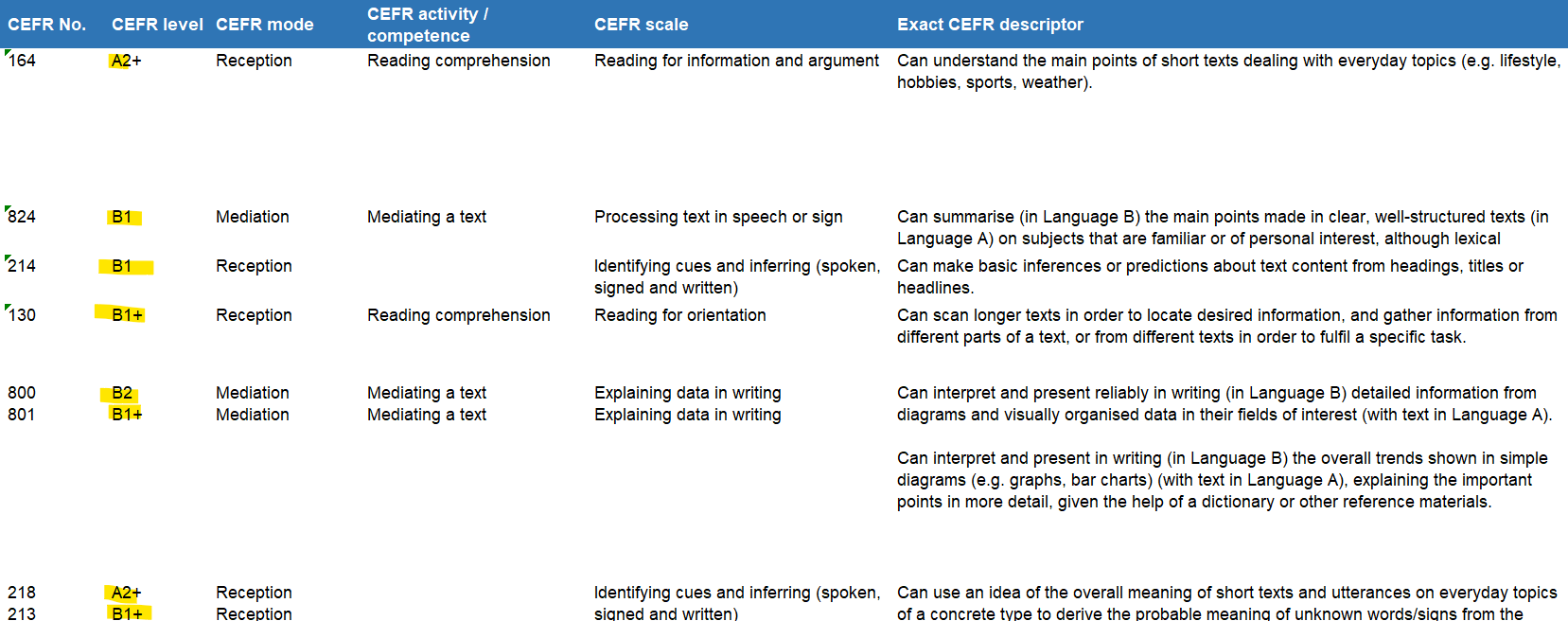
And the matches we identified from the CEFR searchable descriptors varied wildly across CEFR level. Well, to teachers this is obvious. We are often asking learners to perform tasks in mainstream classrooms that are *technically* above their proficiency level, hence requiring lots of scaffolding etc. Yet that’s what they need to navigate in that moment. Developing the subskills they actually need seems more relevant than just filtering this CEFR descriptor set to, say, A2 and populating the subskills for our syllabus.
This long-winded description puts us here:
- 194 subskills across Reading/Viewing, Writing, Speaking/Oracy, Listening
- Crossover with their origins… Combinations of the following:
| Influence / origin | Number of subskills |
| CEFR 2020 | 156 |
| DfE KS3 | 125 |
| KS3 curriculum application | 22 |
| Voice 21 | 52 |
| Genre/SFL-informed | 47 |
| DfE KS2 | 40 |
| Curriculum synthesis | 30 |
| Academic-literacy synthesis | 10 |
| Disciplinary-literacy synthesis | 4 |
| Metacognitive reading strategy | 2 |
| KS3 metacognitive application | 2 |
The list is epic, and I’ll audit it down I think. For example (from Reading subskills, yes they need R1.X IDs…):
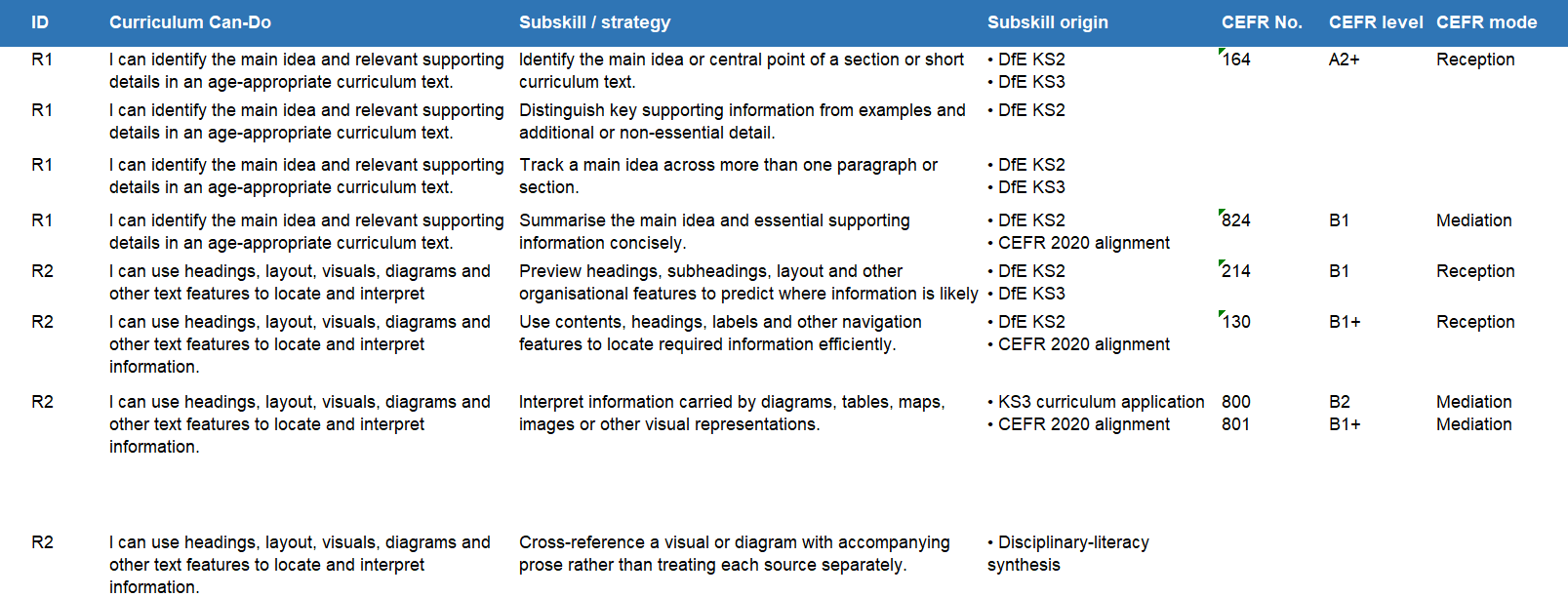
In R1 here, I might merge a couple of these. That said, they are all technically different.
I love R2.4, the cross-referencing visual and prose info. Very useful and relevant!
Anyhow, the next step will be a very human audit, AI has done… okay with this one but I think it was a big and important step.
Am I pleased that I didn’t draw directly from CEFR in the first instance here? Yes because then we get to lead with the curriculum framework first, and gather influences from elsewhere – and we end up with R2.4 type subskills out of it.
What about the other competencies?
Oh yeah! Well, communicative competencies was sort of engulfed here into the writing, listening and speaking/oracy subskills. Plenty of crossover.
As for the plurilingual competencies, well, they were easy to draw directly from the CEFR (snapshot):

Although they need a thorough check still.
Anyhow, these can be used a bit differently I think – they will most certainly form part of the teacher notes on lesson resources, to nudge teachers towards multilingual practices. And, where possible, embed as skills to explicitly practice – we’ll see how that works out at mapping.
Exactly WHAT makes these subskills potentially better than those used in an existing coursebook?
To answer that, I think we have to compare what we have with one of the better coursebooks out there – Lift. I don’t have their subskills list though, noooo! But I do have information on their curriculum design…
- The skills coverage in Lift only ‘correlates’ with Common Core Standards, and WIDA. It is not derived directly from curricular focused skills in the first instance, or from EAL-aligned descriptors. As a result, you get lines like this in the Lift correlation docs, that show coverage of certain standards is skewed:
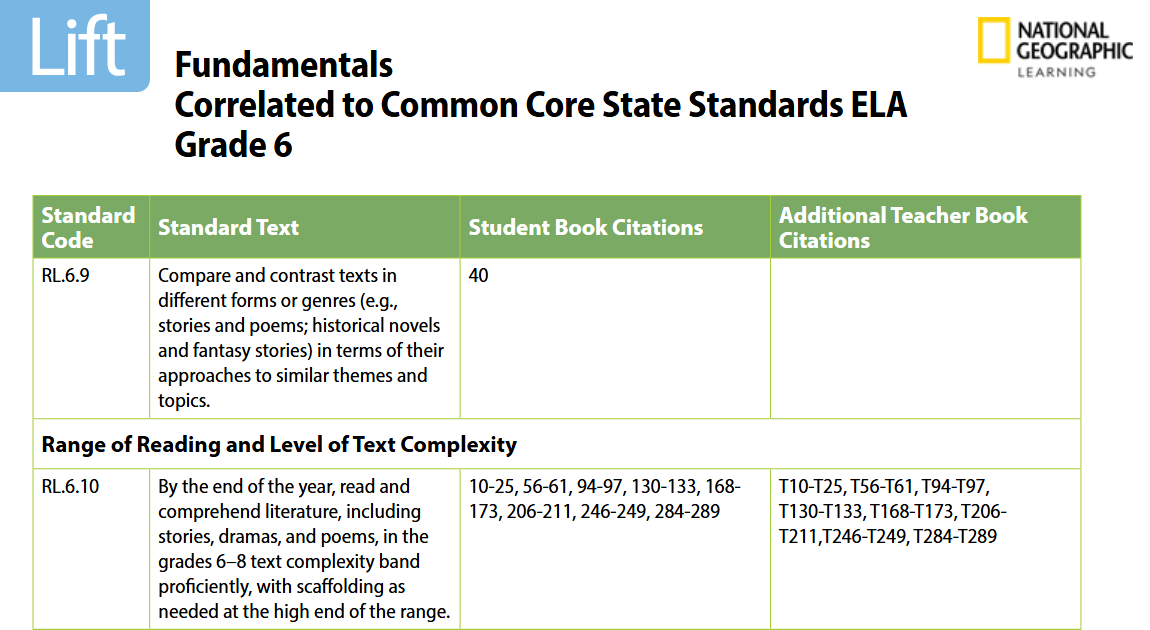
- In contrast, I have led with the curriculum framework (ENC) in devising my subskills. I shaped them from it. In theory anyway.
- Lift has a strong correlation with WIDA according to a review of their coursebook (well 4 units of one). However, the review skews evidence in favour of Lift. When you read the evidence:
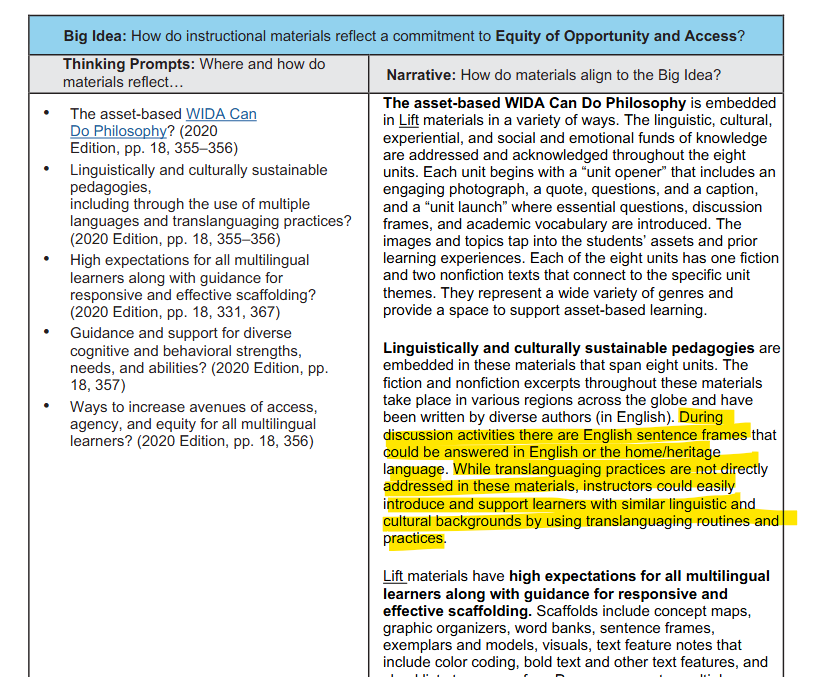
Asset-based approaches like translanguaging have not been directly addressed in any part of the resource and it is the responsibility of teachers to apply these (I guess based on what they know?). Despite this…
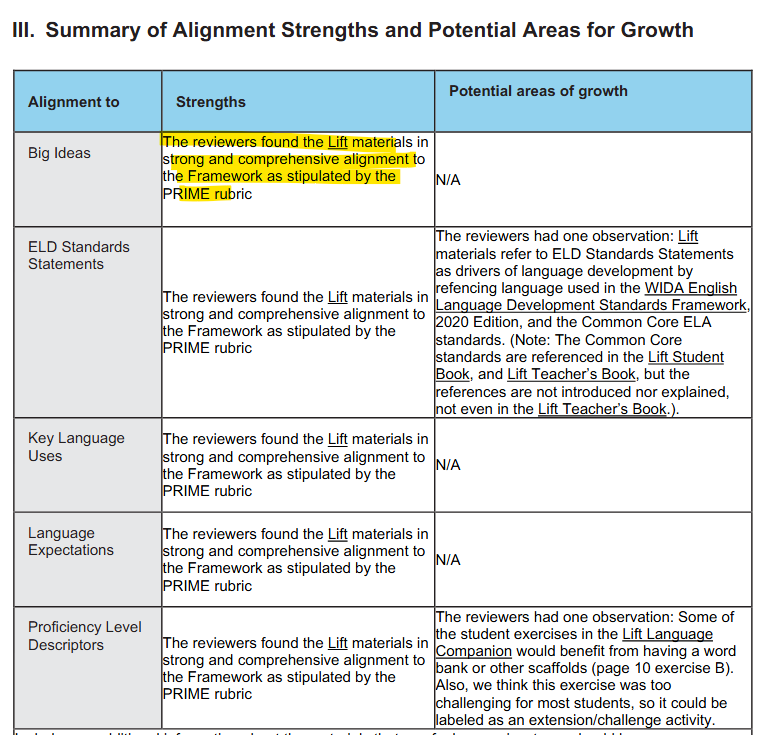
Lift was deemed as strongly and comprehensively aligning with Big Ideas on Equity, Opportunity, and Access.
- By building our own syllabus which embeds the development of plurilingual competencies, we can truly make multilingualism an asset by design, rather than relying on teacher expertise to tap into it.
This honestly isn’t a criticism of Lift, I’m just saying. If we approach syllabus design with better curriculum alignment and asset-based approaches in mind from the outset, then we could potentially create a product more fit for purpose.
Anyhow, unit outlines next I think…
Categories: General, materials writing, teacher development


Hi Pete, big fan, first-time commenter. I’m really enjoying this series. I’m currently working through (and struggling with) a closely related problem at the international school where I work.
In terms of syllabus design, I wonder whether beginning with vocabulary banks, can-dos, and a subskills inventory risks making tasks the final vehicle for practising content that has already been selected. From a task-based/emergent-language perspective, I would be tempted to reverse the process: begin with the meaningful things learners need to do in their homeroom and subject classrooms, then analyse the language that emerges as they attempt those tasks. I am not against a syllabus, in fact, where I am now, we are in desperate need of one, but I would see descriptors, vocabulary banks, and subskills more as tools for task analysis than as a sequence of content to cover.
I suppose what I am trying to ask is: what should we treat as the primary unit of planning? A language/subskill item, or a meaningful task learners need to accomplish? I would be very interested in your thoughts, particularly on how you see the eventual units and tasks relating to the subskills map.
LikeLike
Hi, cheers for commenting! Yeah I hear you in that a better approach would be to lead with the task. Bear in mind the context here though:
Schools are using prescribed coursebook syllabus. That’s the type of provision they want in place. I’m creating a syllabus here that makes such prescription more principled.
In the contexts I’ve worked in which the EAL set up has allowed for more freedom, I’d be taking an academic task covered recently in science, backwards planning based on tasks outcomes and scaffolding accordingly in the way you’re suggesting. It’s highly responsive and better suited, but also quite time-consuming and dependent on teacher expertise, do you think? Plus, that is the immediate task, not necessarily the functional thread underlying the task, and learners my not see how the skills they acquire are transferable, cross-curricular, etc.
What changes do you think I should make, if any? Should I ditch the subskills? I can do that and see where it takes me – its all an experiment! Let me know and I’ll shape the process around your thinking if you want.
LikeLike
I agree. I was initially viewing this project too much through my own idealistic approach, rather than the parameters you are working within. Part 4 has already started to answer many of my questions about where the tasks sit within the overall design, and I really like the cross-curricular nature of the unit questions.
And yes, I agree also about teacher expertise. Again, my idealistic side probably hopes that the comparatively high entry expectations in international schools (PGCE/QTS and DELTA/DipTESOL-type qualifications) would make this a given, but I am all too aware that qualifications do not necessarily translate into the expertise needed to implement a genuinely responsive model, particularly in these contexts.
No changes to suggest. I’m looking forward to seeing how the next stages develop, it’s giving me a lot of food for thought.
LikeLiked by 1 person
Don’t give up on idealism! I am totally with you in my heart of hearts – it’s the context and constraints that are defining my approach more than anything. Maybe I’m getting old.
One thing worth mentioning is that as I layered genre-approaches into the subskills then that does create Can-dos that relate to our typical academic task demands. I just described the approach as preemptive rather than predictive (over on LinkedIn). But, after your prompting, I have noticed some gaps. Cheers for the input.
And honestly, this is totally iterative and I’d love to bounce ideas. If you want anything factored in or steered in a particular direction just say – I’ll try it out!
LikeLike
Really enjoying this sequence. Have you looked at the Pearson Global Scale of English too? Wondering whether some of their can do statements for skills might be more granular than the CEFR ones, possibly. Good luck!
Sandy
PS I’m sure IATEFL MaWSIG members would be interested in a webinar where your all through your process – seeing how different people approach materials writing is consistently fascinating.
LikeLike
Hey, cheers! Yeah, had to use GSE a bit for mapping the Pearson IGCSE book. It is SUPER granular. For me, it’s a bit OTT, in parts but it does also cover some criteria that CEFR doesn’t. ‘Reading aloud’, like sounding out words, is something that springs to mind. Do you use it much? Ha have you seen the vocab list on it, epic granularity there.
Re: MaWSIG tbh while this is hard for me, it’s bread and butter for some of the people in MaWSIG so may be boring. I’ve only mapped one full scope and sequence for a coursebook and WHOA it was a challenge, but it really is quite fun in a geeky sort of way. And disheartening when someone is like ‘you know, this would have been a better approach’ and it’s like ‘you’re right! Back to the drawing board!’ Do you have much experience of this type of task?
LikeLike
I think it’s a really common misconception that you have to be an experienced coursebook writer to be a member of MaWSIG, but that’s not true at all! Members are from all stages of materials writing, right from working on materials for their own classrooms all the way to multi-published authors, and everything in between. Even experienced authors enjoy learning about how other people approach things too. I don’t think this would be boring at all – in fact, I think a lot of people would be really interested in your process, and most people would have no idea where to start. I’ve never put together a scope and sequence for an ELT course, only teacher training, and I’m in the ‘no idea’ camp! You can apply to speak here and having just left the committee, I know they’d be interested in having you speak! 🙂 https://docs.google.com/forms/d/e/1FAIpQLScGkLqrtAbobuVZmEys8pK7p0gvIGb07EFuZDyK8FcO6-oZVQ/viewform
I agree about the granularity of the GSE, but I actually think that’s one of its strengths, depending on what you want to use it for. Because it really breaks things down, it can provide inspiration for what to cover within specific areas when you’re trying to decide what to teach. I haven’t used it myself as I’m not teaching any more, but I do suggest it as a source of inspiration for DELTA Module 3 courses.
LikeLiked by 1 person