
If you missed Part 1, basically I’m attempting to build an ‘academic English syllabus’ for EAL contexts. The overall purpose is so that we don’t have to fall back on using ELT coursebooks for tiered provision. Famous last words – I might go through this whole process and feel that a coursebook was better in the first place.
Aaaaanyway – onto vocabulary! Ooooof, what a tough one.
So, I’ve really wanted to hit the ESL-coursebooks-and-relevant-vocab issue head on here. There’s far too much general English content in many of these books, and where there is academic vocab development, it’s not always optimised. I like what I’ve seen from Pathways (never used it), a bit from Lift (colleagues used it), and the leading with academic functions from Pathways too, but I think overall most books need more focus on academic vocab families than vocab. And they need to make more relevant and principled choices, OR make their choices clearer. Yes, I’m dissing Global English again a bit.
Vocab selection might authentically begin with the task, but in this case we know the type of tasks and topics often covered in the mainstream. And we have some useful academic corpora to draw from. So, I see priorities as these:
- Establish a functional language bank, but tentatively at the moment
- Build a ‘core Tier 2’ vocabulary families bank, which we will spiral into the course units. These won’t be the only Tier 2 terms we teach, of course, just ones that we can prioritise for recycling.
- Build a Tier 3 bank of possible terms to draw on at grade level. Also factor in previous grade level vocab for consolidation and mop-up. We have to be careful here not to introduce too many new concepts as taught by an EAL teacher rather than a specialist subject teacher, as we don’t want misconceptions and half-teaching, etc. That’s part of the reason I’m thinking units can be subbed in/out, order rejigged, etc.
So, let’s get started…
Functional language bank
It’s a doddle for AI to create generic functional language banks, like here (30 second output):
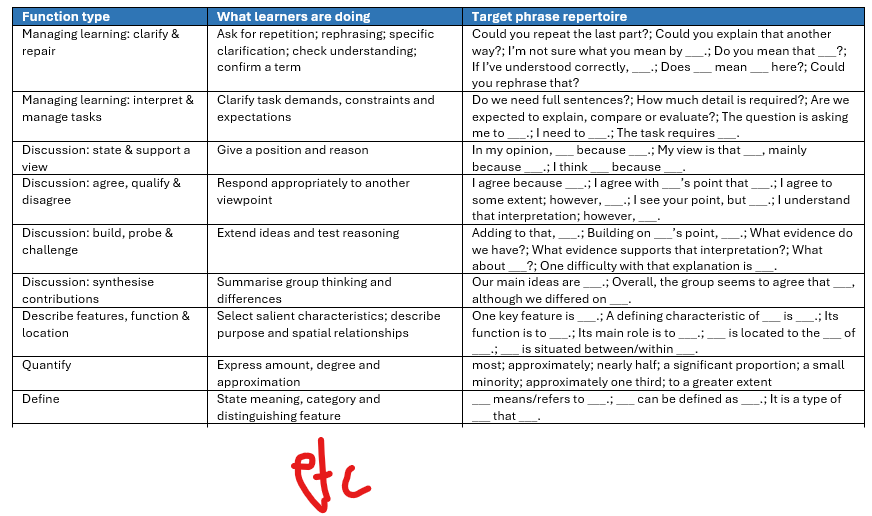
And these are somewhat useful, but not fully yet. These are the language element which will relate much more tightly to the actual task process and academic function, so we should wait until our learning tasks are defined before deciding on our functional language list. Functional language on hold, but rough ideas produced and should be easy to layer in.
Tier 2 vocab families
We do want something more prescribed here. Tier 2 vocab is always going to pop up, but I think it’s a good idea across a syllabus to ensure that a core amount of useful Tier 2 vocab is introduced and recycled. What would be the most useful? Hmmm. We need a corpus!
I couldn’t find a good corpus taken from the English National Curriculum (please share if you know a recent enough one), so I opted for the Middle School Vocabulary List (MSVL). This connects to the Coxhead AWL, which I imagined would be a starting point anyway.
What’s a good amount of Tier 2 vocab to frequently include across units? I’ve gone with 50 word families. That might sound low to some. But remember:
- It’s not the only Tier 2 vocab that will be taught. Lots more will arise depending on tasks and topics, and there’s always plenty of opportunity for incidental and implicit learning of Tier 2 vocab across a syllabus
- These are items we deliberately plan to recycle – we make a point of them appearing across the units for various reasons.
What reasons?
- Frequency of occurrence in middle school academic contexts
- High-utility, i.e. transferable across the curriculum, and across a range of functions
- Goldilocksness. Not too general that they could just pop up in everyday contexts (guarantees exposure anyway), not too specific/Tier 3/technical – such as metalanguage
- Command words which learners will encounter regularly
Here’s a snapshot of the MSVL list sorted by frequency (there are 374 items in total):
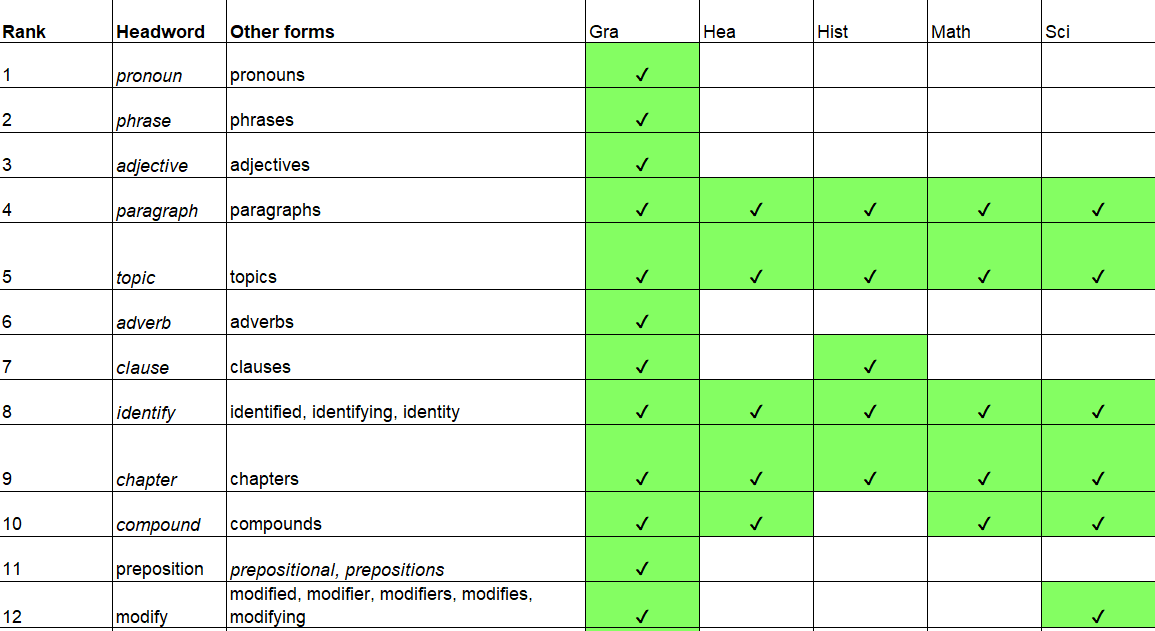
And you can see that it needs filtering. You couldn’t just say ‘I’ll choose the top 50 most frequent words for recycling’ because there’s less useful metalanguage in there, there are words that don’t have high utility across subject areas (English/grammar, health, history, math, science). And although not every word should have a broad word family, that would be useful/valuable. So, some filtering with the help of AI and some rather strict Pete-defined rules…
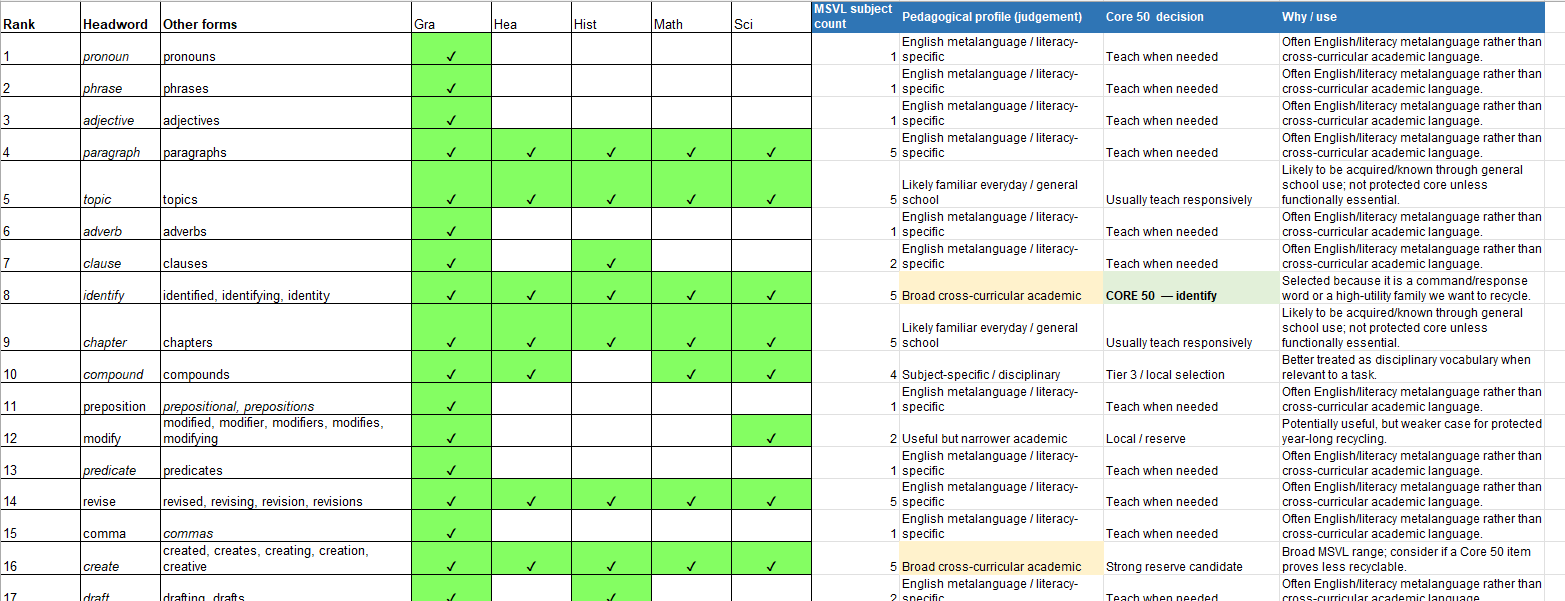
So, this applied some logic to the selection, but we couldn’t just rely on the MSVL alone. When you look at the list of 374 headwords, it’s missing quite a few useful command words that would be worth factoring in, (describe/description, explain/explanation, etc). I may be refuting the ‘these will pop up in everyday teaching’ buffer here slightly by including such terms. However, with the emphasis being on curriculum access, we really need to get these command words into play and recognised easily.
AI had some things to say on other high-utility words. I agreed with it in some cases, knocked it back on others, and eventually we had our ‘Core 50’ list. Part of which looks like this:
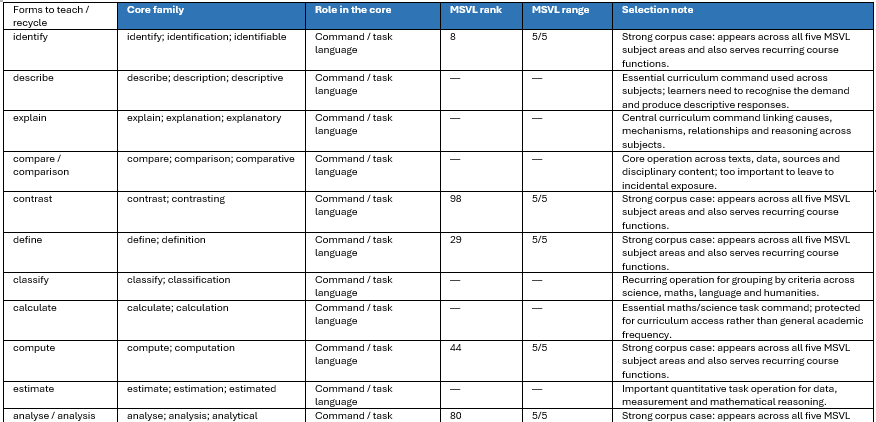
And this to show another example role…
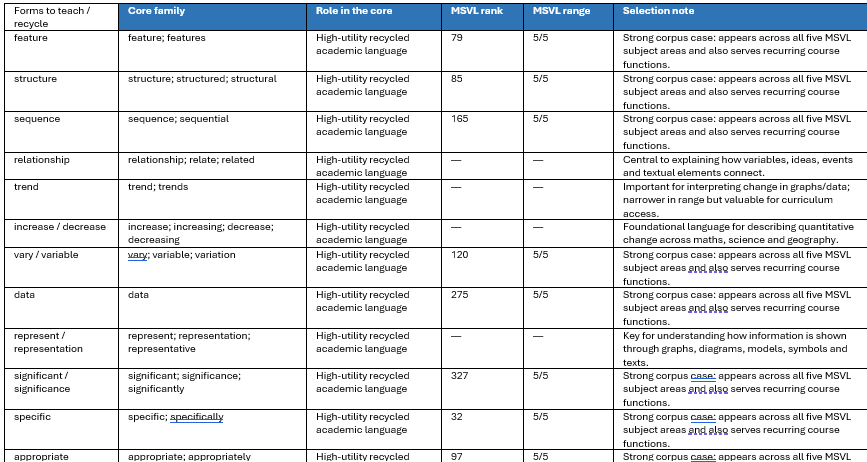
I’m currently at the mapping phase, so the examples above are still provisional. I find a word in there now and then that I’m like ‘too general’, ‘not high-utility enough’ but I’m at the ‘don’t overthink it’ phase now as there’s been enough principled decision-making – I think I can justify the selections…
Tier 3
For the Tier 3 vocab I have taken lists of potential Year 7 subject/topic vocab from Oak National Academy subject/topic listings. Snapshot here.
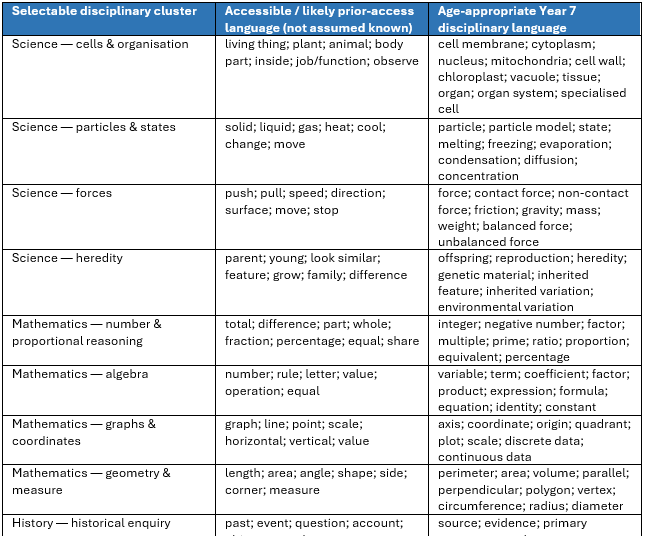
There are some important principles to consider with the Tier 3 vocab:
- Selection, not coverage. This is the type of language that a subject teacher will intro, so we might prime for some, consolidate others, etc, but ultimately its a list of topics that we COULD draw on for lesson content, not a strict ‘these terms must be taught at this stage’ thing.
- Try to use a coherent cluster of words for lesson/unit content. It’s not like ‘oh this unit is quite sciency, let’s throw in a load of science words!’ It’s more like ‘select and build on a coherent selection of vocab for a given lesson/unit task’.
- Use the familiar (or possibly prior knowledge) language strategically. I’ll factor that in at lesson planning stage
- Priority is language and curriculum access – we don’t want to turn EAL specialists into the sole teacher here. This will need careful mapping, and in practice the collaboration between subject teachers and EAL specialists is key!
What do I mean by the ‘select and build on’ bit. Well, let’s say that we set a curriculum task related to, I don’t know, PSHE, in which the learners task is to analyse data on the global gender gap and summarise findings. I might look at the list of possible vocab, look at an example graph from the WEF Global Gender Gap report, and think ‘ooh this is a good vehicle for teaching/reviewing some of those maths terms like axis, percentage, proportion. And I could teach inequality here, which appears in our geography topics list’ or something. I wouldn’t need to use them all, I can just pick and choose across Tier 3 vocab based on relevance.
(Note, Global Gender Gap report was a random example that sprang to mind, it might not feature in a Year 7 syllabus – I haven’t mapped that yet!!)
Sorry, that Tier 3 bit felt much more abridged than the Tier 2 one!
Principles for teaching and mapping…
Anyway, the last step for this vocab bit was just to factor in some design principles for when we populate the syllabus and lessons, etc. In our master doc we have things like:
- Plan repeated exposure to Tier 2 (we will map and chart that carefully)
- Teach terms alongside useful collocations and patterns
- Teach morphology where relevant/useful
- Clarify/check Tier 1 where needed (factor into teaching notes)
And I’m a bit like ‘I’m not including stuff knowingly without evidence so I’m building the principles around research I’ve read (morphology, see Bowers and Kirby 2010; repeated Tier 2 exposure, see Lesaux et al, 2010) so I’m trying to anchor this in research.
Anyway, next up I think we need some kind of unit structure and defined functions/tasks. We have enough basic syllabus architecture to start piecing together a coherent sequence – we need the tasks now to help us build and shape that further. I’ll save a ramble on that for a while because this is two in two days!
What do you think of my approach to vocab selection here?
Cover photo by Brett Jordan on Unsplash
Categories: General, materials writing, teacher development


Leave a Reply