
(This is a text-heavy post, so every now and then I’m going to drop in an album cover of a band I’ve been listening to recently – just so you don’t get bored)
I’m building an ‘academic English syllabus’ for EAL intensive classes. This post is an interlude – I have some points to clarify based on your comments.
Why didn’t you lead with tasks and map the syllabus skills coverage based on task needs?
One reader felt that the idea of creating a prescribed subskills map was not compatible with task-led approaches. The risk is that the lessons will get built around the skills, not around the tasks. That is a fair comment for sure. Part of this process is to challenge myself and find holes in my logic – believe me, there have been many!!!
To clarify, I think the hierarchy and purpose of my subskills set may have been misinterpreted a bit. I’m not intending for one-size-fits-all skills-lead-tasks-follow. I see the subskills as an important coverage check, but they are not the syllabus.
You could definitely approach this in a more task-driven way by starting with a task audit and then map your coverage from there. Instead, I chose to go with… ‘task-led and coverage-driven for quality control’. Why?

Reason 1: Worry about the reliance on task audit (and interpretation of that audit)
The quality of the task audit would be soooooo important. You might end up with a lot of authentic academic tasks, but uneven coverage. You might end up clustering around common academic functions, repeating the same micro-skills development, and so on. You could argue that is representative of what learners need to do in-the-moment, but does it guarantee adequate coverage of key academic behaviours for application in the long-term?
You could get to the end of your mapping, do a recce on the skills developed, and realise ‘you know, we’ve 23 lessons in which the task function is to ‘recommend *something* and only 3 on ‘summarising’; there are 26 lessons in which the reading skill practised is ‘select relevant information’, and only 2 in which learners ‘re-present information’; etc. If you were basing that audit on current curriculum demands, you might think it suited, but in fact it could be highlighting that the curriculum itself is skewed in its skills coverage, and you are merely replicating that. Also, repetition isn’t necessarily progression, and finding +1 input for a task that’s repeated 20 times might be taxing.
I mean, a full task audit within your taught curriculum would be a great exercise to do – and very insightful! But it feels a bit risky to build all your content around it. And if SLT got wind of it, I bet you’d be noone’s friend in pointing out task coverage gaps. Eeeeek!
(Pete note: 23 tasks for ‘recommending something’ takes me back to the British Council myClass days haha)
Reason 2: Risk of subject isolation
Leading with a task audit might skew thinking towards subject-specific task design. ‘In science they need to write-up experiments, explain how food chains work…etc’ and you might end up with this really narrow ‘that-exact-task-like-responsive-support-after-the-fact’ type approach. Which is fine, useful even, and we could have a bit of that. However, it neglects that the underlying functions of those subject-specific tasks are cross-curricular threads (describe a process; explain a sequence or relationship, etc). The academic behaviours learners need are relevant and transferable, but a task audit might reduce them to isolated subject-only moments if you don’t then plan for cross-curricular applications.
Reason 3: some foundational skills might get neglected/undertaught
I’m sorry for the word foundational again if it seems negative. Anyhow, let’s go back to an older example on oracy drives in international schools. Have you ever noticed how the focus of an oracy drive is sometimes totally skewed towards productive/expressive oracy, and listening is heavily neglected? Knowing this, we know that our multilingual learners may (or are likely to if you back yourself!) need to develop specific listening skills and strategies. We can predict what those skills might be for certain tasks, things like:
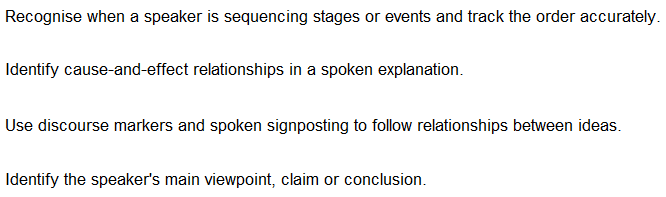
Good task designers will be able to identify when these subskills will be relevant to the tasks they choose. Why not have a list of these predictable subskills to hand while mapping, so you can address them as relevant, and identify tasks in which repeated practice could occur? You can track coverage easily, and plug subskill gaps where relevant to ensure some level of balance. However, you don’t have to shoehorn in subskills practice for the sake of it.
I have 194 subskills that are broadly relevant to language development in academic contexts. If they are not all addressed adequately, as the tasks don’t provide for that, fine – we won’t push it. But we can certainly preempt the type of skills learners will need for common academic functions/tasks as we know from experience the social processes involved, and these can be generalised into action-oriented statements to assist with mapping.
Remember, the skills and subskills are built around actual curriculum descriptors, mapped curricular subskills and language features (see Bell or WIDA), blah blah. I haven’t done a generic ‘pluck from the CEFR’, although after an audit it turns out there’s a lot of alignment.

Reason 4: Context
I am following a task-led design, I don’t think that’s the same as a pure task-based one. The chances of a TBLT purist being given the freedom/time to create a syllabus in international school contexts is, in my view, low. But then I’ve just been working in a prescription-heavy context and that may have skewed my own thinking/motivations.
Pure TBLT does not necessarily fit with models of international school EAL provision. Language demands are, to an extent, prescribed through the curriculum; sometimes EAL learners may need more explicit instruction than might be used in TBLT, etc. That doesn’t stop us making good use of tasks, and building instruction around tasks that are based on immediate needs to communicate, but there is a certain level of pre-determined content/skills/language/genre that should be addressed for the purpose of curriculum access.
Note, the overriding approach to a programme does not completely define the delivery. For example, just because language features may be prescribed, doesn’t mean we have default to structural modes of input like Present-Practice-Productive Task. Plus, emergent needs may well take this proposed content off-piste. In practice, I’d hope it would! Much more fun and good opportunities for emergent language, etc.

Reason 5: I think it’s more likely that I would get a slightly more prescribed approach like this past a member of SLT
Nothing judgey about that, honestly, I just think the logic and the ‘coverage-driven for quality control’ approach is immediately more transparent. Bear in mind, many SLT are non-specialists in EAL, and may well come from a subject discipline in which syllabus content and skills coverage are heavily prescribed. For me, this is a compromise to provision beyond the coursebook that could land.
- At St Joseph’s, I was trusted to create an EAL syllabus from scratch. While it functioned ‘okay’ as a hybrid model, it did not have this level of coverage at all, and could have asked more of the learners at times. So I’m acting on that.
- At Harrow, the level of prescription in the syllabus was higher, but with more reliance on pre-packaged resources.
My current approach is a synthesis of the two contexts (throwing responsive provision while at St Andrews into the mix), but it leans more towards my St Joe’s model as curriculum access was forefronted in that.
So, end of interlude. The next post goes into task design and genre coverage…
Image copyright: KRiemer, Pixabay
Categories: General, materials writing, teacher development


Really appreciate you taking the time to clarify these points, it’s helpful to understand the approach and thought process behind it all.
As someone who’s only worked in one international school, the references to St Joseph’s, St Andrew’s, and Harrow are really interesting. When the series is finished, could you possibly include a short reflection on how this model sits alongside the different approaches you’ve experienced, in a little more detail? Such as what each context made possible, what constraints shaped things, and how this version has responded to those?
LikeLike