
I just attended the panel discussion at Pearson Day in Thailand on Generative AI in Education: Challenges and Opportunities. The theme was ‘Reimagining English Education in Thailand’, so it was fitting that one of the panellists was Dr Supong Tangkiengsirisin. Dr Supong was part of the team behind FRELE-TH (Framework of Reference for English Language Education in Thailand), a local adaptation of the CEFR framework. In this post, I’ll summarise the FRELE-TH for your general interest, and link it (loosely) to today’s talk!
About the FRELE-TH
Thailand adopted the CEFR framework as part of their national English education policy back in 2014. However, there were some reservations about how well the framework could be implemented in a Thai context:
- Could a tool developed in a European context adequately describe language development in a Thai context, or the teaching of English as an international language?
- Were the communicative activities described in the framework representative of Thai learners’ English needs?
- Was the framework granular enough at certain proficiency levels?
- etc
For the CEFR to be fit for purpose in the context, arguably some localisation was needed. The FRELE-TH adaptation was produced by a team of 11 scholars from Thai universities in 2017. More on the rationale for this adaptation is summarised here by Hiranburana (2020).
There are some genuinely interesting bits there, such as the team’s estimations for the CEFR levels needed by various (potentially) English-using professions in Thailand:

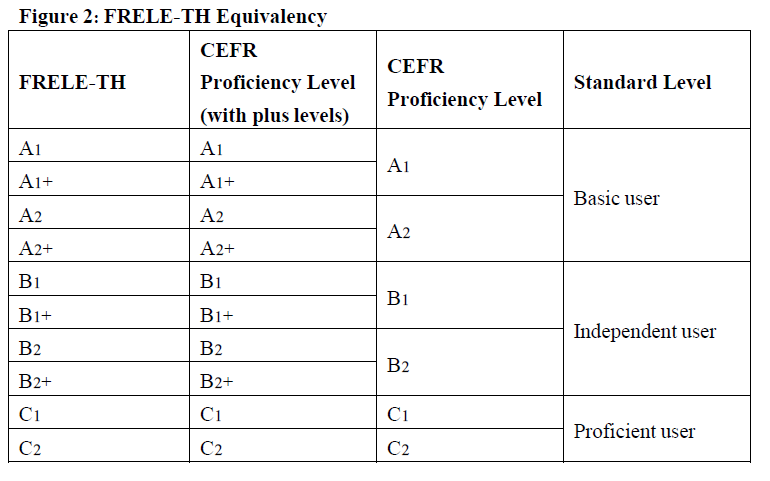
Another overview from Hiraburana et al (2019) outlines some adaptations made to the CEFR in the FRELE-TH. These include increased granularity with + level descriptors added:
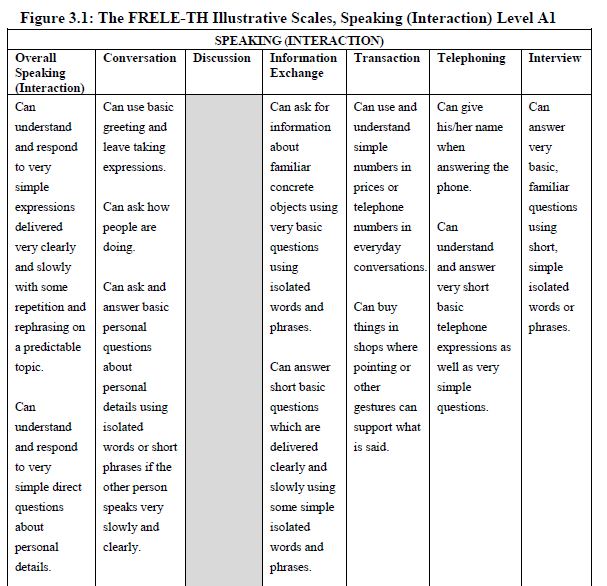
Illustrative examples of communicative activities, which were designed to be used for pedagogical purposes (linking the CEFR directly to curriculum design):
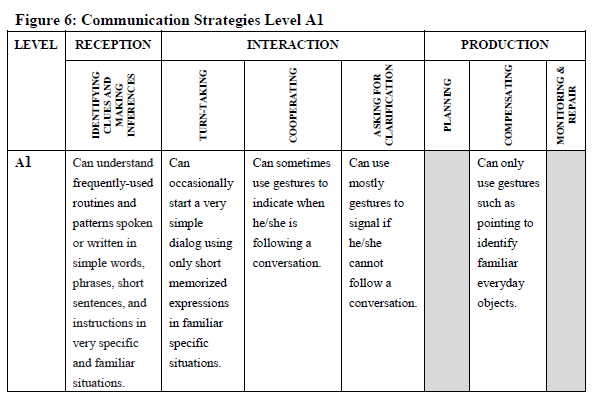
The addition of communication strategies at A1 level (something which was absent from the CEFR at the time but which was addressed in a 2017 update):
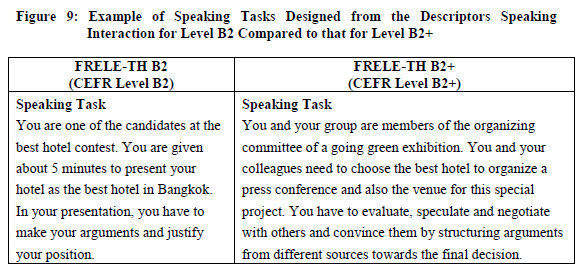
Examples of how curricular scope and sequence for OBEC-endorsed coursebooks could incorporate functional exponents based on the FRELE-TH, and examples of localised, task-based adaptations for assessment (and their assessment grids) at higher levels:
The conclusion from Hiraburana’s (2020) summary emphasised that ‘the FRELE-TH could be used as a basis of the English Educational Reform’ (2020:72).
My summary above is super-abridged. The rationale behind the FRELE-TH is well worth exploring and is a clear example of how scholars in Thailand were reimagining English education in Thailand long before Pearson chose this as an AI-related conference title! Ha.
However, while the FRELE-TH wasn’t a failure, it also didn’t succeed. This CEFR adaptation didn’t take off. It was not adopted by national policy makers, hence not adopted by publishers producing government-endorsed resources; it was not adopted by language schools; from my understanding, the tool was never really operationalised. Why?
While Dr Sopung’s work on the FRELE-TH model was not mentioned in today’s panel discussion, I felt like a couple of the comments made in relation to adopting new tools did actually connect back to the FRELE-TH.
What problem did the FRELE-TH solve?
The panellist Dafi Jenkins, Head of Programs at RMIT Vietnam, commented on the relevance of AI in the learning. A rough quote: ‘First of all, we have to be sure that our AI use is actually helping us solve a problem. If it’s not, it’s useless. I remember smartboards and IWBs. Noone really stopped to think what problem an interactive board was solving, and the answer was, it wasn’t solving anything…’
This is not entirely true of the FRELE-TH. It was solving a problem – that the existing CEFR framework was arguably not fit for purpose in a Thai context. However, given that the CEFR was adopted here in 2014, and the FRELE-TH created in 2017, there wasn’t actually much time for the problem to become realised. I’d imagine Thai educators at the time would have been much more bound up in getting to grips with implementing the newly adopted CEFR. Had the FRELE-TH adaptation been adopted in the first instance rather than leading with the CEFR, perhaps things would be different.
However, the CEFR was an international standard for testing, or labelling for test scoring. In that sense, an adaptation of an established international framework, a framework which had become entwined with globally recognised qualifications, might not have been practical. The FRELE-TH would probably have ended up feeling ambiguous with regards to equivalency, or a less valued version of more established tests. If, that is, it would have become more of an assessment tool than a design tool. That can easily happen.
Dr Supong’s mention of translanguaging, and multilingual contexts
In the AI panel discussion, Dr Supong did mention how important it was to consider exactly what is being assessed, and accept AI use for aspects of the learning which are not. He mentioned translanguaging practices in a similar way – how other languages can be effective pedagogical tools, provided the language of assessment would be English in the context discussed.
One strong criticism you could level at the FRELE-TH is that the adaptation is concerned only with (mono)linguistic, social and pragmatic competencies – plurilingual and pluricultural competencies are not part of the adapted framework:
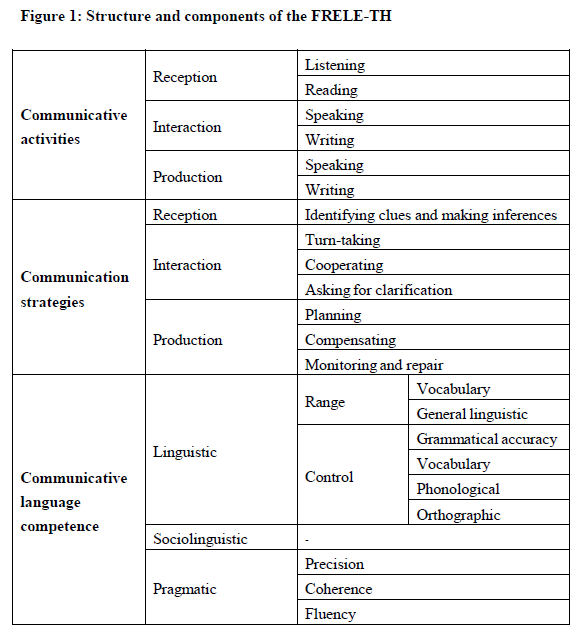
I have written before about how reductive some uses of the CEFR can be, especially in how they focus on core skills, and how the breadth of multilingual-focused competencies outlined are largely ignored. The FRELE-TH arguably fell into that trap. In an English-as-an-international language context, plurilingual competency development is paramount. Emphasising this at framework and curriculum design level wouldn’t have strictly been an adaptation within the FRELE-TH, it would have been a more principled and comprehensive implementation of it. Unfortunately, this was omitted. To be completely fair to FRELE-TH, I think plurilingualism was more a key concept introduced through the CEFR, but the actual framework didn’t have specific competencies in this area until after the FRELE-TH was created.
Linking this to the conference theme
Anyway, back to the Pearson Day theme of AI.
As someone who has been dabbling with AI-assisted curriculum design recently, I do see how AI can assist in developing frameworks and broader curriculum architecture. It could certainly help enhance aspects of the FRELE-TH to address some of the gaps I mention, but the issue of whether the adaptation is needed remains.
However, we can now reconsider the core challenges that FRELE-TH sought to address in an AI-assisted context. One of the biggest challenges was this: despite 10-12 years of studying English, Thai learners still struggle with English communication (Hiraburana et al, 2019). Hiraburana (ibid) explores some of the reasons why…
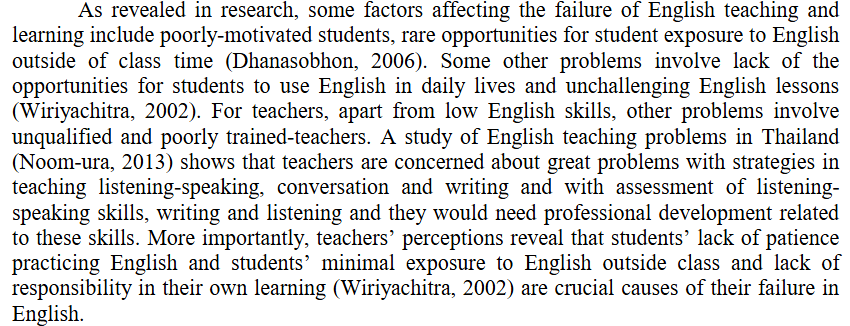
… I am sure that AI could be used effectively to address some of these challenges. While a locally adapted framework may not have been the solution, the research behind it still seems very much relevant (some slightly dated). It outlines some of the more embedded problems which AI could help address. I’d have liked the panel discussion to have grounded the questions locally first by outlining some of these major contextual challenges, as outlined in existing research, and maybe explored how AI could mitigate these. Doing so would have felt more true to the context – save the global topics of plagiarism in AI for more general contexts, and address localised concerns head-on.
General points from the panel discussion
Even so, the actual discussion included good insights and practical examples of AI use.
- Dafi Jenkins shared examples of the AI training tools they were using at RMIT Vietnam to help learners develop their writing, and mentioned the training that learners were given to use the tools effectively.
- Pornpimol Sukavatee made various references to the UNESCO guidance on AI in education, which you can explore here.
- Dr Supong spoke a bit about product versus process approaches to writing using AI, and the role AI can play in the latter
- Brett Blumenthal reminded us that the proof is still in the performance – a CELTA trainee may well use AI to produce a lesson plan if we don’t manage such restrictions, but the skill is still in effective delivery. There is nothing wrong with AI support at a planning stage when delivery still requires a level of independence.
Categories: General, reflections


Leave a Reply