
It’s been mandatory to teach Thai culture and language at international schools here in Thailand since the late 1990s. The Thai Ministry of Education recently produced new guidance for international schools on how they should teach Thai history, culture, and language. This post considers what these changes mean for the wider school community.
A greater emphasis on Thai language development
On 2nd June 2026, the Thai MOE outlined a renewed emphasis on Thai history, civics, and language, as well as on discipline and global citizenship. See here for the announcement, and here for a summary in the Bangkok Post.
In the announcement, the MOE stress how developing strong foundations in Thai as a first language* can support learners in further developing their linguistic repertoires, as well as preserve identity. Beyond the potential benefits for additional language acquisition, a stronger emphasis on solid first-language development aligns with UNESCO guidance (see Languages Matter), and Thai language is seen as an important tool for cultural transmission – it is a vehicle through which to better understand and preserve culture, traditions, social norms, and so on.
While the teaching of Thai language/culture has been mandatory for a long while, the current announcement, coupled with OPEC’s Aug 2026 release of comprehensive ‘Guidelines for Developing Thai Language, Thai Culture, and Thai History for International Schools’, prompt a renewed focus on how these areas are taught. Mandatory curriculum revisions introduce new competency-referenced frameworks for first-language and foreign-language Thai learners, and models for planning progression. Schools have until the start of 2027 to make their curriculum revisions.
Why is this mandatory in international school contexts?
The teaching of Thai language, history, culture, and civics are a huge part of the Basic Core Curriculum which is followed by all Thai public schools. As an example, here are the ‘Relationships in the Development of Learner’s Quality according to the Basic Core Curriculum’, as published by OBEC (who oversee public schooling). The full curriculum document can be found here.
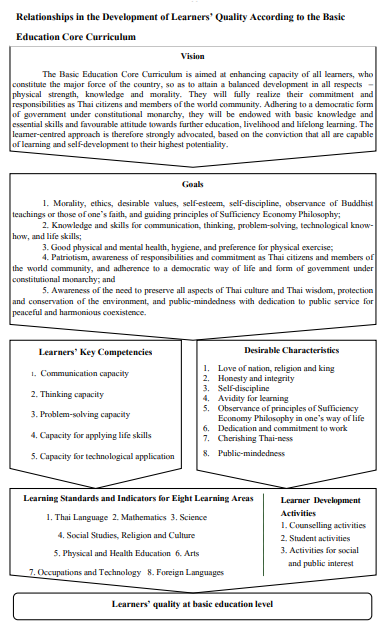
A cursory glance at the vision, goals and characteristics show how deeply and meaningfully Thai culture and civic learning is embedded in the public curriculum. OPEC, the commission which oversee private schooling here, have guidance which aligns with much of what appears in the Basic Core Curriculum. They also stress that foreign nationals studying in Thailand should also have opportunities to learn Thai language and culture. The second paragraph of the OPEC (ibid) executive summary mentions this too:
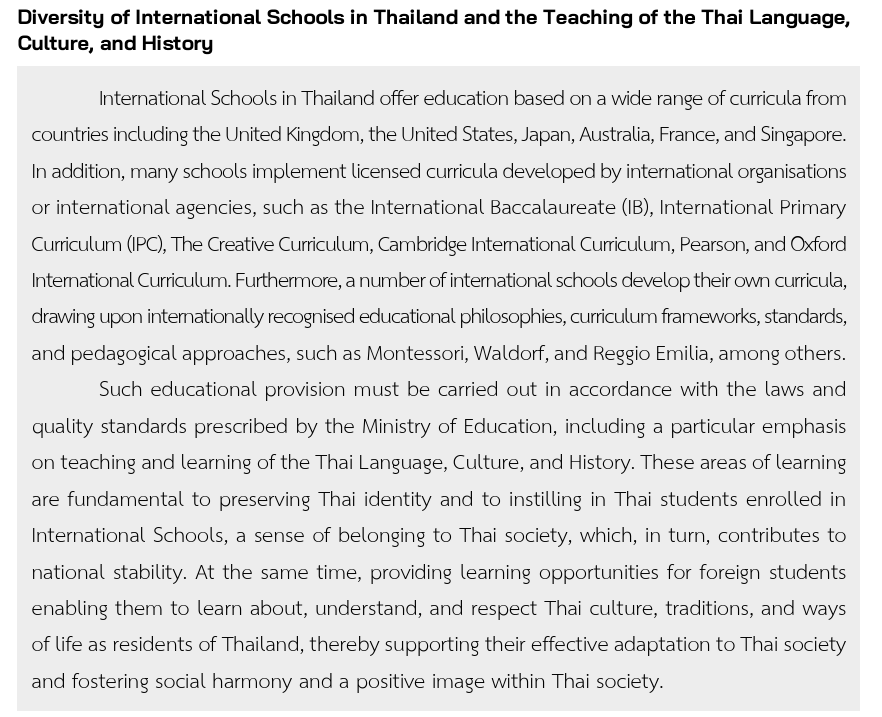
Thai language and culture in international school contexts
The June ministry announcement specifically highlighted the need for increased mother-tongue support for Thai students in international schools, a concern that was also relevant to the OPEC guidance. As mentioned in that Bangkok Post article, the increased emphasis on English proficiency in international schools is pushing Thai language development (specifically for Thai nationals) more to the background in some contexts. This is not the case in every international school, as we are also seeing a rise in multilingual programmes at more established international schools, and clear multilingual advocacy from certain school groups. However, not every international school provides sustained opportunities for the development of Thai and other home languages. Put another way, not all international education here in Thailand promotes additive bilingualism to the same extent.
The Thai MOE take a cooperative approach to addressing this issue in their announcement:

Time to reflect?
In general, the announcement raises some important questions for international schools at this point that go beyond just curriculum revision in Thai language departments.
- To what extent is Thai learning and culture meaningfully integrated into wider school life? Beyond curriculum requirements, and beyond tokenistic celebrations of fashion, food, festivals, etc
- To what extent are international schools equipping their international staff to understand and respond to the cultural, historical, and linguistic context in which they teach?
Whose responsibility is it?
Sure, specialist Thai teachers have the main responsibility for teaching Thai language and culture. But it is not solely their responsibility; it’s a responsibility of the wider school community. Rather than siloing Thai development off to the Thai department, could school leaders do more to make this a collective staff endeavour? Could they do more to build sustained interest and curiosity in Thai culture and language among internationally-hired staff? Maybe.
Here are some practical ideas.
- An initial induction into ‘Education in Thailand’ and ‘Understanding the Basic Thai Curriculum’ would help teachers understand content, assessment practices, etc that some of their learners may have encountered in previous schooling
- Extended Thai cultural programmes for new staff, lasting beyond induction periods, could promote interest, curiosity, and longer-term investment.
- Guided learning/Workshops on Thai history for staff could help them understand the local/national context. This could be valuable for curriculum design, with teachers producing more culturally responsive hooks for certain mainstream topics. These can be designed and led WITH Thai staff (a great opportunity for co-planning!) rather than imposed on them.
- Buddying systems with international and local staff could help provide safe spaces for discussion on culture
- A sustained Thai language programme for new staff, leading to clear competency-based outcomes, may help teachers recognise the benefits of multilingualism, certain language transfer challenges their learners may face, and so on.
These are just loose ideas. My point is mainly that providing opportunities for staff to develop their cultural and linguistic knowledge equips them with the skills to support learners in their development – to build more culturally-responsive international school curricula, culturally-responsive school environments in general, etc.
Above all, I think the June 2nd announcement from the Ministry of Education should not be dismissed as a tick-box compliance exercise. It is a genuine opportunity for schools to reflect on the extent to which they are truly engaging in the local context, demonstrating meaningful localisation, and nurturing a culturally responsive community.
Okay, last bit sounded a tad preachy, sorry!
*Not every Thai national has Thai as a first language. The MOE didn’t hedge that in the announcement.
Image: Office of the Private Education Commission (OPEC), Guidelines for Developing Thai Language, Thai Culture and Thai History Curricula in International Schools (2026).
Categories: General, reflections, teacher development


Leave a Reply