
I’ve been building this ‘Academic English Syllabus’ for EAL learners. You can catch up on the process here if interested. Anyhow, in this post, I’m sharing the first draft of a full (AI-assisted) lesson sequence.
Here it is.
And here is some commentary…
Step-by-step
As you saw in the previous post, I was mapping each unit step-by-step.
- Step1: confirm a suitable unit assessment
- Step 2: create a sequence of tasks for each lesson that would build skills and language towards the assessment (but that were academically useful in their own right!)
- Step 3: map possible input (reading and listening), ensuring exposure to a range of genres
- Step 4: mapping possible subskills and language coverage
- Step 5: audit (taking out overfill, checking plausibility of tiered vocab coverage, checking relevance of functional language, etc)
- Step 6: amendments etc.
For me, you have to work with AI this way. If you ask it to fill too much too soon, it just goes a bit wooooohooooo. However, working step-by-step has its flaws as AI seems to tweak its processes if you come back to it after a while:
Me: Yesterday you helped me map Units 1-3 of the syllabus. Today let’s work on Unit 4.
AI: Sure! I’ve mapped the tasks, input, skills, language and added them to our workbook
Me: whoa whoa whoa what? Right, delete that and let’s talk through the unit outcome first!
Coverage-quality audit – subskills
Our subskills list was never designed with full coverage in mind. They were more of a list of teachable or observable subskills that could inform planning. The mapping logic was:
- Attach a subskill to a lesson if it is clearly needed for completing a main task
- Attach a subskill if it is likely to be taught, modelled, practiced, etc within planned classroom activities for that lesson
Here’s a concrete example of that:
In Unit 2.7, the learners listen to a data briefing. They identify which information that the speaker gives comes directly from a visual and which is further explanation. This requires various listening skills, such as matching spoken references to visual data (L9.1) and combining info from spoken and visual data into notes for representation (L9.5). However, there is likely to be some orientation to the visual data first, which presents a chance to develop/practice ‘interpreting info from a visual’ as a reading/viewing task (R2.3). During a lesson, the teacher may create a more responsive focus on one particular subskill over others. It’s about creating opportunities to develop skills rather than simply ticking off that some practice has taken place.
I get that by this logic you could shoehorn in a whole range of subskills for every lesson, tons of oracy ones in particular. But it’s more about highlighting prominent opportunities for development and practice. For example, I could probably shoehorn Speaking subskill 3.3 (signal agreement, partial agreement, etc) into about 50 lessons once the lesson resources are created. However, this mapping stage is more about identifying one or two clear learning contexts in which it is likely that such a skill would be explicitly taught, modelled, practiced, etc. This is not hard and fast – and things may change at the resource design stage.
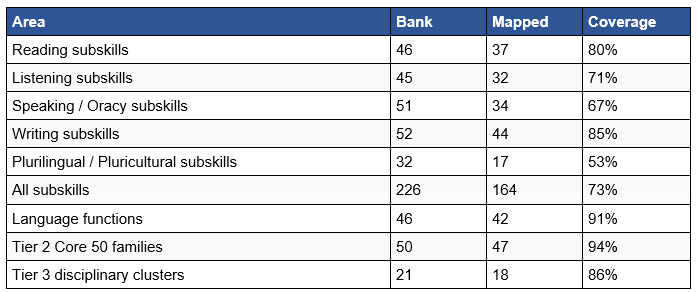
Based on that approach, there was a fair amount of preemptive mapping done for our subskills. The percentages probably make sense for writing vs speaking; you can imagine that writing tasks maybe need a bit more in the way of planned input for development, whereas with oracy you can sometimes springboard into developing subskills as the need arises, or they are particularly ‘in-the-moment’ in nature. Here are some examples of the oracy strategies not yet mapped as ‘good opportunity in this lesson to practice…’
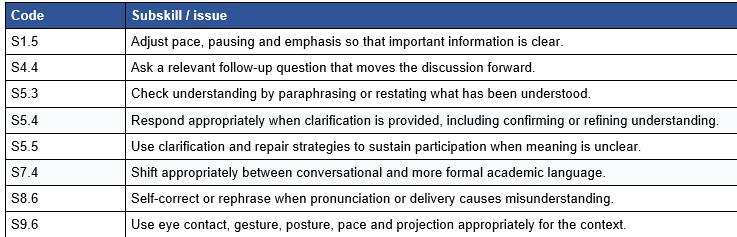
As you can imagine, so many of these will be addressed responsively in classroom contexts, so mapping them for me isn’t so necessary. Others, like S7.4 about shifting registers, is definitely something I could map, probably to our Unit 8 which involves a subject concept explainer task. It could even form part of the assessment criteria, where learners are tasked with using everyday terms to help explain difficult concepts. The short of it is this:
- This initial subskills mapping is ‘what stands out’ at the syllabus planning stage. They give us hooks and direction, whilst ensuring possible coverage would be balanced enough.
- Tweaks or additions will be made at the lesson planning and resource creation stage, and AI can help map and track those updates.
- Things happen in a lesson that teachers respond to, meaning opportunities for further, or different, subskills focus arise. Teach the learners, not the syllabus blah blah.
A good example for the latter is the mapping of our plurilingual strategies. It’s one thing planning for these, it’s another creating an environment in which spontaneous opportunities for plurilingual development are embraced. You’d expect lighter mapping, but we do also want planned skills development to ensure the use of plurilingual strategies are embedded and expected.
So, we’ve managed to identify opportunities for a range of subskills to be honed. Our audit breaks this down in more detail:
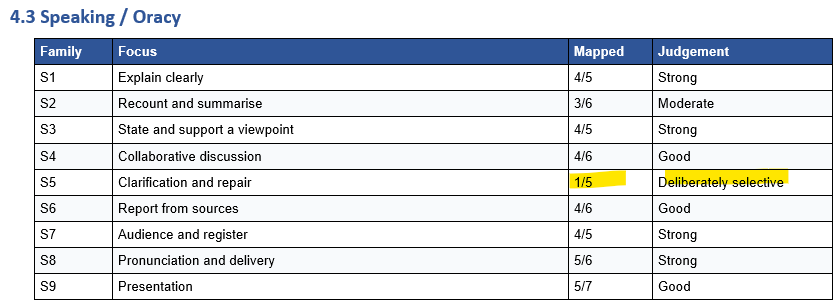
And that’s kinda useful for reminding me of my thought processes, like ‘be deliberately selective on clarification and repair because this is more of a responsive focus for teachers…’ type thing.
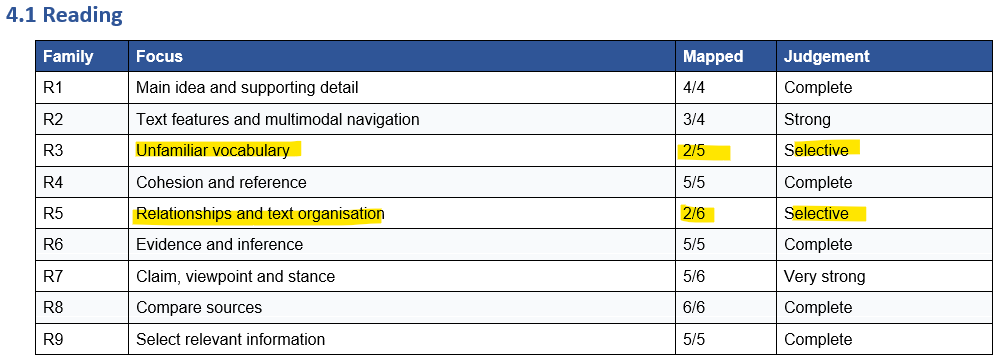
And reminding me that I will build certain skills into the resource creation phase as standard. For example, there are some subskills related to text organisation which will be developed/practiced every time learners encounter a new text type when they are previewing or analysing text organisation, field-tenor-mode, etc.
Audit – vocabulary
So, some areas of this were intentionally prescriptive. Notably, the recycling of Tier 2 vocab:
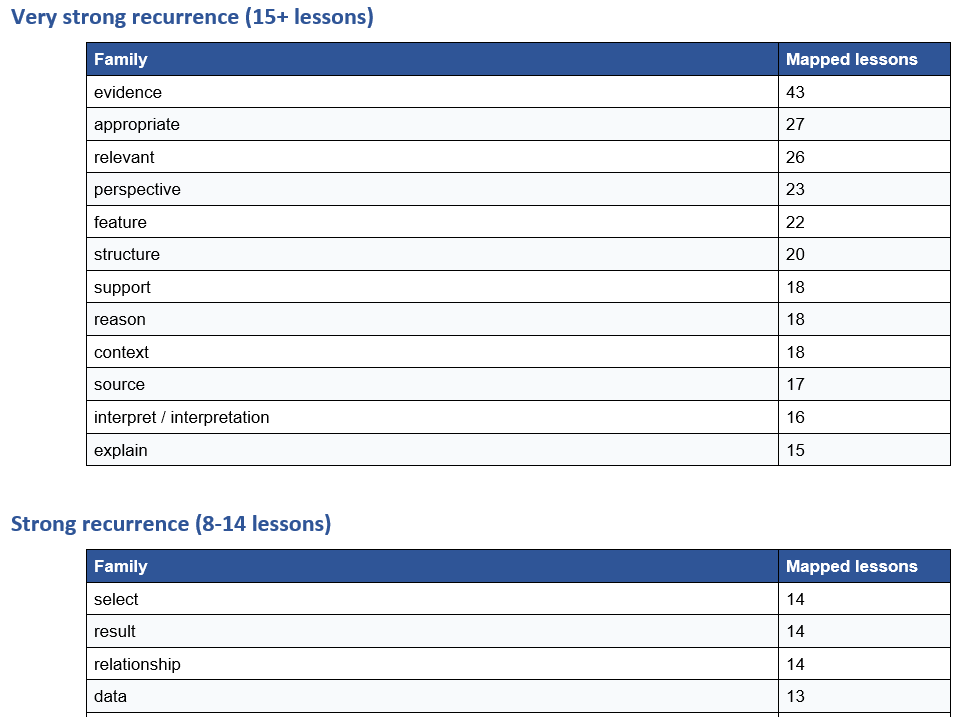
Etc. Things have gone okay on that front, with 47/50 of our terms adequately recycled (I mean, pre lesson creation obvs!). I’ve removed a few terms that I don’t like as much now tbh.
For Tier 3, we didn’t want to shoehorn for coverage, and as such there are some topics that didn’t feel relevant to any particular lesson/unit. So, they just don’t feature:
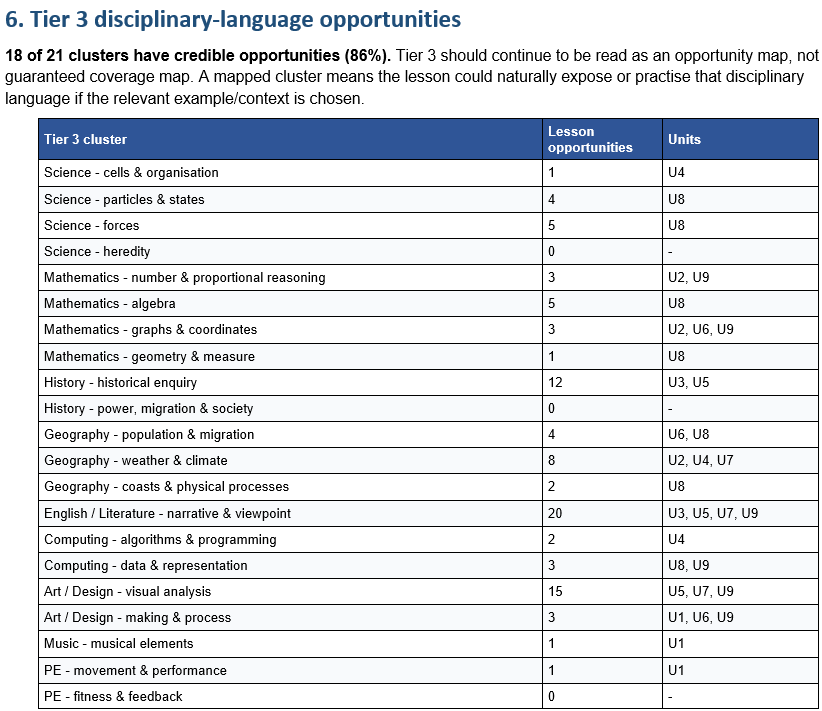
But you never know how that will truly play out during lesson creation (or delivery for that matter). I’d expect some changes to this section during the resource design phase.
Possible language functions coverage is high (42/46 functions) but for these I definitely did the opposite of the subskills mapping! With subskills I pruned for relevance, but for functions AI went nuts and over-populated where it thought we could tap into certain functions. So, that one will be amended at Draft 2:
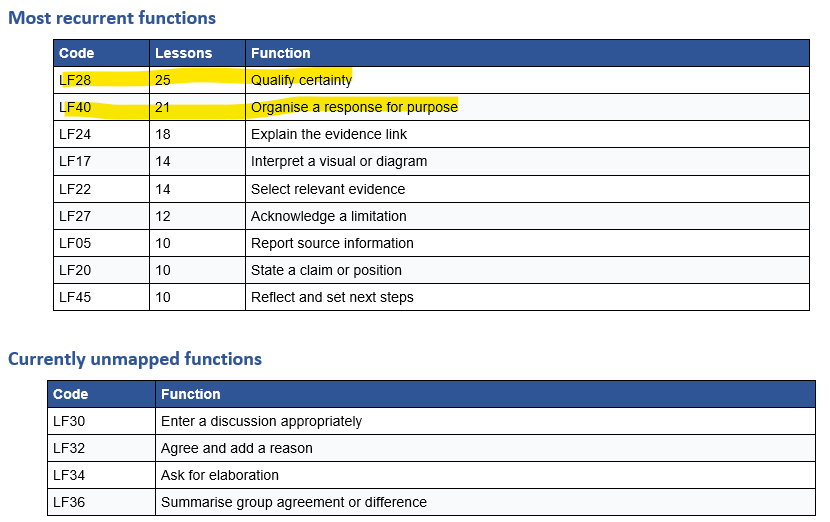
But as you can see too, the functions we don’t include are more ‘micro-discussion’ strategies. Either I treat those as responsive, or plan content around discussions to help draw out development/practice. Let’s see – I’ll have a think.
Genre audit
I mean, just a snapshot of part of that.
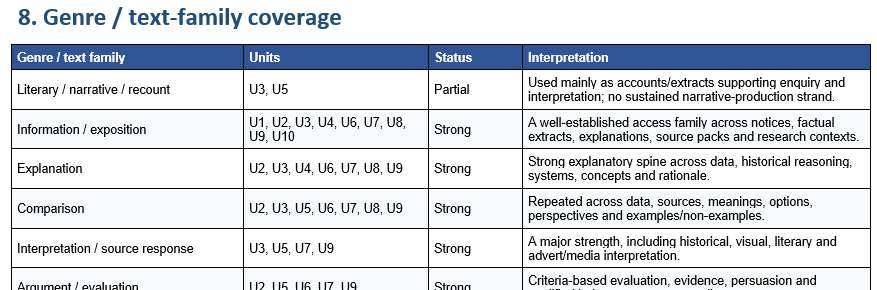
Some partial, most ‘strong’. AI decided I like the word ‘capstone’ in one of its interpretations. I don’t even know what that means. God I’m fed up with ‘source of truth’ too. It feels like something mythical. Look at that too – ‘strong explanatory spine’. It sort of reminds me of how Mr Undermatter used to speak in our correspondence. Not that my materials writing posts were real or anything.
Spontaneous audit – Boyd Roberts’ dimensions and the SDGs
No, that’s not a prog rock band. I wrote this post a while back on ‘A connected curriculum’ which mentions Boyd Robert’s dimensions of ‘education for a better world’
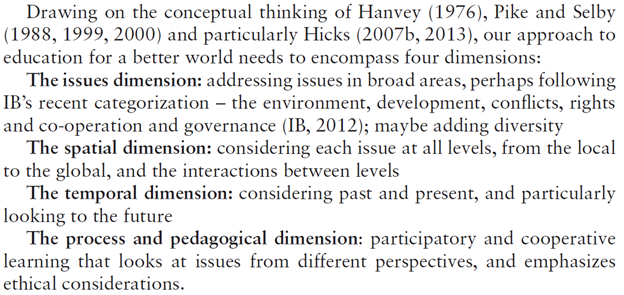
I thought it worth reviewing what AI and I had created to assess opportunities to tap into these dimensions. I layered in possible SDG focus for that too. I won’t ramble on here, but you can see it in a column in the lesson sequence tab.
Verdict so far
I’m not totally trusting AI, but I think we are collaborating quite well at this point. There are some things I like about this syllabus map:
- It has the potential to aim high. High expectations with appropriate support, yes.
- I like the unit assessment tasks – many of them have the potential to engage and most are highly relevant. I particularly like the final two.
- I can see how these topics could be repeated and, with vocab tweaks, create a good spine (ha) for a Year 8 version of this syllabus.
Things I’m less enamoured with:
- AI-assisted resource writing. I’ve got to give strict guidelines for this, and I think it’s likely to go wrong.
- The need for a strict ‘human check’. At this stage. It’s not filling me with excitement but then it is only 8am.
Image: Copyright Blendtec
Categories: General, materials writing, teacher development


Leave a Reply