
I’ve been working with AI to create an academic English syllabus for EAL learners. The last post shared the full syllabus map (see here). I’m moving on to document an important step here – outlining the instructional design principles.
Why outline the instructional design principles?
I’ve been part of various syllabus/curriculum builds in international schools. There are usually time constraints involved, and this often means that structural and quality assurance aspects of the workflow get skipped. There’s often a syllabus-map-straight-to-resource-creation kinda jump involved.
In contrast, as a coursebook author, you’re never expected to jump straight from map-to-resource. You get a brief which outlines a whole array of instructional design principles for various levels and stages of the materials creation process. These can be anything from:
- nitty gritty details (texts should be no more than X words, no more than 10% of words above B2 included)
- structural guidelines (each reading text must include orientation questions, pre-teach, read for gist, comprehension, one additional DART, etc)
- pedagogical decisions (grammar points are taught using inductive approaches)
- design/layout guidelines (Use bullet points for XYZ, each subheading should include skills type, etc)
Basically, a typical in-school syllabus design process can be loose and inconsistent without clearly defined instructional principles. At the other end of the scale, the creation of published resources can be uber-restrictive and formulaic due to having very tight instructional design principles.
For this syllabus design project, it would help to hit the middle ground. The AI-assistance makes it easier (time-wise, quality-control wise) to layer in some clear/consistent design principles moving forward, and to create a proper bridge between syllabus map and front-facing resources. This should, in theory, make the final resources much more fit for purpose.
I guess what I’m saying is something like:
- Syllabus map: the intention, the scope, the sequence.
- Instructional design principles: practical development of that intention/scope/sequence
- Resources – bringing it to life for learners and teachers
But yeah, there’s overlap between these components. Anyway…
Outlining core design principles
I blurted about 50 design principles into AI that I felt explained how our syllabus map should be interpreted when planning. I just went a bit whooooooa, and ChatGPT helped me tie these down to some core principles with sub-points. The main principles were:
1. Start with meaningful end performance and work backwards
2. Let tasks lead; use the syllabus architecture as quality control
3. Build every lesson around purposeful progress in content and language
4. Sequence learning towards increasing independence
5. Make input rich, credible and worth working with
6. Orient learners to meaning before demanding close processing
7. Teach language functionally and explicitly when useful
8. Scaffold challenge — then make the scaffolds removable
9. Build cumulative language learning through retrieval, modelling and reuse
10. Treat the learner’s full repertoire, perspective and agency as resources
I take points 1- 5 as core to the design, no question. Principle 6, well, this is my failsafe of sorts against something I don’t like in materials design. Here is Principle 6 in more detail:

I want a consistent focus on meaning-making and texts as acts of communication – not just as vehicles for ‘skills practice’. And I want the close processing stages to be developing skills, not just practising them, so I want that built into the design logic.
Principle 4 and 8 might seem to overlap in a ‘removing support, towards independence’ type thing, but I think one is at sequence level and the other is at stage and micro-process level, so they are different to me.
Principle 9 is really important given the ‘core Tier 2 vocabulary’ coverage I’ve been considering. And Principle 10 – ha, don’t worry, multilingualism is not a footnote… this is not a hierarchy of principles, just a list.
Ensuring the syllabus map feeds into the planning
It would be rubbish now to have created that comprehensive syllabus map but for AI to largely ignore it, so I needed to outline rules for inclusion:
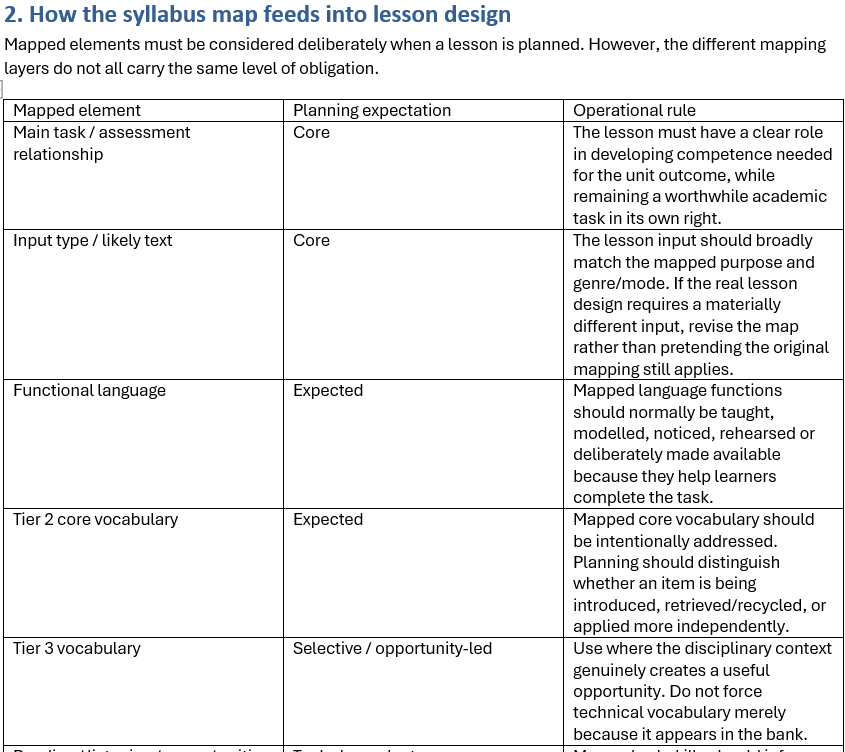
Etc.
Other stuff
I mean, when you’re thinking of instructional design principles, and knowing that AI will assist with a lot of the creation, then you’ve got to outline clear(ish) expectations for most things. I have long lists of considerations for texts, scaffolding, vocabulary instruction, and so on… Basically, think of what AI might need guidance on and tell it. Then get it to summarise it back!
Quality control
The syllabus will need plenty of auditing. I need parts of this to be automated rather than it all being led by me, so again you need to factor that in. Examples of things that will be audited (there are about 10 in total):
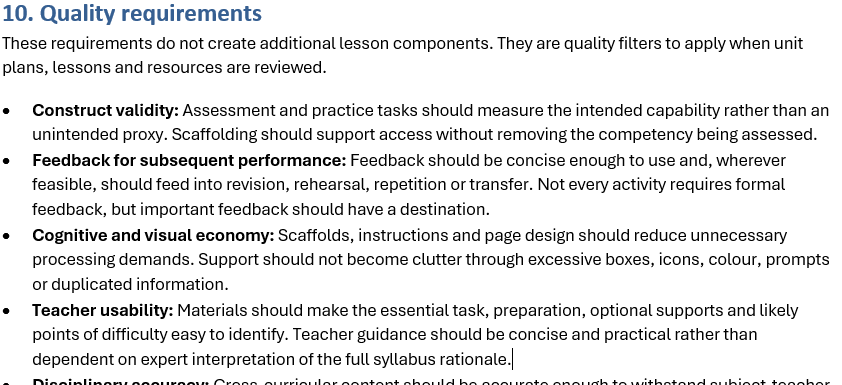
All the above considerations form part of an audit, which will basically be a series of design-checking questions. This is a layer of control that, with the support of AI, doesn’t have to be skipped in our own resource design now due to time constraints. I’d totally advise teacher-syllabus-designers to create their own instructional design principles and feed these into AI as a standard principles list for any of their resource design tasks. Maybe you do that already!
The guiding principle: backwards design
So, for me, the backwards design principle is huge. We always need to be planning with that final task in mind and consider how we are working towards that in our unit. That’s how things appear in the map, but I need to drill down a bit now to ensure things get threaded together across a unit. So, first step, outline the final task for each unit.
The context doesn’t have to be fully defined yet, but the task demands do:
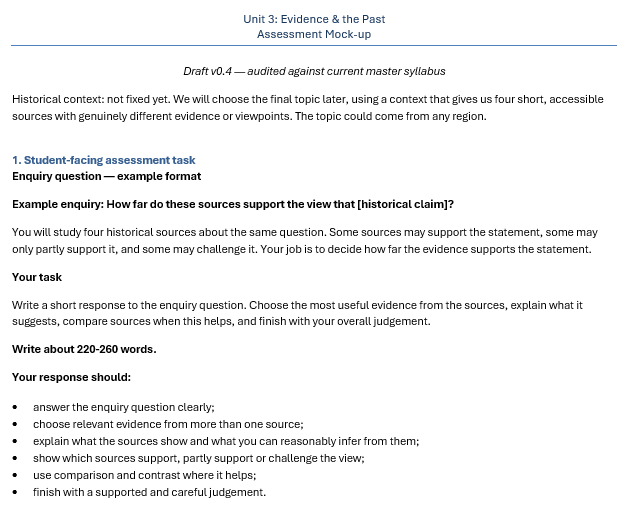
We need a bit more to go on to ensure these are drawing from the syllabus map, and where they are not! The info below is the sort of background info I am creating – only small parts of it will be student/teacher facing (and will be tweaked accordingly for that). The point of this is to double check that our lesson content is helping us build towards that final assessment performance – and that the sub-skills practiced are academically relevant in themselves.
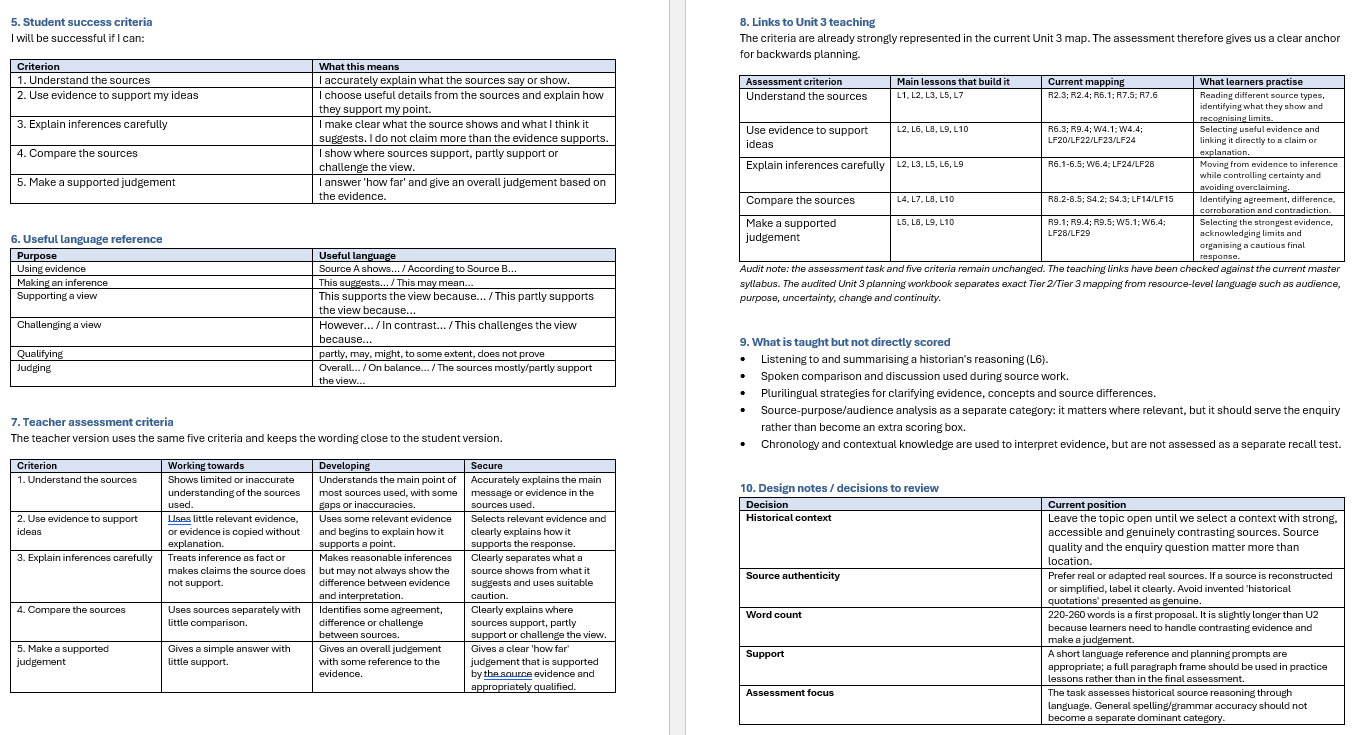
Probably worth a reminder here that we are pitching at A2+. If you actually look at the useful language here and the design notes then they hint at the scaffolding and support that will be embedded. For me, this is high expectations on the academic functions, but also appropriate expectations re: the depth of language we expect learners to use and the support given.
Based on the assessment outlines, and on the previous syllabus map, we can then build a rough lesson flow/planning reference for every lesson:
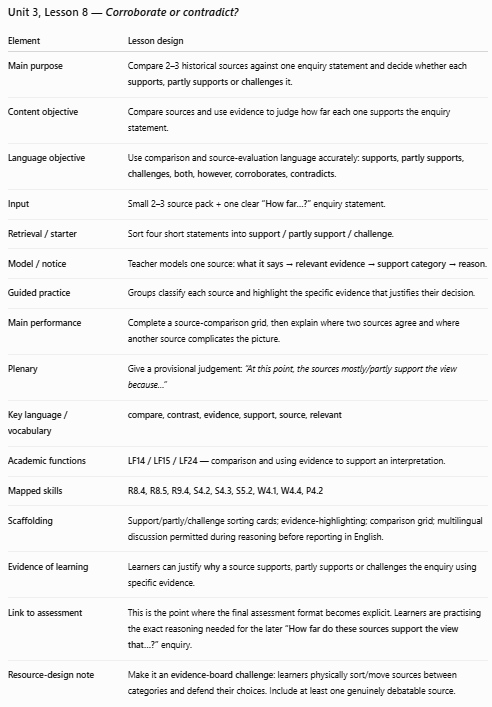
Yes, regular readers will know that I don’t like the use of ‘permitted’ in the context of other language use – that will be fed into ChatGPT!
What a long-winded process!
I mean, I can see why you might think that. However, it’s worth remembering:
- AI is going to take the lead on designing the resources – I am the quality checker. The tighter the guidance, the easier my job is in the long run
- This is not a ‘one syllabus only’ process. Beyond this, we will be building a Year 8 version, maybe a Year 9 version, a pre-A2 bridging syllabus which might be taught as a summer school pre-sessional. This syllabus should set the standard.
- This is all the technical stuff, it’s not teacher/learner facing yet!
Also, a fault in AI use among teachers that I’ve picked up on is how early we hand over the control. Equally, there comes a time when you need to release the shackles and have AI take over, otherwise things are no longer time-efficient – plus you risk tying the design in knots a bit.
It’s fair to say, I think, that AI now has most of what it needs to create quite tight resources for this project. However, it is lacking a few things for the next step:
- Graphic design guidelines – a set of standard visual ‘assets’ and templates, etc. Part of this instructional design stage (I didn’t share it all) mentions things like icons, learning menus, and so on, but based on their pedagogical value. We need a clear visual design step and some design mock ups.
- Access to bespoke (AI) tools, such as ElevenLabs for creating listening content or maybe Canva for more snazzy design. Obviously that’s a cost for me so I might wait a bit.
I think the project is much better for this stage though. You can kinda see the syllabus coming to life now! And even AI has got a bit ‘come on Pete, enough already, let’s build’. So, time to listen to the robot…
Photo by Tanja Tepavac on Unsplash
Categories: General, teacher development


Leave a comment