
I had a positive job hunting experience towards the end of this week. I put out the feelers for work at a good school on Wednesday, was offered an interview on Thursday, interviewed Friday morning, then rejected Friday afternoon.
Why so positive given the rejection? Various reasons, but these two stand out:
- It was a huge confidence boost. I’ve been down in the dumps since coming back to Thailand and having a disappointing experience at my first school. It’s good to know that there are others out there that consider me worth interviewing. I’m actually at 3 interviews from 3 applications so far, so it’s a great start!
- It challenged me to stop feeling sorry for myself and prove I have something to offer.
The interviewers asked me to prepare in two ways:
- Create a 5-minute presentation
- Create a 5-minute video of my classroom practice
The latter was unlikely given the turnaround. What I did put together, even in that tight turnaround, was a bit crap if I’m honest. But hey, I was under pressure and I still got something ready.
The presentation was, however, a bit better. The question to answer was:
How would you optimise the delivery of second language acquisition in the context of a school with 700 students and 3 EAL teachers?
I’ve shared my full response below – the text under each slide is the actual script I read (didn’t have time to prep without script). Do bear in mind that I had about an hour and a bit to think this through on Thurs eve, and limited context of where the school was currently at. It was a solid 6.5/10 response under the circumstances I’d say. The ‘Nigel Winterburn in Champ Manager 2’ level response.
________________________________________________________________________
How can we optimise second language acquisition, in the context of a school with 700 students and only 3 EAL teachers?
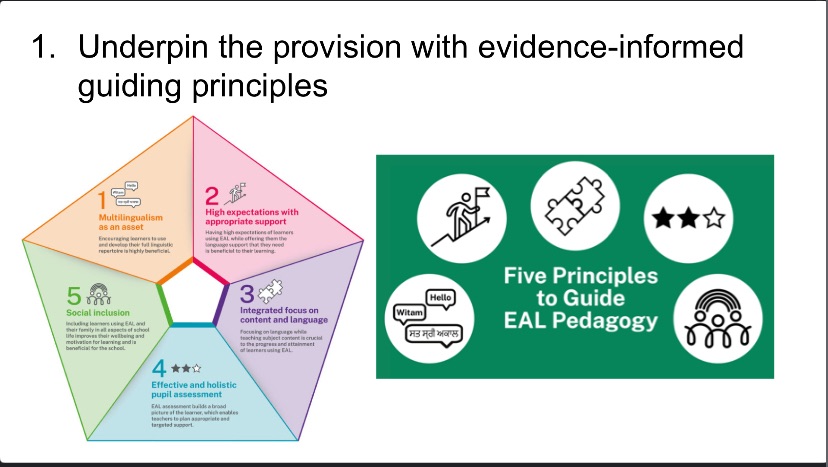
First and foremost, a school needs a set of guiding principles. A good place to start is by looking for established guidance from experienced EAL providers. The Five Principles to Guide EAL Pedagogy from the Bell Foundation, are a good starting point.
Ensuring that these guiding principles are for all staff, not just an EAL team, is important. We want staff to buy into a culture of inclusion and a shared responsibility for the development and well-being of our multilingual learners. It is important to share practical examples of how these principles can be enacted. Many teachers may feel that Principles 2, 3, and 4 are more intuitive or applicable for classroom practitioners, but Principle 1 and 5, in my experience, may require a culture shift in some schools.
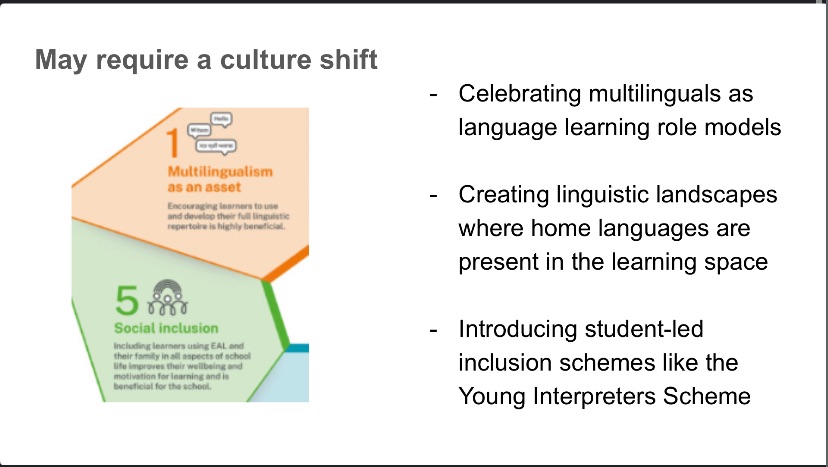
In our book ‘Supporting EAL Learners’ [flex Pete, come on], myself and Adri Szlapak dedicate a section to practical examples for making multilingualism as an asset and for supporting with social inclusion. Examples include:
- Celebrating multilinguals as language role models
- Creating linguistic landscapes where home languages are present in the learning space
- Introducing student-led inclusion schemes like the Young Interpreters Scheme.
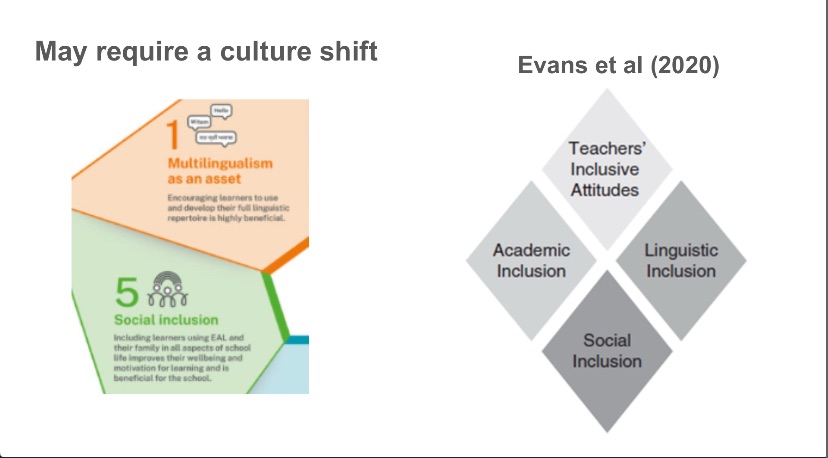
In my role as Head of EAL, I adapted input from CPD with Eowyn Crisfield into an INSET on types of inclusion within a school setting, which helped to raise awareness of approaches to socially inclusive provision.
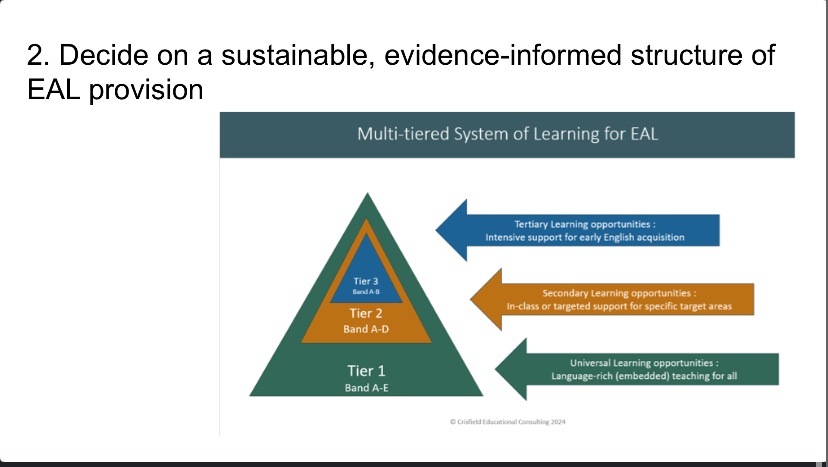
As well as setting the tone for learning through this whole-school culture, we also need clear guidance on how to support all learners in the classroom. Tiered provision, such as that outlined by Eowyn Crisfield, makes the expectations for appropriate support clear:
Crisfield suggests a three-tiered model, including universal support for all, Tier 2 involving in-class support, and intensive provision at Tier 3.
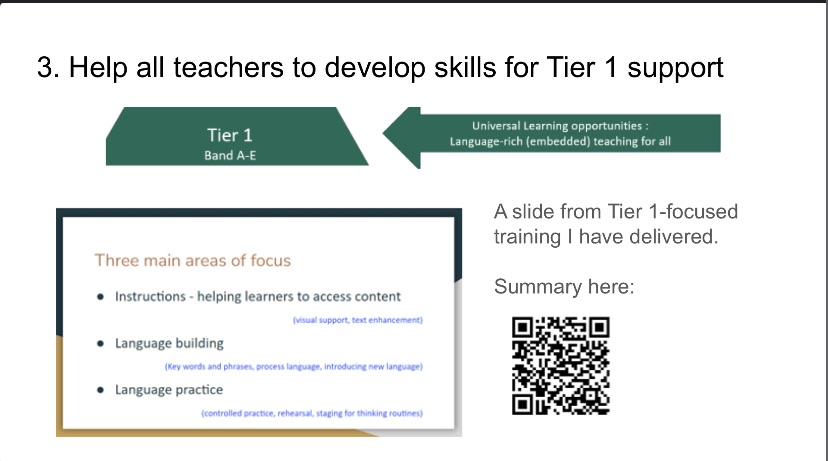
At Tier 1, universal learning opportunities and access to a language-rich curriculum is the responsibility of all teachers. Where support is needed for class teachers to develop their language teaching skills or draw out language learning opportunities, the EAL team can help provide such support.
In my previous role at St Andrews, I provided training to teachers on some core aspects of provision, such as visual support for instructions, effective ways to introduce new language, and quick opportunities for controlled practice of new language.
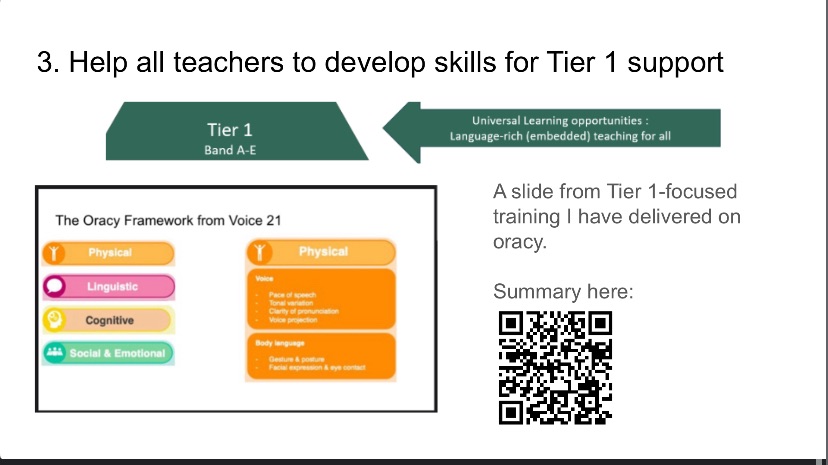
In my role as Head of EAL in the High School at St Joseph’s Malaysia, I delivered further training on Tier 1 aspects of provision, such as ways to review vocabulary, and supporting learners in developing their oracy skills.
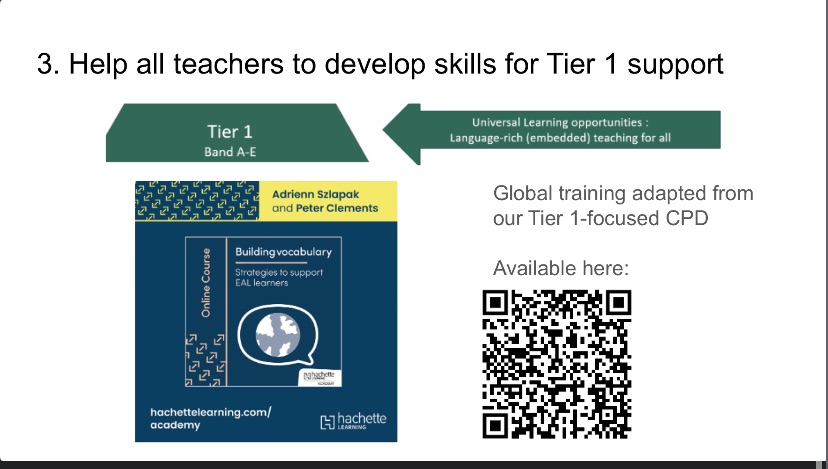
The reviewing vocabulary training has been adapted into a global product for Hachette Learning Academy, which is available here [keep those flexes coming, Pete]
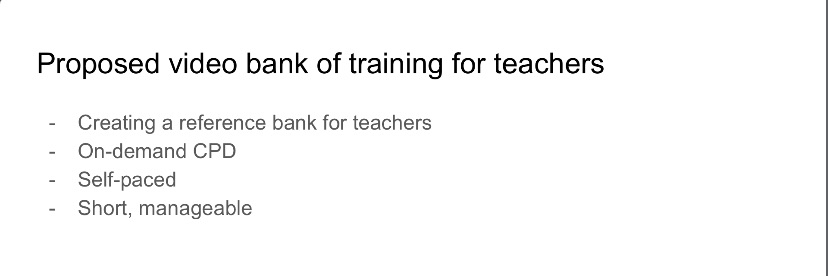
For me, one issue with CPD is that is useful in that moment but ideas may rarely be revisited. As a member of an EAL team, I have an idea of creating a series of mini-cpd videos for teachers which they can dip in and out of. A reference bank of practical tips basically.
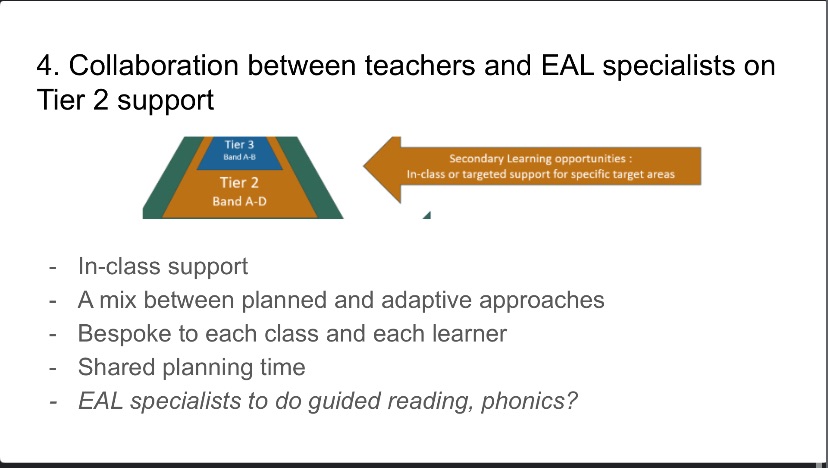
Tier 2 support would ideally involve EAL learners getting into form classrooms and being in and around the learning. Aspects of the support offered may be planned, such as a short language input delivered by the EAL specialist to a group or whole class, although the majority of the support provided is often adaptive and based on in-the-moment decisions.
Collaboration between EAL teachers and classroom lead teachers is important or ensuring Tier 2 provision meets the specific needs of the learners – shared planning time can help with this.
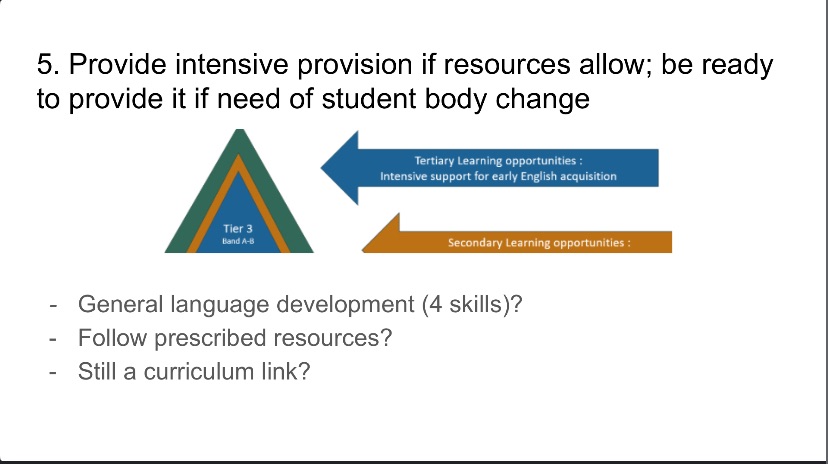
Tier 3 provision, intensive pull-out support, would involve focused provision delivered to small groups of learners with emerging or developing levels of proficiency. With a team of only 3 EAL Teachers for a school of 700, there is likely to be a trade-off between Tier 2 and Tier 3 – it is hard to provide both tiers of support when the team is small. The decision of which Tier to prioritise really depends on the greater need among the student body, and may change term by term.
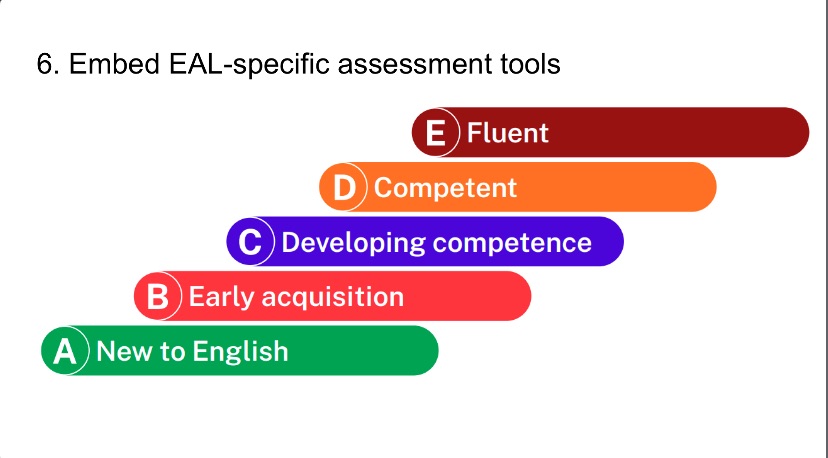
EAL-specific assessment tools help to establish the level of provision needed for certain learners. Crisfield’s Tiers are aligned to the Bell Framework for Assessment, which is my preferred assessment tool, but I am familiar with WIDA. While assessment using the Bell Framework would ideally be the responsibility of all teachers, in my experience, it would typically be the responsibility of the EAL team.
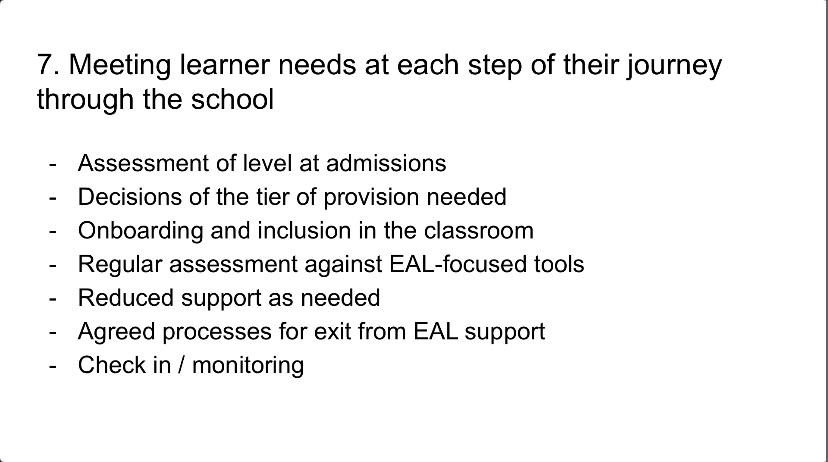
Having a clear EAL-focused assessment tool like Bell adds clarity for the learner journey. A typical journey for EAL learners through the school would be:
- Assessment of level at admissions
- Decisions of the tier of provision needed
- Onboarding and inclusion in the classroom
- Regular assessment against EAL-focused assessment
- Reduced support as needed
- Exit from EAL support
- Check in / monitoring
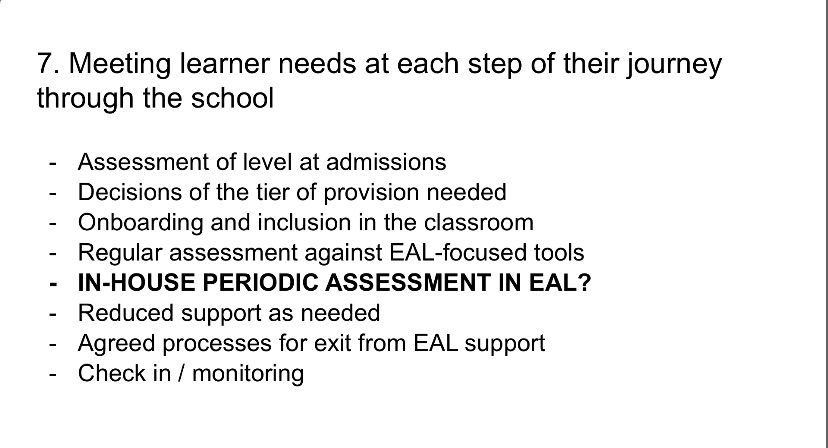
The Bell Assessment is great for formative assessment, but it lacks an initial screener and period assessment tools. The role of the EAL team may be to create such as periodic assessments to ensure decisions on exits are informed.
______________________________________________________
It’s not my finest hour by any means, but I’m proud of it. I stepped up in limited time to share ideas with (some) clarity. I did that, and while I didn’t do much else positive during the interview (maybe a ramble about translanguaging was passable), I came away with a renewed sense of ‘me’. Yes, I probably do have something to offer an international school here. Not necessarily because I know a bit about EAL, but because I’m engaged in/with it. I felt passionate about a professional convo for the first time in a good few months, and the good cop on the panel did seem genuinely appreciative of my thoughts. That passion I have will spill over into my classroom practice (while not perfect), somewhere. I mean, hopefully!
Feedback on the above would be most valuable of course. It was very off the cuff and I can see things I may have not addressed properly. Feel free to share ideas – much appreciated!
Categories: General, teacher development, Uncategorized
 ELT Planning
Leave a comment