
I’ve just completed the Assessment Only Route (AOR) to Qualified Teacher Status (QTS) through the University of Sunderland. Here’s a review of this short course. I’ll be blogging a bit about some parts of the course in more detail when I get the chance!
What is the AOR to QTS?
(See this overview of the course from Sunderland)
It’s a short course (6-12 weeks) for experienced teachers. It leads to being awarded QTS by the Teaching Regulation Agency. This is a requirement in order to teach in (most) state schools in England. The AOR route enables you to attain QTS in England while teaching abroad.
In order to do the course, you need a minimum of two years teaching experience across two schools, and across at least two Key Stages. You also need a degree and GCSE Grade C/4 or above in English, maths and science. If you did not study GCSEs, you’ll need equivalents (or perhaps take an equivalency test).
To take the Sunderland course, you need to be currently teaching in a school that follows the English National Curriculum, or an international curriculum like IB. You also need a mentor at your school, such as a scary member of the SLT.
By the way, current cost is 2200 GBP.
Anyway, all the above info and more can be found on the overview page (see previous link).
Why was the AOR right for me?
I decided to take this course because:
⁃ I wanted to improve my teaching practice. This practical course would give me a great opportunity to do that
⁃ I’ve spent most of my career to date teaching abroad. My experience and other teaching qualifications (e.g. DipTESOL, PGCEi, MA) are certainly valuable, but do not guarantee employment in state-maintained schools in England. A return to England may be on the cards at some point, so QTS will be needed.
⁃ Not having QTS can be a stigma in international schooling. At my first international school in Bangkok, I was not placed on the teachers pay scale as I didn’t have QTS. That still bugs me. I’d rather make sure that won’t happen again.
⁃ This route allows me to get QTS as an EAL specialist (which comes under the subject category of ‘English Studies’). It is excellent to see universities like Sunderland recognizing the value of EAL as a specialism, and this pathway is actually very suited to teachers moving from more general English language teaching and into international schools.
What did the course involve?
In a nutshell, the course involved:
⁃ Providing some preliminary evidence to check eligibility
⁃ Presenting more detailed evidence during an initial interview
⁃ Completing an assessment phase in your own educational setting. This phase lasts about 12 weeks
⁃ Celebrating
But in more detail…
The application phase
Applications for the course are rolling as there are three different start dates per year.
I started my application back in October last year (aiming to start in Term 3 – March). The admissions team at the Uni were really responsive – providing lots of info and answering my questions. It’s worth noting that there are a couple of steps in this application process:
Step 1 (easy step): complete an expression of interest form and send a CV. The form just summarizes your quals and experience, no personal statement needed.
Step 2 (chunky step): compliancy phase. This is when the uni check all your prior qualifications so you need to send clear evidence. They also check suitability through a DBS/Police check, so you’ll need to prepare for that.
At Step 2, you also write a personal statement. On the application form, it mentions that the personal statement is ‘crucial’ for determining your suitability for the course. You write (up to) 2000 words responding to 5 key questions related to various teaching standards, so it really does need thinking about. These are the questions:
What does a good lesson look like and how do you ensure that your learning environment and lessons are inclusive to all ability levels and learner types?
Explain your taught curriculum over the course of the year, indicate the schemes of work used, your involvement in longer term planning (particularly departmental and team planning) and how you stay current with your curriculum and subject-specific knowledge.
How do you assess pupils (both formative and summative), collect and organise data and use this to facilitate pupil progress (both short and long term) for all ability levels?
How do you facilitate appropriate behaviour management strategies and a positive behaviour for learning environment in your classroom and in the wider school?
How do you adhere to the professional standards and knowledge required from a teacher and to what extent are you aware of safeguarding within the school setting?
If successful, you will also need to answer those same questions in a face-to-face interview (see next bit), so the personal statement is effectively a planning stage for that.
This is the compliancy checklist:
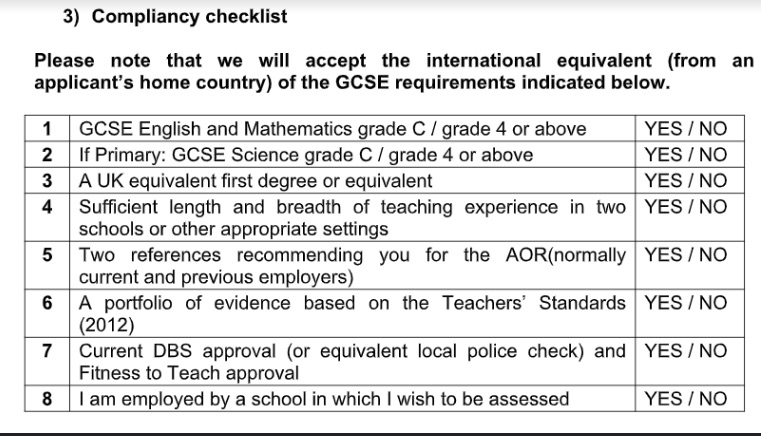
Note: you DON’T actually need to have a formal portfolio of evidence (number 6) at the compliancy stage of application. You submit all the other info, THEN your application is ‘forwarded to the next stage’. That’s the interview…
The application phase may seem rigorous, but it sets you up well for the interview. It’s well thought out, comprehensive, and communication from the admissions team was very clear throughout.
The interview phase
There are two things you need to prepare for the interview:
⁃ a 20-minute presentation in which you address the same questions as in the personal statement. You should provide clear evidence from your own practice where relevant.
⁃ a portfolio of evidence covering the full range of teacher’s standards outlined by the Department of Education. The teacher’s standards can be found here. You are asked to compile your evidence in Box – an online file storage site.
I had one month between the email inviting me to interview and the interview itself. This gave me approximately 3 weeks to start compiling my portfolio of evidence – the assessor needs about a week before the interview to review your portfolio. So, the earlier you start gathering evidence, the better. Bear in mind that you will have lots/most/all of the evidence from your own teaching practice already, as you’re a practicing teacher. It may seem daunting to compile, but it’s often easier to find the evidence than it might seem at first.
The interview itself lasts around 90 minutes (although block out 2 hours if, like me, you’re a rambler). It’s a one-to-one interview with the main assessor from the uni, and consists of three parts:
⁃ An exploratory chat. You chat with the assessor about your experience to date, your educational ethos, your reasons for taking the AOR, etc. The assessor asks lots of probing questions just to learn more about you as an educator, but it’s not like an inquisition or anything!
⁃ Presentation. You deliver your 20 minute presentation live. The assessor watches/listens, follows up with some questions, etc
⁃ An audit of your portfolio. The assessor shares their evaluation of your evidence so far. They explain which of the teacher standards have been evidenced well, and which require more evidence as you move into the assessment phase.
The interview stage was awesome. My assessor was really supportive and seemed genuinely interested in my teaching context. The presentation was daunting, but the follow-up questions led to a really worthwhile chat. I thought this was, again, a well structured stage of the course. The audit at the end was super useful as it provided really clear guidance and areas of focus for the assessment phase.
The assessment phase
If your interview is a success then the assessment phase begins! This lasts up to 12 weeks. For this phase, you are assigned an assessor from the university, and you interact often with a mentor at your school. During the 12 weeks, you…
⁃ are regularly observed by your mentor (minimum 6 observations)
⁃ submit a video recording of one of your lessons for a mid-point assessment. This is evaluated by your designated assessor at the university, and you receive thorough feedback
⁃ undertake a final observation, in which you are observed live by the university assessor via MS Teams (or in person).
⁃ meet with your mentor often to talk about progress, next steps, and to complete lots of forms!
I loved this phase, and it flew by. The assessor at the uni was laid-back, supportive (again), and gave really constructive feedback. My mentor at the school was my line manager, who was awesome throughout the process. This gave us a great opportunity to get to know each other’s practice more, discuss approaches, share knowledge of our learners, and so on. I can’t really judge the course itself on the quality of my own mentor as that varies for everyone! But I can say that the course provided us with a worthwhile chance to collaborate. As a result, I feel that my own practice, and our understanding of teaching and learning in our context, has moved forward in some ways. The course created the conditions for that.
There was a lot of admin during this phase. This included:
⁃ Three ‘checkpoint’ forms assessing progress and next steps. Completed after meetings between me and my mentor
⁃ Formal lesson plans completed on a proforma from uni of Sunderland
⁃ Feedback and reflection on observed lessons
⁃ ‘Career planning’ documents for after the course
This is not a criticism as they are all worthwhile/necessary docs. It is just worth bearing in mind that you and your mentor will need to find time to meet quite often during the assessment phase.
Completing the course
If your assessment process is a success, the uni assessor recommends you for QTS. I couldn’t believe this, but the process from the university making their recommendation to me receiving confirmation of QTS from the Teaching Regulation Agency was… 2 days. I have never known a process like this to be so quick.
Overall
I’m struggling to find fault in the AOR course through Sunderland. The uni have led the way in AOR courses and it’s clearly been honed over the years – it was a very smooth process.
This isn’t like a ‘check you meet a minimum requirement’ type course, this is more of a ‘confirm you are already an experienced teacher that is worthy of QTS’. My interactions with the assessors were representative of that. They talked to me more as a fellow educator and (kind of) an equal, and that gave me confidence and made me feel they were on my side. My mentor was very much the same, and having that confidence from both parties allowed me to be the real me as a teacher. It’s liberating for a course to be like that – the closest to that I’ve done before was the DipTESOL.
I guess if there was one tiny thing I’d change about the course, it would be the wording of that compliancy checklist, to clarify that the portfolio of evidence is needed prior to the interview, but it doesn’t need to be complete at that point. That nearly gave me a heart attack. But if that’s my only (pedantic) criticism, well…
I’d highly recommend this course to any of my former colleagues who have moved into EAL from roles at the British Council. I’d say it’s perfect for experienced EALers, especially if you might head back home at some point (or to avoid stigma and pay scale challenges). But I don’t want to suggest it is solely a means to an end – I got tons more that I expected from the AOR process and certainly wasn’t just a box ticker.
Rating
Solid 5/5. One of the best courses I’ve done.
Categories: General, reviews, teacher development
 ELT Planning
This is SUPER useful! Thank you for sharing your experience. Can I ask about this statement on the course website:
“If you are awarded QTS, the next step is to begin a period as an Early Career Teacher (ECT). This will be overseen by your host school and their ECT providing body and not the University. This includes a personalised programme of professional support and further assessment against the core professional standards for teachers normally organised by your employing school or local authority.”
Any idea what this means for teachers working frow International Schools?
Thanks in advance if you are able to help 🙂
LikeLike
Hi Lee, thanks for reading. I’m still at the same international school where I did my QTS, and they now have me on the ECT framework. Haven’t had many discussions about it, but basically it is possible to do the ECT stuff at an int school if they support it and have a training programme in place. To be honest I wouldn’t want to say that as definite in other schools but that’s the case at mine. Sorry I can’t help more.
LikeLike
Thank you for the wonderful information, Pete.
I’m a bit confused. Just to clarify, my portfolio of evidence needs to be ready before my interview?
Also, how would the lesson observations take place if overseas?
Thanks
LikeLike
Hi Tom, yeah that bit is confusing – I was thrown by it too. Basically, you start documenting evidence for your portfolio before the interview, and you submit it for review. It doesn’t have to be complete, it’s just an initial review from the tutor. During the interview, they give you feedback on the evidence you’ve gathered and which areas they feel need more focus. So, yes the interview prep does involve starting to build your portfolio, but having a complete portfolio isn’t necessary at that stage. If successful at interview then you get 12 weeks to gather the rest of the evidence needed
LikeLike
Ah I didn’t answer the observations bit… you are assigned a mentor at your school. They do a minimum of 6 obs, because it’s one every 2 weeks. My mentor did more though, and the feedback was all constructive/developmental and a the lesson plans often aimed to address aspects of my practice that I needed to evidence more. The mid-course observation is a video observation that you submit to the unit using Canvas platform (I think!). The final obs with the uni tutor is live via Google meets or MS Teams (I forget which one). So you just set it up at the back of the class and teach. If the tutor happens to be in your country then they may turn up and do a live obs.
LikeLike
Thank you, knowing that is a great help. I have my interview coming up and am super nervous haha only because this opportunity means a lot to me. I have a question about my teacher evidence. Do you know if I can use a piece of evidence more than once? Or must there be a unique piece of information for each standard?
LikeLike
You can deffo use a piece of evidence more than once. I did that a few times and no issues.
LikeLike
Hi Pete,
Thanks so much for your write up here, it’s a fantastic eye-opener into the reality of enrolling. I’ve been an EAL teacher for a few years now, with an iPGCE and M.Ed. I’ve been put off doing the AOQTS because EAL isn’t a listed subject with the university. When I last enquired a few years back, they didn’t allow me to pursue the program just as an EAL teacher.
For your participation in the course, were your lessons all EAL classes, or were they English Language classes? I’m worried to apply, pay for the interview, and then be rejected …
Do you think it would be better to ‘present’ myself as an English Language teacher? I would probably be able to teach those classes, if it helps me enrol.
Secondly, you did the course in Bangkok? For the assessor from the university, did they ever physically come out to see you? Or was it all online? That’s another concern of paying for them to fly over!
Appreciate your help/advice if you see this to be able to reply!
LikeLiked by 1 person
Cheers for getting in touch! I’ll try to cover all your questions in ramble below:
How can you get on AO QTS as an EAL teacher? Well, it’s possible under certain circumstances – specifically, the content of the taught curriculum and your school and the type of EAL provision offered.
EAL/ESL is not technically a QTS-recognised subject. However EAL teachers are accepted onto the AO QTS programme either as English teachers following a curriculum which covers both literature and language, or as MFL teachers if their curriculum is focused on language acquisition.
In my context, I set up a bespoke EAL curriculum at my school which aligned to aspects of mainstream English class and to content across the curriculum. This meant a) I was teaching literature too, but adapted to support my learners in accessing the content, and b) I was teaching language acquisition across the curriculum. That got me in under the specialism of English Studies.
So, your question regarding should you present yourself as an English language teacher… not exactly. You can still be an EAL teacher, but you need to be teaching aspects of language (which you would be!) and literature if you take the English studies route, and explain that well in your application. Or I guess focus on pure language acquisition and go for MFL route? I’m repeating myself I think!
Re: where I did the course. I’m based in Malaysia. I did the whole thing remotely. The developmental observations were done by a mentor at my school. The mid-point assessment with the tutor from Sunderland, involving an observation, was a recorded video observation. The final observation with the tutor was live but via MS Teams/Zoom. So, the tutor never visited me and observed in person. Do they? I believe they do sometimes, and when they do they normally observe various people in the cohort in that region – not just you. My understanding from the main tutor who did my interview (just from chit chat with him) was that candidates don’t normally pay for the tutor to fly out anymore. The tutor may be in the region so would observe you in person if convenient, but there are quite a few ppl in each cohort now so it’s not so doable. But don’t take my word as gospel there, I’m just another candidate after all.
Sorry, long response. Excuse any spelling errors and let me know if I missed anything! Cheers and best of luck etc
LikeLike
Hi! Thanks so much for this, I’ve found it really useful! I was wondering, when gathering your portfolio of evidence, did you provide a write up for each piece explaining how it linked to the standard? Or did you just upload the document type such as your planning, marked work, assessment docs etc?
Thanks so much!
Lizzie
LikeLike
Hi Lizzie, I’ve just written this in response to your comment: https://eltplanning.com/2025/03/19/assessment-only-route-to-qts-d5-record-of-standards/ Hope it answers your question. Good luck with it all!
LikeLike