
This week I attended a live CPD webinar at my school on oracy development, led by Jeffrey Boakye. He’s an ex-teacher, oracy specialist, and author on race and identity. Find out more about him here.
There’s been a real push on oracy development at our school, much of which has focused on embedding a range of oracy strategies in our lessons. Boakye’s session was less about strategies and more about creating the right conditions for oracy development. These included:
- personalization
- building safe spaces that encourage voices to come through
- recognizing learner expertise and funds of knowledge
- reframing oracy as less about routines, more about people and interactions
Themes addressed (though not in as many words) included teaching with empathy, inclusion, and culturally responsive pedagogy.
Here were some key take aways from the session.
Don’t just talk about oracy, demonstrate it
Rather than go for a lecture, Boakye opted for a kind of raconteur-style delivery. He pulled the audience in with pre-emption, rhetorical framing, and relatable anecdotes. He modelled aspects of good oracy and communication, albeit restricted by the mode of delivery. I loved it – very refreshing and the guy is certainly talented at holding an audience.
Recognise learners’ prior knowledge and expertise
Boakye acknowledged that his audience would likely be knowledgeable on the topic of oracy already. He sought to highlight that the room, just like our classrooms, was already filled with expertise and voices. Yet the extent to which we’d be willing to speak up would vary, so finding ways to tap into that was important…
Personalising oracy turns
He mentioned how people usually love talking about themselves, so personalising content and providing opportunities to share views, experiences, opinions, etc was important – especially for building engagement. However…
Creating safe spaces
… personal experience also connects to identity – and that is both powerful and complex. The underlying question seemed to be how can we disarm those learners who have their guard/weapons up for whatever reason? Marginalized, anxious, fearful of judgement, etc. There’s the personal and the public, and unless we build safe spaces, voices won’t come through.
Culturally responsive pedagogy
Building on the importance of identity, Boakye gave examples of how he used to ground learning within shared/common culture when working in London. He explained how he tried to connect his students to text (William Blake’s poetry) via a more familiar hook (Dizzee Rascal) and local context (London riots). He suggested that prior to scaffolding for access in this way, his learners reported feeling that literature wasn’t something they felt was ‘meant for them’. It was interesting, however, that Boakye seemed to stick to bridging-type examples rather than pushing further towards culturally sustaining approaches.
Dynamic framing of oracy strategies
The main practical strategy that Boakye shared was a focus on ‘protocols’. These are deliberate processes that encourage equitable access to learning. Examples:
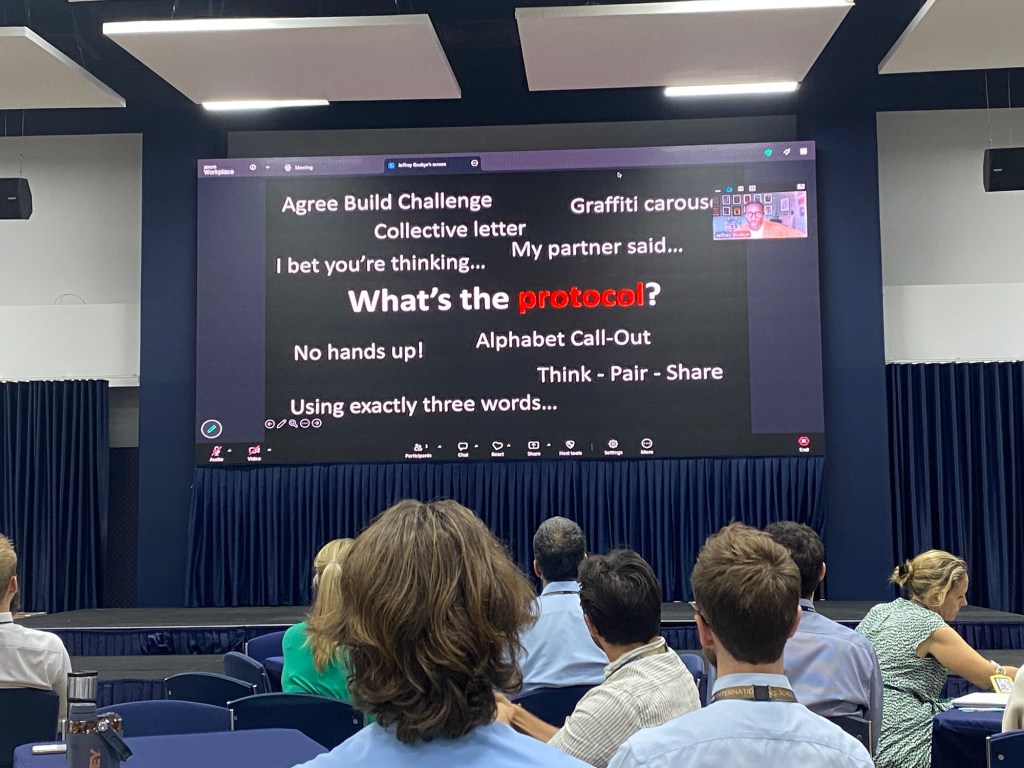
There was an avoidance of the word ‘routine’ in favour of ‘protocol’, despite some of the suggestions (‘think-pair-share’) often being referred to as routines in education circles. Through this tactical use of ‘protocol’, we get the sense that things can change deliberately in the moment (responsive, adaptive – like a planned process being overrided) compared to a more slow-evolving, regular, somewhat contrived habit-forming routine. What’s in a word, really? I’d argue a lot. Routines suggest predictability, yet interaction (the crux of oracy) is rarely that predictable. Unless we restrict it with a routine, of course.
The questions we should have
Boakye’s big take-home point was that oracy is more about questions than answers. He encouraged the audience to go beyond questions like ‘how can we effectively apply oracy strategies?’ or ‘What strategies can I apply?’. Instead, he nudged us towards exploring how we might go about creating the right conditions for oracy development, and what might make our learners feel empowered to contribute.
My thoughts
This was a very well-crafted and well-delivered talk, and the core message about creating the apt conditions for oracy development was certainly relevant to teaching contexts here. Are those conditions much of an ask in themselves? Well, unfortunately they can be.
I’d argue that there’s sometimes a sense of putting the cart before the horse when it comes to oracy development. Teachers are often tasked with embedding certain oracy-focused strategies, yet the foundations for effective oracy have not yet been laid.
When a school culture fails to foster a ‘multilingual habitus’, and instead creates linguistic hierarchies, the impact of oracy strategies can feel contrived and constrained. That can happen in contexts where English is framed as ‘the inclusive language’. Other aspects of a learners’ linguistic repertoire are deemed relevant only as tools for scaffolding output in English, not as equitable output in themselves.
A typical way that this tends to play out, which I have observed in different contexts now, is through planned, pedagogical translanguaging. In an environment which to some might still be deemed ‘culturally/linguistically responsive’, teachers tend to gatekeep the use of other languages. Other languages are acknowledged in ways that are allowed, permitted, or requested by learners. Conversely, in an environment that is culturally sustaining (and I realise this is getting a tad jargony), learners just do it – they translanguage. It’s not necessarily planned (though sometimes!), it’s typically spontaneous and there’s no need to request it. Because, as Boakye highlights, oracy is about interaction, and when you really want to interact, when the conditions are apt to embrace genuine interaction, you’ll find ways within your repertoire to do it.
In his talk, Boakye suggested we be more responsive to learners. Responsive seemed to mean that we situate *their* experience and knowledge within *our* curriculum. ‘Using Dizzee Rascal to access William Blake’. Sure, I get that, and localization/personalisation is absent in the curriculum I teach; it would definitely help with access for all. But is acknowledging identity enough, when a system remains inherently heirarchical culturally and linguistically?
The focus here was on oracy development, but Boakye prompted a broader question. How can we lay the foundations for effective oracy development, rather than jumping straight to performative classroom routines? That’s a challenging question – the answer to which takes time, planning, and often mindset shifts. Which is why we often go straight for the strategies.
Categories: General, teacher development, Uncategorized


Leave a Reply