
I teach a mainstream Year 7 class. The overall level is very high, but sometimes I think the in-house content we have could do with more scaffolding at times. I mean, it’s awesome content – I’m just talking a few tweaks.
We’d been studying Lonely Planet guides, with a view to learners writing their own guidebook page in that style. Great authentic focus. Learners had access to plenty of example pages from the LP and we analysed the typical features of these. However, I felt like some of my EAL learners would benefit from having a less busy example of target features. This is a tricky one, as I’m usually a ‘adapt the task not the text’ type teacher. I made a different judgement call here though.
So, before having learners write their own guidebook page, we reviewed the notes in our mindmaps from exploring these authentic texts (prompts shown):
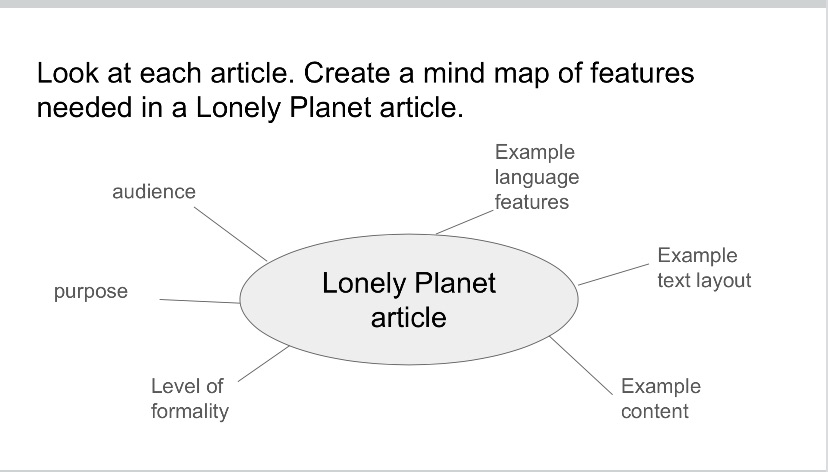
To recap the key features:
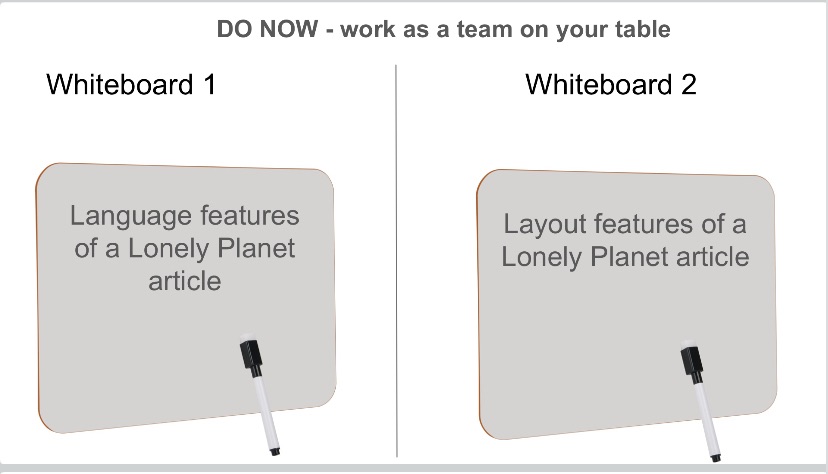
Then I personalized things by having learners think about a local attraction they knew – The Green Lung in Bangkok.
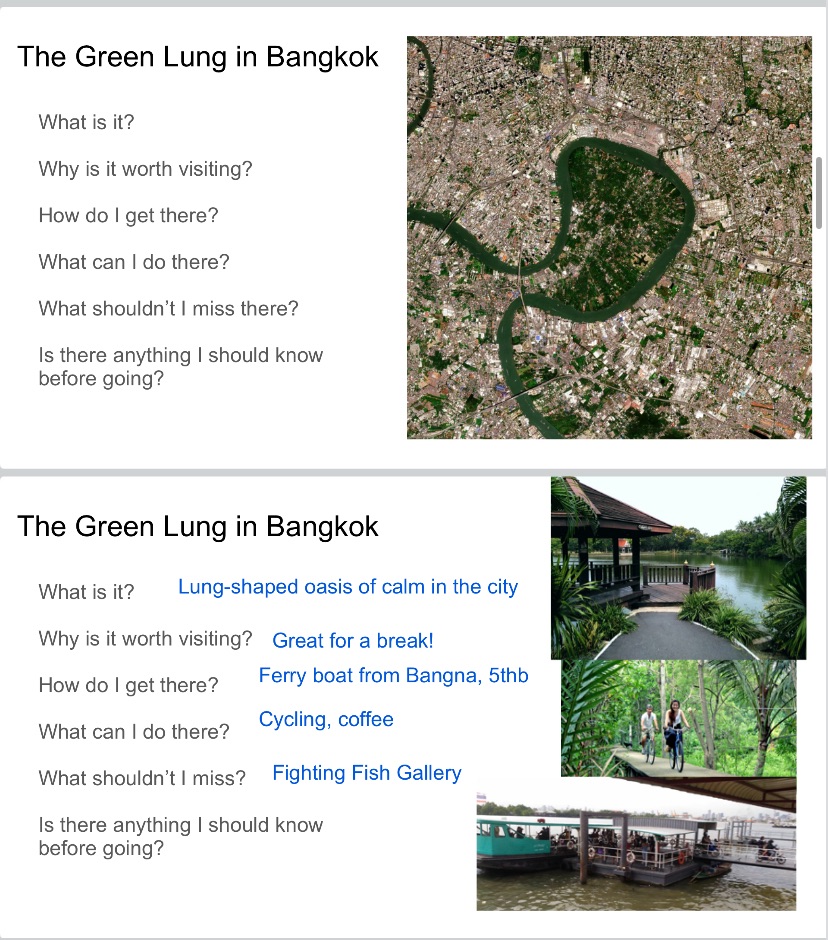
That ‘what shouldn’t I…?’ was a bit of an awkward one, hey? Anyway, the second part was example content for dialogue practice, which was live-modelled.
This all primed for the adapted content:
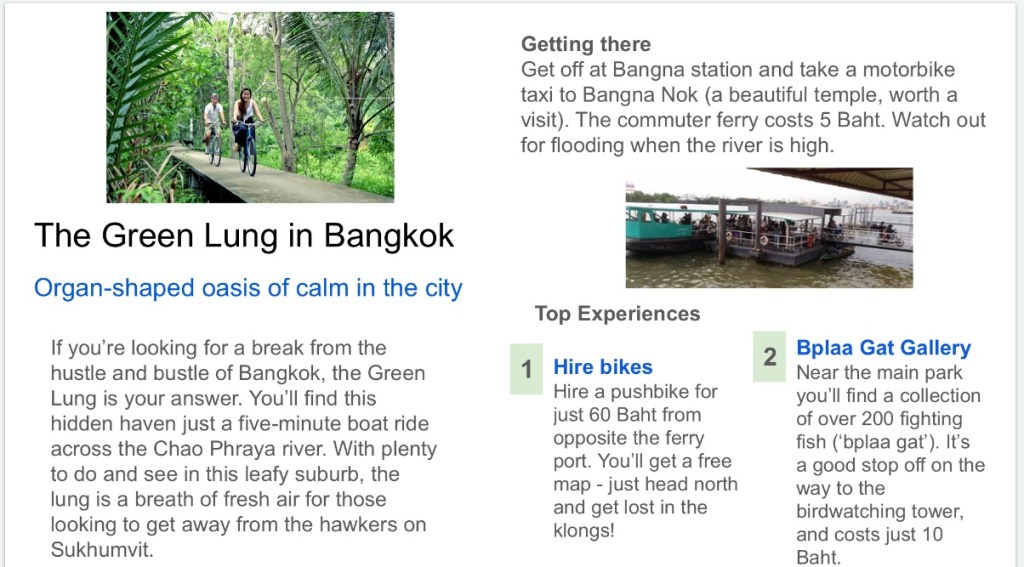
This was my first-page WAGOLL. I purposefully avoided the more factfiley boxes in this model (things like opening times, etc) and went more for target language to use in the body paragraphs. There had already been some pre-teaching of target language, like phrasal verbs, imperatives, etc, so then we identified examples in the Green Lung text. These included:
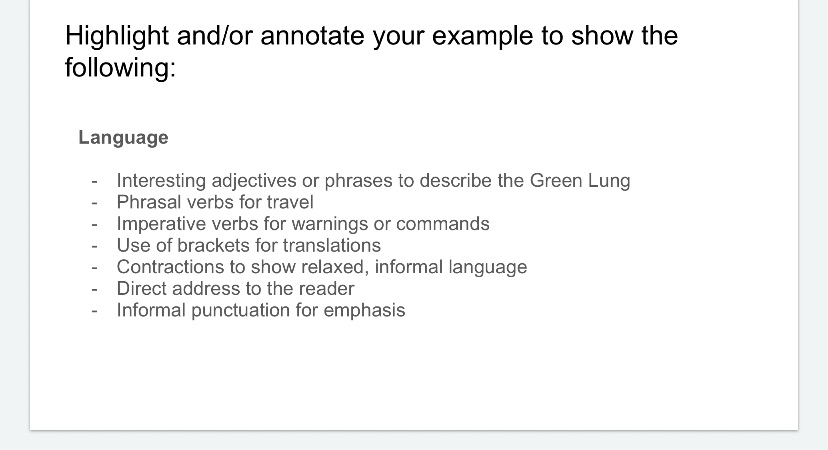
But then also content and structure:
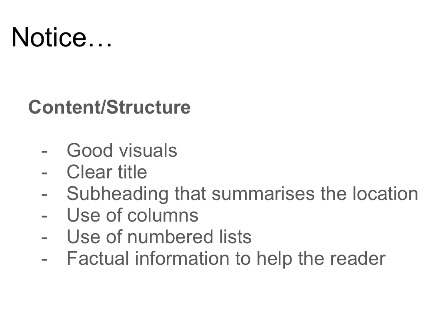
Lots of clear annotation here from the learners. Then we went back to the authentic texts to identify further examples that we may have missed.
We used the same questions about the Green Lung as a talk-for-writing, where learners spoke about their own tourist attraction in Thailand. Then we prepped ideas for language to include in our own guides:
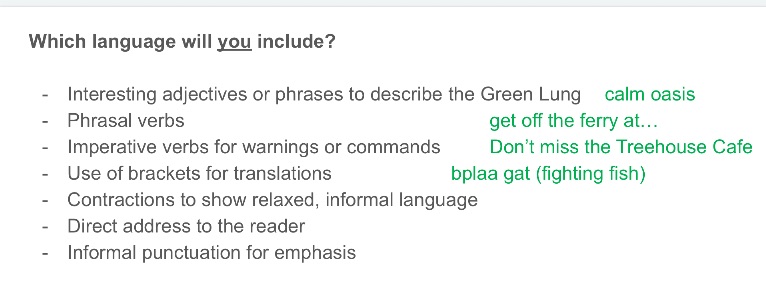
They had an organizer for this. It was good planning for them, but also good for me to check some misconceptions, etc. Then a clearer success criteria provided for the writing task (content and language, although my content criteria focused mostly on structure):
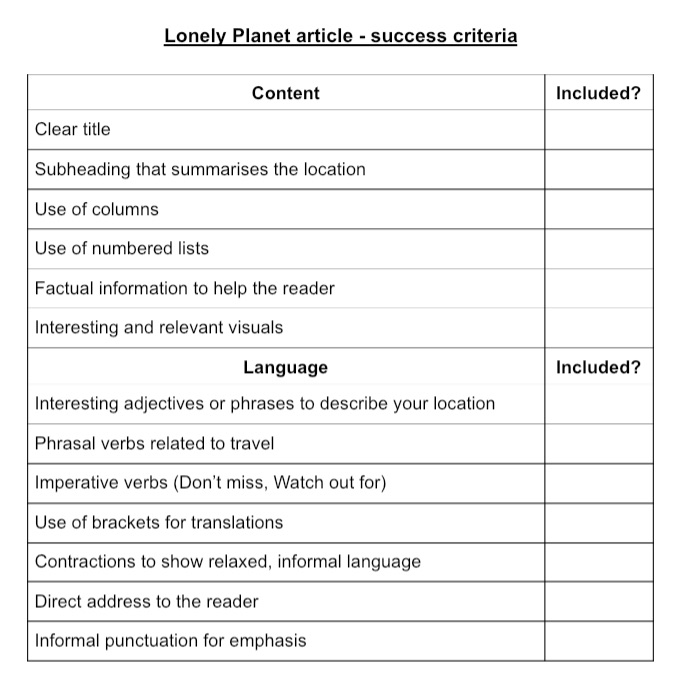
Anyhow, the above approach helped some by making certain language/content criteria a bit clearer. There was more teaching around this along the way – like what constitutes an ‘interesting adjective or phrase’. I spend time adding clarity but then keep ambiguity like that – oops.
This was a peer assessed writing, so providing some clearer language targets helped with that process. I actually felt the content/layout/structure targets were useful for the higher proficiency learners. Some have excellent vocab and vivid description is no challenge, yet writing to a particular layout/structure is more of a challenge for them.
A bit of a rush job on the adaptations – I’d tweak if there were a next time. Still, it served a purpose. I wondered at first about whether learners need some of the terms (phrasal verb, imperative, etc) but provided there’s a clear focus on function (and effect on the reader) then yeah I do think they’re useful. It layers in more features to notice during language analysis tasks, many of which in this case are important for getting the register right.
Categories: General, Lesson Ideas, other, teacher development
 ELT Planning
Leave a comment