
Professional development courses in EAL seem few and far between to me. That’s why I jumped at the chance to take this month-long EAL Coordinator course offered through the Bell Foundation – one of the go-to organizations for EAL CPD. The course ran during my first half-term in a new role as a leader in EAL – perfect timing to get some ideas for developing our department.
So, what was the course like, and how useful was it?
Course Overview
There were three modules over the four weeks.
Module 1 – Exploring themes in EAL coordination.
- It started with admin stuff and GTKY stuff – setting up profiles on the Bell LMS.
- Next, sharing our EAL influences (resources you’ve found useful – websites, blogs, books, etc. The tutor built a resource list based on responses and shared this in the forum).
- Four short, optional tasks: defining plurilingual learners, experiences of plurilingualism, home language maintenance, and a bit on BICS and CALP (or that was the crux of it). Good info/reviews with optional forum discussions.
- ‘Multilingualism, what the research tells us’ (read and respond) task with a good summary doc as a take-home.
- A task focusing on how to develop a school’s wider EAL practice. This began with a quiz on where our school is currently ‘at’ re: integrated (inclusive) EAL provision. The idea of ‘Learning Walks’ was introduced as a suggested way to identify good practice and areas for development. A Padlet was used for participants to share possible areas of focus for a learning walk.
- A video task: listen to EAL Teacher Eowyn Crisfield introducing different models of provision, and some challenges involved in coordinating EAL in general. Make notes ready for a discussion during the next module. See a clip of the video here.
- Final module task: evaluating some examples of EAL school policy docs. This included a downloadable template for us to make our own EAL policy doc.
Most of the content in this module was great, apart from the ‘developing a school’s wider EAL practice’ bit. I found that task a bit loose. There wasn’t a detailed rationale for why learning walks were the go-to approach. It wasn’t relevant to all contexts. The task was in a weird location, because we’d just reviewed some key concepts of provision and now we’re jumping to wider EAL practice of the school, which felt a bit overwhelming.
In contrast, the video task was very worthwhile. It was great to hear Eowyn Crisfield sharing her knowledge and experience, and alot in this short vid resonated with me.
Module 2 – Webinar
The only task in this module was attending a webinar. There were two time slots for webinar – one for Primary and one for Secondary. However, I found there were a lot of Primary EAL peeps participating in my webinar, so not sure what happened there!
The webinar began with breakout rooms for participants to meet and share thoughts on the video from Module 1. That was fun, as we got to know other people’s contexts. I was put in a room with an interesting Primary EAL Coordinator at an international school in Vietnam, plus someone else (Primary) who was following the webinar whilst taking a taxi in Manila. Our group was a contextual mismatch, although the drive through Manila was mildly interesting. My favourite bit was when the coordinator guy started ranting about how senior leaders love to use the phrase ‘we are all teachers of language’ – a soundbite I also love to hate.
After the breakouts, there was a bit of input on types of inclusion (academic, social, linguistic, and attitudinal).I thought that was really interesting and useful. Along with the Module 1 vid, this was probably the highlight of the course for me and the clearest input by far.
There were further breakout rooms afterwards, reflecting on how to implement inclusion types. Again, useful, if a bit less scenic than before because the taxiing participant from the Philippines couldn’t connect.
Module 3 – Implementation project
We had a choice of two activities for our final task on the course:
- Draft an EAL policy for our school
- Create an EAL action plan for inclusion
I went for the latter, because:
- Our school had a fairly fresh EAL policy already
- Writing policy doc is a bit boring
- I had lots of ideas for things to implement at the school inclusion-wise, so the action plan would help gather my thoughts
I started with that sense of ‘tut, gotta do a task to complete this course and I’m really busy, so don’t know how much I can put into this’. However, once I started, I was like ‘ooh this is actually really useful and it’s making me consider things from other perspectives’, so it was a valuable process. In fact, it did help me to work out my priorities moving into the next half-term and beyond. Plus, the feedback from the tutor was both supportive and constructive.
Oh, there was quite a good skills self-assessment doc too:
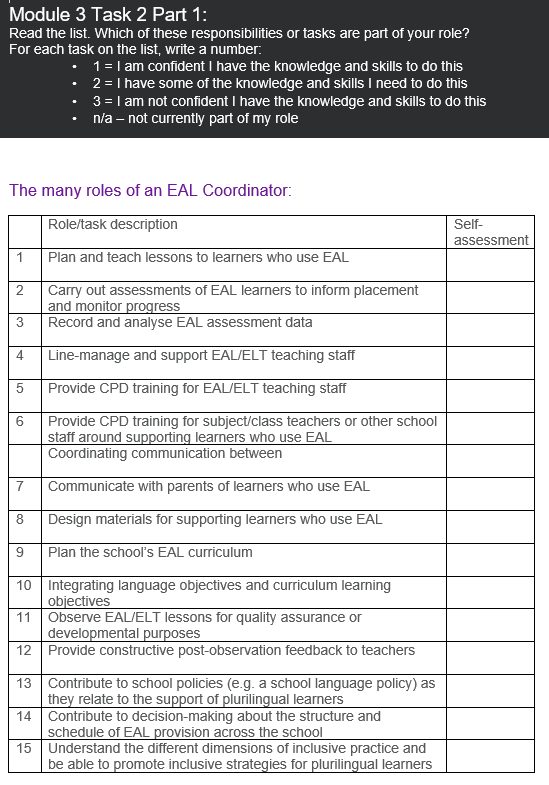
And the chance to put questions to the cohort in a final forum.
Tutors
There were two tutors on the course, Tom Beakes and Jo Thomson. Jo delivered the webinar well and gave useful feedback on the project. Tom responded to forum comments and queries. Both seemed knowledgeable and supportive although I didn’t interact with them a lot myself.
Forums
There were lots of opportunities for discussion throughout the course. They did one of those ‘respond to at least two people’ things to get the discussions going. I’m rubbish in forums – I’m as boring in forums as I am in real life. Still, they did exist for those people with better social skills!
Platform
The learning platform was alright. A bit clunky and annoying to navigate at times. I kept ending up in the forums when I wanted to be in the digital coursebook. The scrolling in the coursebook was a bit faffy. It could have been slicker, but overall it was usable. And as usual, most of the problems were likely down to me rather than the platform itself.
Resources
There were some useful resources shared during the course: policy templates, action plan docs, videos, resource bank, summary of research into multilingual approaches, padlets, etc. Quite a lot when I think about it.
Overall
Worthwhile. Very quick. With three modules (4 hours, 2 hours, 4 hours) spread out over four weeks, I found it manageable. Parts of the course were pretty informative, some of it was breezed over a bit. The final tasks were well chosen – very relevant.
This was my first course through Bell. I expected a tad more depth if I’m honest, but the course helped shape my plans for our department and I certainly took a lot from aspects of it. I’d definitely do further courses with this provider.
Rating: 4.4/5
 ELT Planning
Leave a comment