
I’ve just been through a worthwhile interview process with a school network called ISP (International Schools Partnership). I didn’t get the job, but I enjoyed the experience and learnt a lot about the company (and myself) through it.
ISP network has been on my radar for a while due to their emphasis on multilingualism as an asset. The only other school that seems on par messaging-wise with ISP network here in Bangkok is Shrewsbury, who have Eowyn Crisfield in as a consultant. I’ve now had interviews with both, rejections from both, but positive vibes from both too, so I don’t feel deterred!
The job
The role was for Regional Multilingual Lead for six schools in the ISP network across Thailand and Vietnam. This was kind of above my usual remit, but I was encouraged to apply and invited to interview, so I felt I was in with a chance. I have a kind of quirky professional profile in many ways so I was probably an outside chance. Still, the Grand National winner in 2025 was a 33-1 shot, so…
The interview task
The main interview task was a presentation answering the question: How would you drive home the strategic goal of multilingualism in your context? I was given 6 slides only and no time limit, so naturally I prepared a Pete ramble for an hour. Then, when the interview started, I was told I had 10 minutes. That probably did me a favour, haha.
They provided a role profile to guide the presentation. It included things like needing to build an active community of practice within the region, guiding leaders to align provision with the ISP multilingual pillar, rolling out new tech, etc.
My response
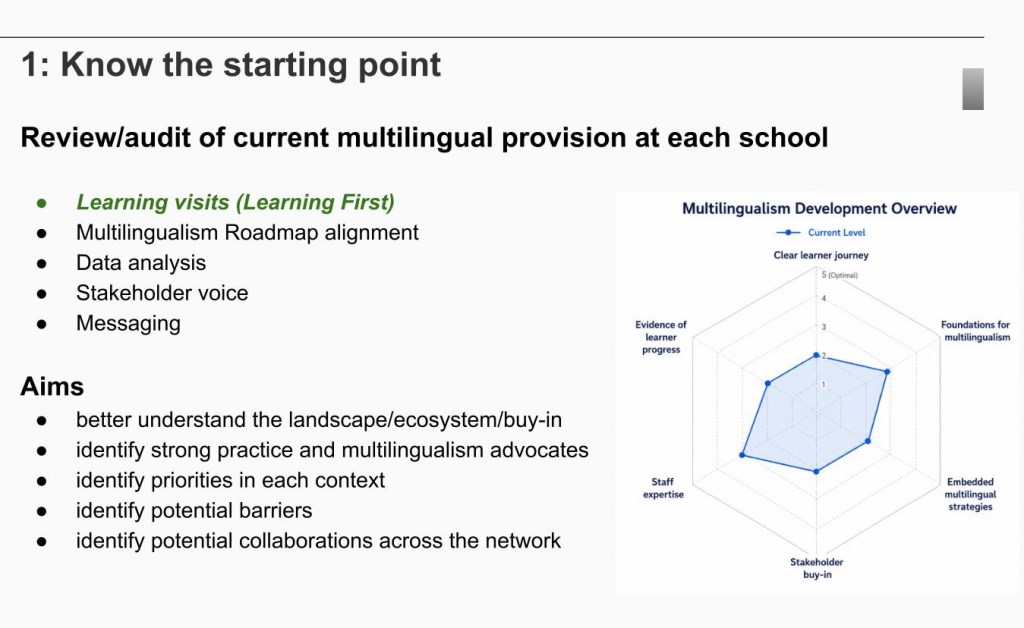
If I had 6 schools in my remit then how would I work out what’s needed at each one? Well, a recce/audit basically. Get into schools, work out where they were at, understand more about the constraints and opportunities, build relationships, identify priorities. The above is basically what I pitched, and said I’d create a detailed report for each school which would include some crap visuals like the example given.
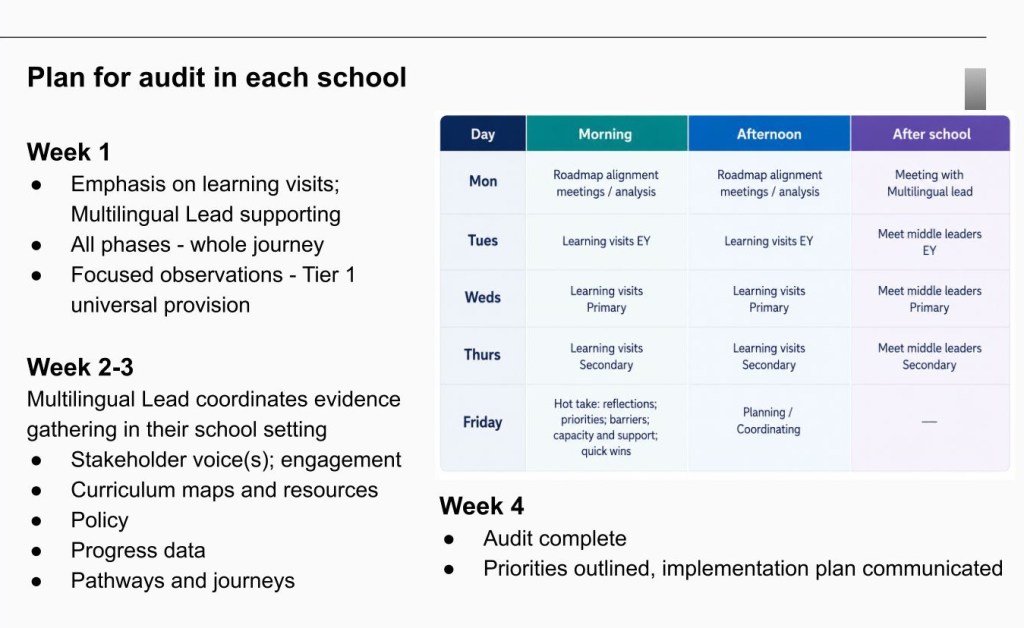
I expanded on that audit process in the next slide. The main things I emphasised were a) evaluate practice at all key stages (don’t miss EY!), b) input from all stakeholders, c) get the in-school teams on board and with a sense of ownership.
By the way, the images in my presentation were AI produced, but with all my own wording. I wanted it to be genuine Pete-worded and not polished AI generated stuff. But, for some reason, it feels almost risky these days to rely on your own wording – I bet AI would have had (digital) kittens if I’d pasted these slides into a chat and asked for honest feedback!
Anyway, my next slide was basically ‘what happens after that audit’:
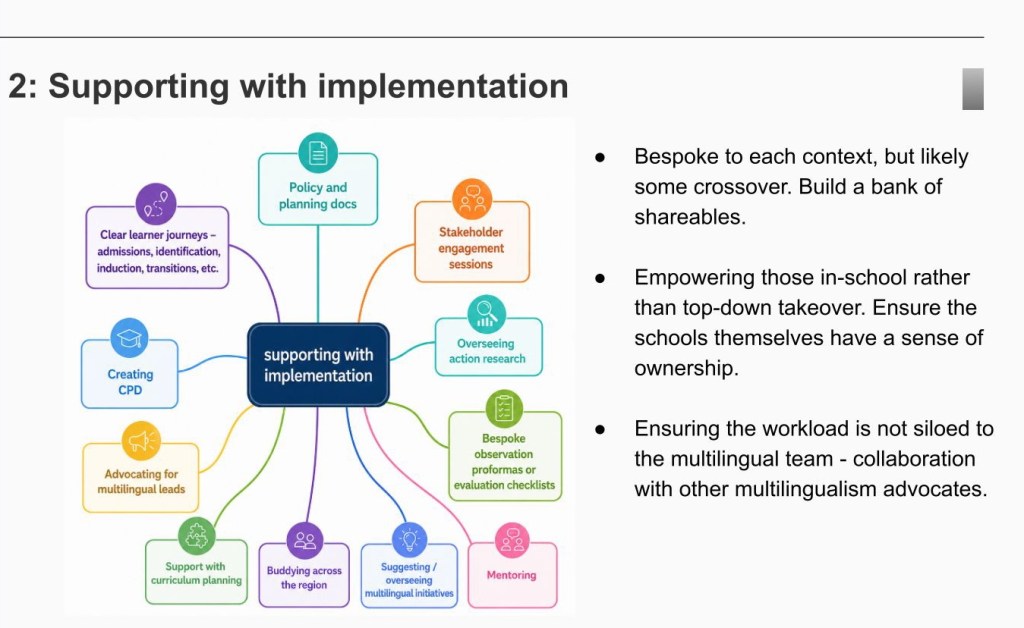
In slight-cop-out-but-genuine fashion, I said ‘a whole number of things depending on the context’, and I listed said possibilities, displayed in an ugly mindmap. I also used the time to reinforce that my approach would be to empower others within the school, facilitate, and actively demote the idea of siloed approaches – make things a genuine whole-school endeavour.
In slide 4, I highlighted how I would build a Community of Practice across the network.
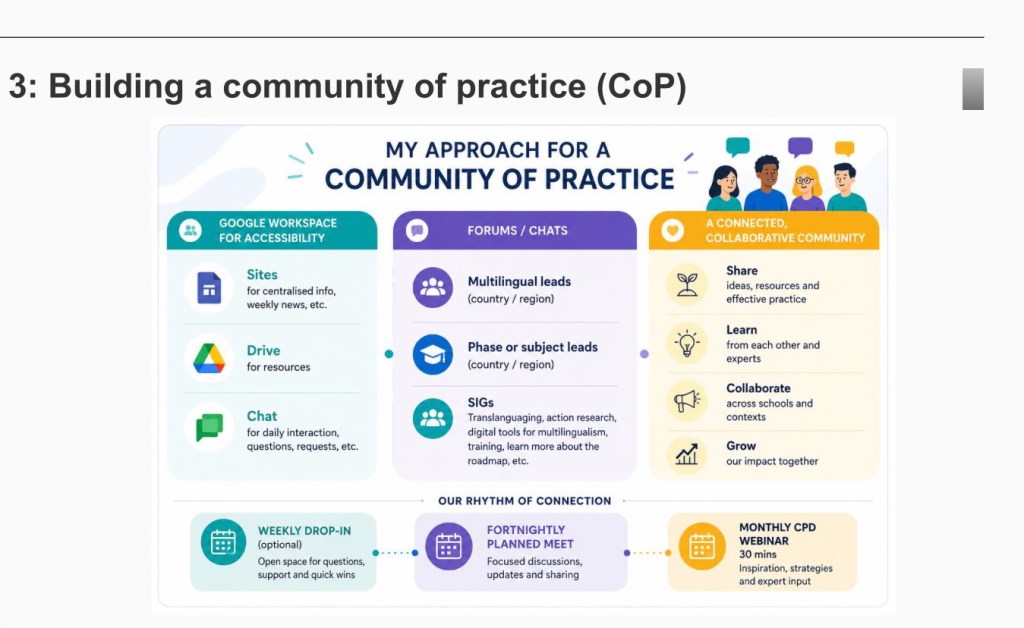
It was my wording, just put into ChatGPT to zhuzh it visually (zhoosh? Djuuush?). Apart from that right-hand column, which ChatGPT freestyled. I kept it because it made sense and looked okay.
I then mentioned some possible initiatives that could be used across the region – things that could help collectively identify the ISP multilingual pillar in each school.
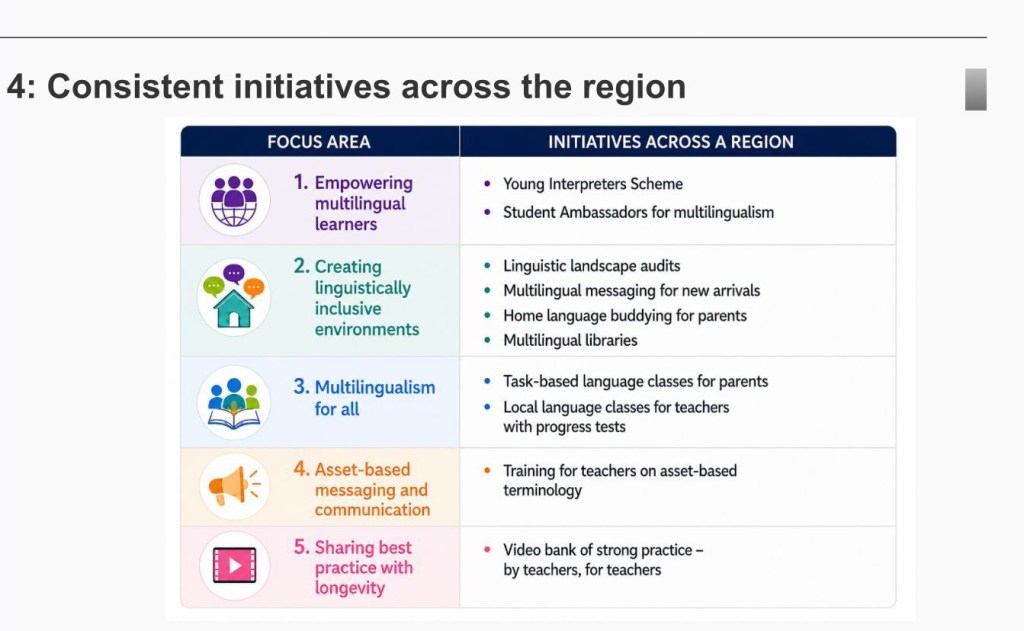
This was one slide I was actually proud of after the AI visual zhuzh. I took some inspiration from my and Adri’s previous book. I felt this slide was important because it emphasised involving all stakeholders in the multilingualism culture shift, and to empower the learners themselves.
Anna Leaman – yes! Your current ‘teach the parents’ vibe got a nod, and I was ready to suggest that ISP collaborate with you. Alas, they didn’t bring that bit up in the post interview chat.
Slides+time were of the essence here, so I opted for one more. I made a visual representation of my skillset to make it clear what I offered and what my areas for development would be.
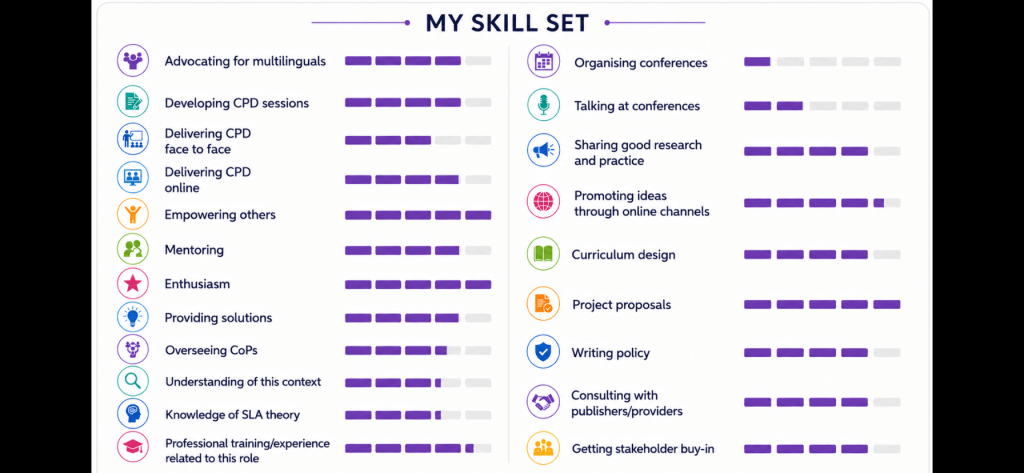
On reflection, I’d have bumped ‘Empowering others’ down to a 4, and bumped ‘Understanding context’ and ‘knowledge of SLA up slightly. Not much. Otherwise, yeah it mostly stands.
My logic for this slide was basically that if I’m expecting honest, vulnerable reflection from school leaders on their current multilingual practice, then I should model that type of reflection myself. I’m probably an idealist there – not too sure how that went down during the interview to be fair!
The rest of the interview
The presentation was a springboard for discussion – stuff on how to engage leaders, getting stakeholder buy-in, etc. There were tricky questions, I rambled, but I don’t think I disgraced myself. I could and probably should have answered one of the questions with ‘I have no idea!’ because the cover up ramble wasn’t my finest. Luckily, a loud fire alarm went off outside my classroom, and by the time it stopped I think the panel had forgotten what their question was anyway.
Verdict
You know what? I had a great time in this interview. I can’t believe I’m saying that about an interview, but I did. I didn’t get the role, but I did much better than expected. It was a huge confidence boost and (two weeks on) an important reset for me when I consider the bigger picture.
Bigger picture
In short, I took on a new teaching role last year but it wasn’t a fit. It also did nothing for my professional confidence, as my line manager didn’t feel I was up to standard. So, I’ve been spending this academic year trying to rediscover ‘professional me’. Trying to work out what I actually want to do, what I’m good at, what I need to work on, and what types of professional people I vibe off.
I’d committed to finishing the year at my school, which was a good move professionally. Eventually, I ‘found my tribe’ of sorts in the workplace, developed my practice once I had the right people around me, and gained some perspective. My narrative shifted a bit from ‘I’m inadequate’ to something like ‘I think I’m alright but I’m just in the wrong place’, and that really helped when searching for a new job. I was getting quite a few interviews, and the process gradually became less ‘eeeek, I need to find work!’ and more ‘I need to find enjoyment and the right fit.’
I mentioned an interview with a school called Shrewsbury. Here’s a summary of how that went. This was a turning point for me in my job search, because it was the first time in ages that I felt able to express my professional identity properly. The feedback was positive, and while I was disappointed I didn’t get the role, I felt like I’d been given a voice and a platform by the leaders in that interview. A bit of self-worth returned, and things went up from there. I found myself with interesting offers – deliver a guest seminar on EAL strategies for the Uni of Sunderland, be a reviewer for a new series of graded readers, write a book for a major educational publisher… And then, getting approached to interview for a role driving multilingual strategy forward across six schools and two countries. Whhhhhaaaaaaat.
Given how the year started, I’d say I’ve come out of this one okay. Jobless, but okay! The Shrewsbury and ISP experiences taken together were great confidence boosts, and showed me that there are definitely places out there where I could fit – in principle at least. I said I have a quirky professional profile and that highlights it – I’d have been a primary EAL specialist in one context and a regional lead for a network in another. But, I reckon I’d have enjoyed both, which is the important thing. Well, that and the impact on the learners of course.
Mind you, you never really know that until you’re doing the job – maybe both roles would have been terrible!
Categories: General, reflections, teacher development


Leave a Reply