
I recently shared an example unit of work from our EAL syllabus. Here some further insight into the long-term and medium-term planning for our syllabus.
We are only in the second year of setting up our provision. Year 1 was all-hands-on-deck for resource planning. Our focus was on creating functional, well-structured, student-facing resources leading to clear outcomes. It wasn’t on writing planning docs. Sure, the two should have gone hand in hand (in an ideal world). But consider this:
⁃ There was me and one other teacher to plan six bespoke units of work from scratch for each year group (KS3 and KS4, but the latter was exam-based so a tad different).
⁃ The other teacher was new to EAL. They needed time to settle in, learn various tools and approaches, build trust in the process… they didn’t need to be stuck at a desk writing planning docs at that stage.
Year 1 was about developing new practices, Year 2 is about consolidating them. It’s time to shore up the planning. New teachers are coming in and I need to leave the dept with clear guidance to work with. Plus, an ISQM accreditation is impending, so we need to make our dept practices/processes clearer.
I shared a parent-facing curriculum overview in this previous post. Our long-term planning doc looks different…
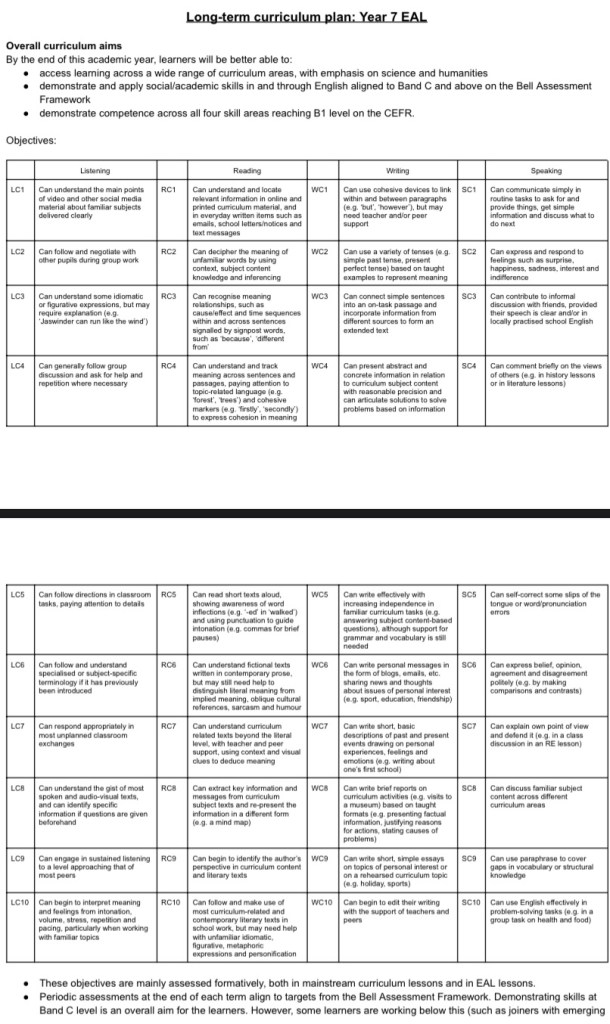
If you’re familiar with the Bell Framework, you’ll see that Band C is shared at the start of our curriculum doc. You may not have seen the framework used in such a way, I get that. It’s meant as a doc for accessing learners in mainstream classes, not for bespoke programmes. And it’s not meant to be a linear tool – you’re likely to teach learners with jagged profiles whose ‘four skills’ vary across the Bands considerably.
However, it’s one of the few EAL-specific assessment frameworks available, and we need a benchmark. We’ve got learners joining us mid-year that are at Band C, learners with us for a while still working towards Band C, and some already beyond it. We built our EAL syllabus at Year 7-9 towards Band C descriptors as a minimum, yet assume (and plan for) support/stretch around that.
Does this display high expectations? Well, on paper maybe not. In practice, given our student demographic and how we stretch and challenge within lessons, yes. Band C gives us a baseline target and a hook for planning.
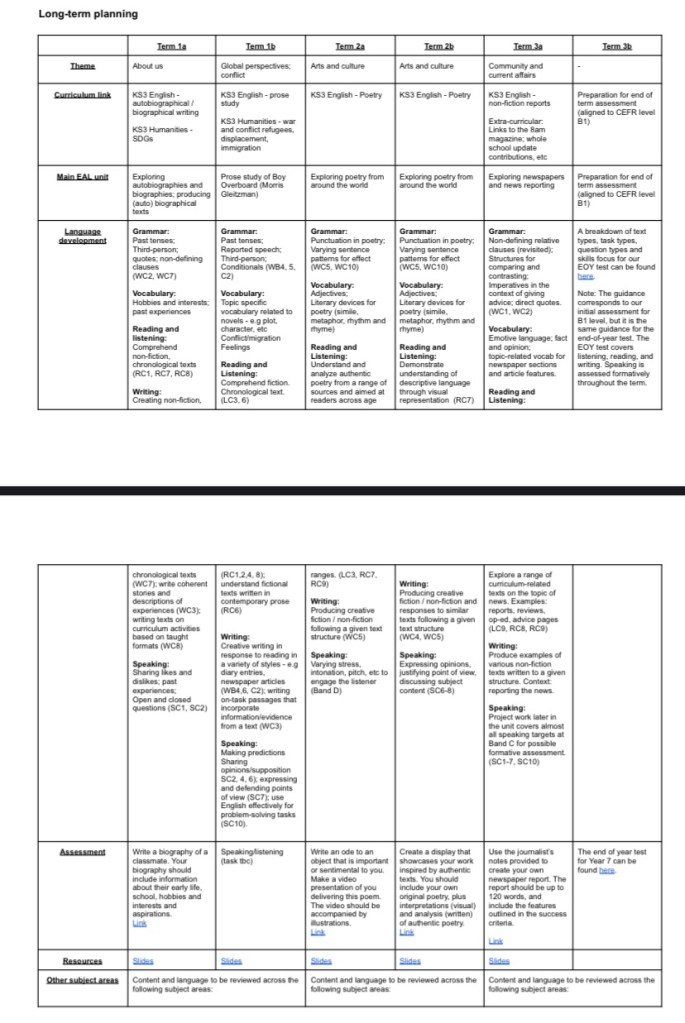
As I’ve mentioned, Bell descriptors and opportunities to assess are weaved into each of our units. During any unit there are opportunities to observe and assess skills related to a whole range of descriptors across Bands B-D. However, there are definitely stand-out descriptors that we focus on in a unit, as there are stand-out foci on grammar and vocabulary.
What’s worth noting from a more ‘ELT’ perspective is that any focus on grammar, and it’s rarely an explicit focus, isn’t ‘leveled’. Our grammar coverage is at the point of need and related to the content taught, it’s not a case of working through certain grammar points associated with certain ‘levels’ of learning. We do level test in a CEFR way at the end of the year just to appease various stakeholders to be honest, but I’m quite forgiving on accuracy when I assess that – and weighted more towards communication, development of ideas, vocabulary, etc.
The long-term plan ends like this…
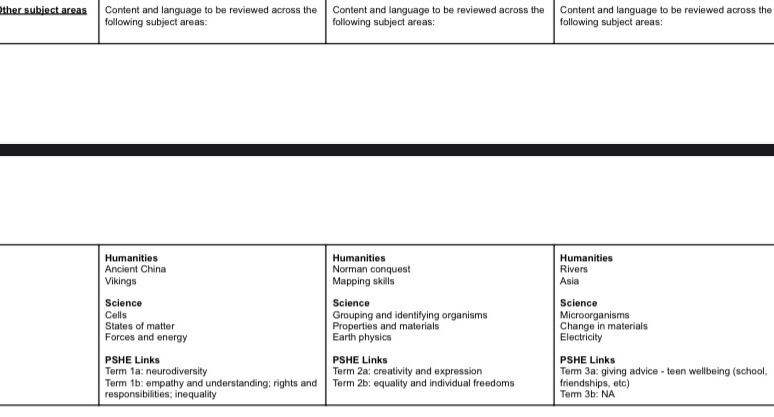
We need to spend time helping learners review subject-specific content. Bell assessment comes into its own then for sure. And, while we don’t have PSHE lessons per se, there are themes that I feel we link to on that front.
What do our medium-term plans look like? We are in the presence of creating our planning docs for each unit. I created two versions of a unit plan for the first unit listed above. The first looks like this:


However, I decided to simplify things a bit. There’s lots of duplicate info (link assessment stuff) that I could just link to instead, and during the process I did start to think ‘Pete, you’re on an 80% timetable as a HoD. How are you going to find time to write 20 or so of these?’ So, I settled on…


I wanted to emphasise ‘tasks’ in the planning. This is because of our department focus:

By listing a main task, I could quickly glance at our planning doc to see the extent to which the tasks covered were ‘real-world’. They didn’t have to be for every lesson/week, but we needed a fair amount of purposeful, meaningful, real-world application of language – not just all pedagogical tasks.
Going back to where we started, the student-facing resources, I mentioned in this post how we then link the Bell targets to that too:

The missing link is now helping learners to better understand the assessment targets.
Oh man. Having written all this down, I’m now thinking that reading about our processes is probably quite boring! HOWEVER, after my last EAL-related post that went blow-by-blow through an EAL unit of work, someone said it was super useful to read. I feel like there are a lot of us that are having to create these bespoke syllabi, accelerated programmes, intensive courses, and so on, that are probably thinking ‘am I alone here?’. So, no, you’re not. And I can happily share our raw processes here to reassure you that we are all trying to work things out in our own way! Haha.
Feel free to get in contact if you’re after ideas for long- and medium-term EALing – me and my colleague Becky would be happy to help.
Categories: General, reflections
 ELT Planning
Hi Pete,
You have explained in quite some detail here – thank you.
Some questions:
How do you settle on topics eg you have chosen Biographies for year 7? Did you collaborate with English subject teachers first and then discuss with others to find out what they were going to be teaching?
Do you have different topics for all year groups regardless of their English proficiency?
Do you have access to teachers yearly plans?
Also, are you on Linkedin? I tried searching but didn’t come up with anything.
Thanks for your help
Sonya
LikeLike
How do you settle on topics eg you have chosen Biographies for year 7?
Did you collaborate with English subject teachers first and then discuss with others to find out what they were going to be teaching?
– Yes, we had access to the plans from mainstream English.
– In the case of biographies though, we followed this as a theme, we did not use the same biographies as in mainstream.
– We chose Greta Thunberg and Malala as two biographies to focus on. Some reasons: vocab around Greta had so crossover to humanities topic (climate change). It was also a route into exploring broader themes such as neurodiversity. Malala was a link to Pashtun, and fed into our next unit on the book Boy Overboard – useful context builder.
– We did focus on autobiography too, as they did in mainstream. For that, we did use Boy (Dahl) as in mainstream
– Our unit needs changing now because they’ve ditched biographies as a full unit right now.
Do you have different topics for all year groups regardless of their English proficiency?
– yes. We could pitch each unit with more/less challenge as needed. Units at Year 8 didn’t necessarily need more challenge language-wise than Year 7 because this depended on learner needs, but different content and themes that suited the learners was what we led with.
Do you have access to teachers yearly plans?
– yes. Very important.
Also, are you on Linkedin? I tried searching but didn’t come up with anything.
Yes! I should be around somewhere on there!
LikeLike