
I’ve been flicking through Jamie Clark’s Teaching One-Pagers recently, and overall I’m a big fan. Evidence-informed summaries of research and practice – informative, accessible, perfect for the staffroom coffee table.
As Oliver Caviglioli points out in the foreword, One-Pagers is a collection of ‘the most relevant, referenced and hotly debated educational texts in recent years’. It is a great curation, and covers lots of ground (especially on learning and memory). That said, I was a tad disappointed to see that research and practice in the field of language acquisition didn’t really feature in this resource. And it could – it so could!
When will evidence-informed language teaching get more of an airing in mainstream books for educators? We are all language teachers apparently (grrrr that soundbite), yet effective language instruction doesn’t seem to get much coverage in books that are designed to help us reflect on our practice, build pedagogical knowledge, and prompt meaningful professional conversations.
This is not meant as a dig at such resources like One-Pagers, Teaching Walkthrus, and so on – I genuinely find them very useful and the authors do a great job. I just really want to see more experts out there have language development on their radar, and find ways to address the growing need for evidence-informed language teaching strategies. It would be nice for resources like these to at least nuance certain key ideas so that they don’t read as catch-alls for every aspect of teaching and learning.
If I’m not making my point clear, here’s an example – and One-Pagers is a scapegoat just because it is at hand…
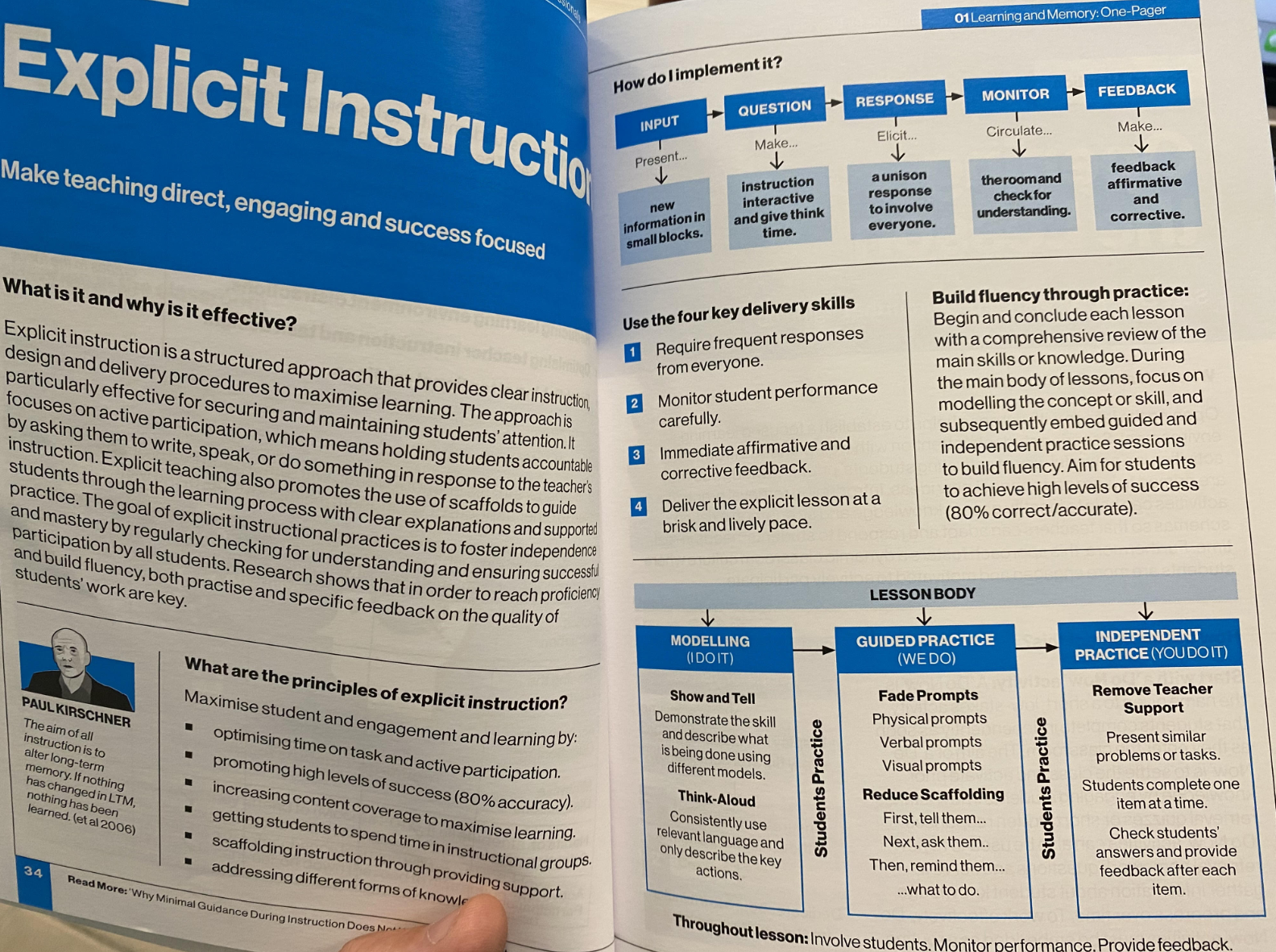
Explicit instruction gets quite a lot of airtime in education these days. It may be effective in certain (maybe many?) contexts and subject areas, and it can be for language instruction too, but with caveats. E.g.
- It is widely accepted that implicit learning is the default mechanism for language acquisition. Explicit instruction should focus on processes that may speed up acquisition, such as consciousness-raising tasks.
- Consciousness-raising does not have to (and many would argue should not) take place in a ‘presentation-practice-production’ style sequence of explicit instruction. Focus-on-form approaches are seen by some as more relevant (at the point of need) and less obtrusive – putting communication first.
- Consciousness-raising tasks may involve input flooding (providing repeated examples of target language in context, in a comprehensible manner, and through both written and spoken texts). This may take time compared to explicit instruction, but it is seen by some as more meaningful and memorable.
- A deductive ‘show and tell’ is only one evidence-informed approach to presenting new content. There are many studies into deductive vs inductive approaches to explicit language instruction which suggest both approaches have merits.
- We need to understand which aspects of language can be explicitly learnt and when this may be possible (teachability/learnability, etc)
My point here is not to pull the idea of explicit instruction apart. It’s just that busy subject teachers dipping in and out of this resource may assume that explicit instruction can be applied effectively to teaching both content and language in their subject area. Alternative (and *also* evidence-informed) approaches to the teaching of language really should be explored in these resources. Otherwise, teachers overapplying some approaches might run the risk of learners’ language development heading in the wrong direction.
Header image: Copyright IMDB
Categories: General, reflections
 ELT Planning
Leave a comment