
Our senior leadership team (SLT) oversee a broad-ranging quality assurance process at our school. Here are some of the processes we have undertaken as a department to reflect on/ensure the quality of EAL provision in our context.
These may seem like standard practice for some other EAL coordinators. For others, you might find an idea here for reflecting on your current provision.
Targets for development
Each department in our school needed a development plan. This had to align (in part) with the school development plan (SDP), showing how the targets filtered down into departmental development. This was easier for us, as quality EAL provision was high on the SDP agenda. I’ve mentioned the specific targets we devised in this previous post, and we have been gathering evidence for how/whether we achieved these targets throughout the year.
Curriculum evaluation
SLT tasked each department with evaluating their taught curriculum, as is standard. How we did this was up to us. At the start of the year, we devised our own EAL curriculum from scratch which a) aligned to certain themes and assessment tasks in mainstream English while b) supporting learners in accessing content across the curriculum. The first iteration of this curriculum would certainly need reviewing!
The process involved noting down pros/cons, suggestions, and actions related to each of our units. We also considered other feedback from student voice, teachers, etc. My EAL colleague Becky was great in this process as she took the lead and was really honest – much better to have that ‘this unit just didn’t work’ type honesty than try and tweak the untweakable!
One thing we established from our curriculum evaluation was how much both us and our learners (based on ‘student voice’ and reflections) valued project or product-based assessments. Examples:
⁃ Our Year 7 Poetry unit ended with learners collating a series of their own original responses and/or poems related to famous poetry. See here.
⁃ Our humanities-aligned unit included an extended project in which learners undertook independent research into responsible consumption around the school.
These curriculum-aligned projects gave us ample opportunity for ongoing assessment and were very task-oriented, often (not always) with a real world focus. More of these needed!
The curriculum evaluation also helped us to decide if/where we can align our curriculum with key texts in English next year (Animal Farm coming up FTW!).
Termly data analysis and summaries
Each term, Heads of Departments (HoDs) complete an analysis of data from learner assessments. The nature of this varies depending on the department. For us in EAL, it involved:
⁃ reviewing learner data from two common assessments each term. Identifying learner progress and, coupled with data from our ongoing (Bell) assessments, identifying learners who may be ready to enter our mainstream English programme.
⁃ Planning for interventions or for changes to our teaching approaches/strategies should learners not be making expected progress
⁃ Collating data on existing learners, new joiners, leavers, and those exiting the EAL programme to inform SLT and others of changes, needs, classfill, and so on.
⁃ Reviewing data from our after-school programme (learners working towards B1) to identify progress, those exiting the programme, etc
⁃ Review progress of our IGCSE ESL learners. Inform SLT regarding learners that have achieved the required level of progress to continue on our ESL pathway, move into first-language English, etc. Share grade predictions.
⁃ Summarise progress, explain anomalies, inform SLT of upcoming challenges or areas to discuss.
I’ll be honest, data analysis is my least favourite process (reducing students to numbers on spreadsheets – blergh). I concede though, it’s necessary at times. And being proactive with this has helped with wider school processes (e.g. timely reminders to produce handover info for English teachers taking on our EAL learners, etc).
Outlining quality EAL teaching and learning principles
I’ve posted before about how we established our teaching and learning principles – see here if interested.
A reminder of our principles (subject to change/evolve):
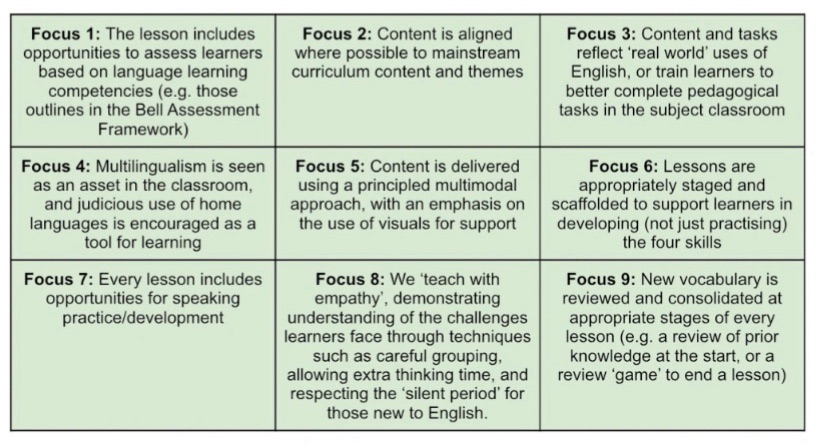
These very much underpin our department practices and the QA process. Throughout the year, we documented evidence of the team working towards these principles. We recorded these on a centralized ‘Quality Assurance’ document that the whole team could access. Evidence was really varied, anything from lesson resources, evidence from observations (peer, SLT), teachmeets, research as part of the CPD cycle, etc.
Review tasks for the quality teaching foci
It was important to keep our teaching and learning principles at the forefront of our practice. Undertaking regular review tasks helped with this.
I devised a series of review tasks relating to our principles. These tasks were meant to be completed by my colleague and I. Some examples (bearing in mind these are from an in-dept process doc so bit rambly):
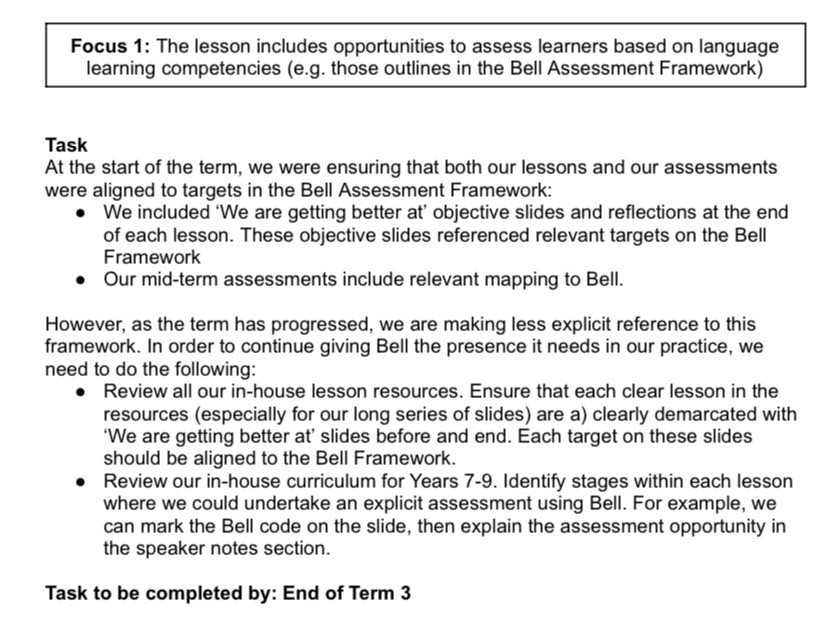
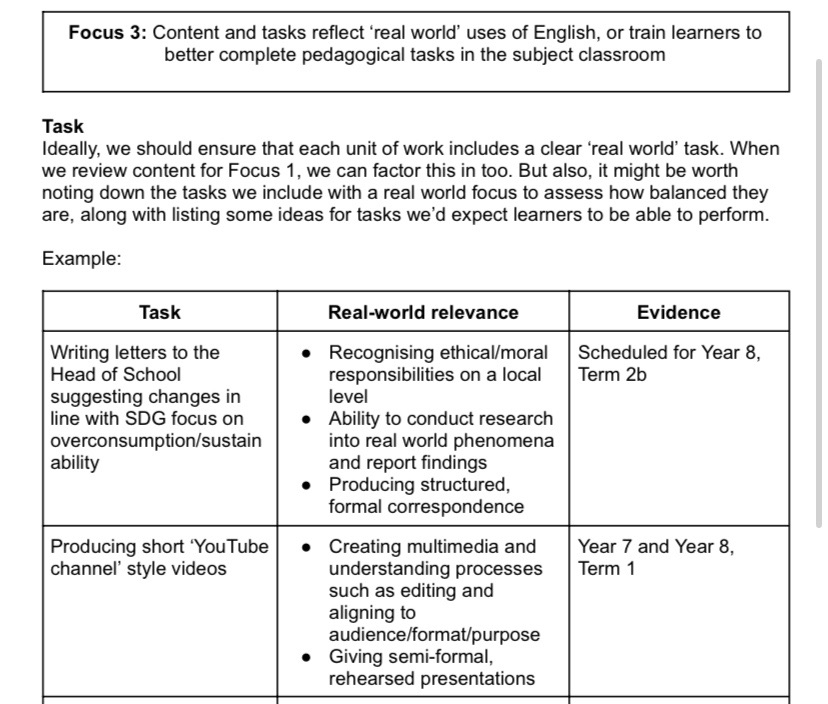
Incidentally, the example for focus 1 there has been pretty good, as it helps us plan for Bell Assessment opportunities alongside using it spontaneously as evidence emerges.
Did we complete all the tasks we outlined? No. Some didn’t feel necessary in the end. Time got away from us with others. Some (such as Task 3 above) were a bit too general in nature, although still prompted useful discussions within the department (had a great one with my colleague Becky on authentic tasks) which ultimately shaped thinking and practice too…
Moderation
Ooooh this was fun! As a new department with so many new assessment practices going on, we needed lots of moderation: using the Bell Framework, common assessments, IGCSE ESL mock speaking assessments, final assessments… We needed to check that we were all singing from the same hymn sheet. I perhaps over formalized this at times for the sake of documentation (although I’ll come to the ‘why’ for that) – the process was much better done as a dialogue without being too formal.
EAL policy updates
Our whole-school EAL policy was devised last year. That was before our Elementary and High School depts were formally established. So, myself and Adri (Head of EAL Elementary) were tasked with reviewing and amending this policy.
I quite like writing EAL policy – not sure why. It feels formal and important – maybe I like to feel important. My inner voice becomes really posh and academic when I write policy, too. Weird.
I did actually enjoy amending the policy. It was an opportunity to better outline some of the progress we’ve made this year, such as making the EAL learner journey much clearer in parts. Our EAL exit checklist (idea adapted from Jackie Wice) has made the transition-to-mainstream process clearer – well, I feel it has at least! I should probably ask SLT/EAL team what they think, to quality assure that. Oops.
Feedback on CPD sessions
As mentioned, quality EAL provision is a big part of our school development plan, so supporting EAL learners was given quite a presence in the CPD programme. I’ve shared examples of our sessions this year (see here, here and here).
It was important that I got feedback on these sessions – how relevant they were to staff, how beneficial for learners, etc. This can be a tricky one to approach. Rather than get feedback from all teachers, who are generally nice people who tend not to offend colleagues that provide CPD opportunities, I did these things:
A) I contacted specific teachers whose voices I really value and asked for their feedback
B) I waited for people to engage. If they found the session thought-provoking, confusing, useful, etc, and the rapport is there, then they’ll get in touch. Less contrived that way. And many did, which was awesome, informative, and led to some good discussions
C) I dropped it into convo in the staff room and just had follow up convos. The science dept are my go-to for such conversations as they offer really constructive feedback
D) I got honest feedback from teachers in the pub afterwards. Wait until the start of the second pint, say ‘sorry to talk shop,’ talk shop, then when teachers have about half a pint left, change the subject.
Overall, I *think*, based on my rather-unscientific-yet-far-less-contrived-than-a-generic-Google-form approach, the CPD was pitched about right and relevant/useful to most. More of the same next year perhaps – practical ideas worked best.
Student voice
Ha, having just been critical of catch-all Google forms, I’m now going to say that this is how we gathered data for our student voice! This approach does have its merits for student feedback for sure.
We wanted to know what students felt about various aspects of our provision. I delegated this to our EAL support teachers, who devised a great feedback form for learners full of statements and Likert scale style responses. I’ll probably share examples down the line. Feedback in general was really positive. It was also clear that we needed to do more to address other subject needs and were going a bit English-subject-focus heavy in Term 2 (when we did the first voice feedback), so that was addressed.
I had grander plans for this – first the form, then a focus group for learners with a member of SLT so feedback was more honest, then implement changes recommended, then further feedback, etc. But we started too late in the year. We will tighten this for next year.
What I felt was lacking was a ‘parent voice’ too. That’s an area for development for this coming year. Teacher voice? Well, we get feedback from teachers a lot, informally, and balanced. They are very willing to help us develop our provision. And they don’t have time for more feedback – the general school pulse survey is enough. SLT? They are quite forthcoming with feedback but it’s about picking your SLT member and your moment wisely. My tactic is usually to rock up and talk to them as they can’t avoid me, but I do tend to forget the feedback that way – I’m going to get the voice notes out next time…
Other
Our weekly department meetings brought up other areas for quality assurance. The fortnightly HoDs meeting brought up more, as there was often some kind of reminder to evaluate *something* – approaches to homework, marking, planning for gain time during exams, drop-in observations, etc.
Documenting the quality assurance process
SLT instructed us to document our QA processes on a given proforma. It had sections on all the main areas: data analysis, observations, department T+L foci, etc. It was a hefty doc which at first I felt pretty meh about if I’m honest. In hindsight, having a centralized doc to refer back to with relevant hyperlinks to follow up on will be really useful moving into next year. So, I take back my initial ‘meh’- the proforma is actually something I’ll use year-on-year as a preference.
It will also be very readable for inspectors, as we aim for accreditation next year. If I were an inspector, I’d be pretty pleased to get a series of department docs that summarise department processes clearly and make areas for development explicit. So yeah, it’s turned out to be a useful doc both internally and externally. And it made collaboration within the department much easier too.
Anyway, I guess they were the main areas of our quality assurance process that stood out. I may have missed some.
What about your QA processes as an EAL coordinator? Is there anything else you do, and is there anything you think we could do better?
If you’d like to know more about how we approached a certain process then just get in touch.
Categories: General, reflections
 ELT Planning
Leave a comment