
Here’s a new regular post, summarizing EAL happenings from social media and beyond. If you followed my previous ‘materials writing news and views’ then it’s basically that but with an EAL twist.
New releases
Joanna Kolota has a new book out: ‘Empowering EAL Learners in Secondary Schools’. See here for the publisher page and here for Amazon link.
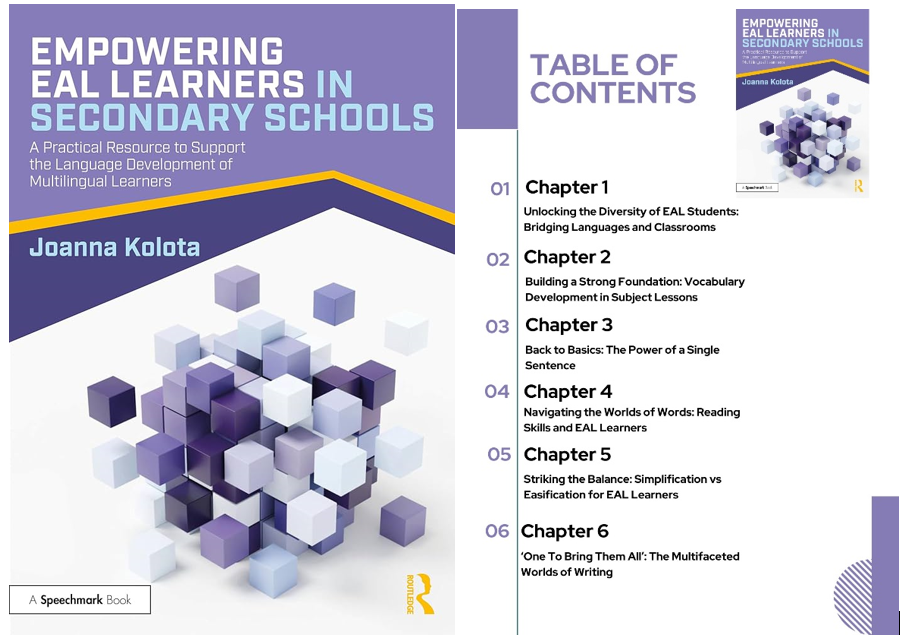
Joanna is gaining a lot of traction on social media (well, I only see X and LinkedIn) with various infographics accompanying the resource. This branding keeps the book on my radar, but I haven’t purchased yet – on the wishlist!
Word on the EAL street is that there could be a second edition of Teaching EAL by Robert Sharples in the pipeline. Watch this space.
What ‘useful’ EAL related books are on the market? One of the publishers out there asked me this question recently (as I’m sure they’ve been asking many others as they are on a market research drive!). Personally, Conteh’s EAL Teaching Book (now in the 3rd edition) and Sharples’ Teaching EAL are probably the two I refer to the most (less so Conteh these days). I know of the Huynh and Skelton book that came out last year which I’ve heard some positives about. Then there’s the ResearchED guide to EAL, the EAL Handbook from EAL Academy, Caroline Scott’s (Learning Village) EAL resource too (here). What others are your go-to reads? How do you rate the ones mentioned?
Bell Resources
The Bell Foundation are bulking out their free resources for teaching EAL. There have been a few promoted recently:
- A KS3 Maths resource on symmetry
- A KS2 Geography resource on Brazil
- A KS2 Maths resource on area and perimeter
The Teacher Notes accompanying these resources are good as they aim to upskill teachers, explaining how/why certain activities are beneficial for multilingual learners. I like that touch – it makes for a chunky download with quite a few pages to work through, but it’s much needed.
EAL Journal
New issue of the EAL Journal is out. Here’s what you’ll find in it:
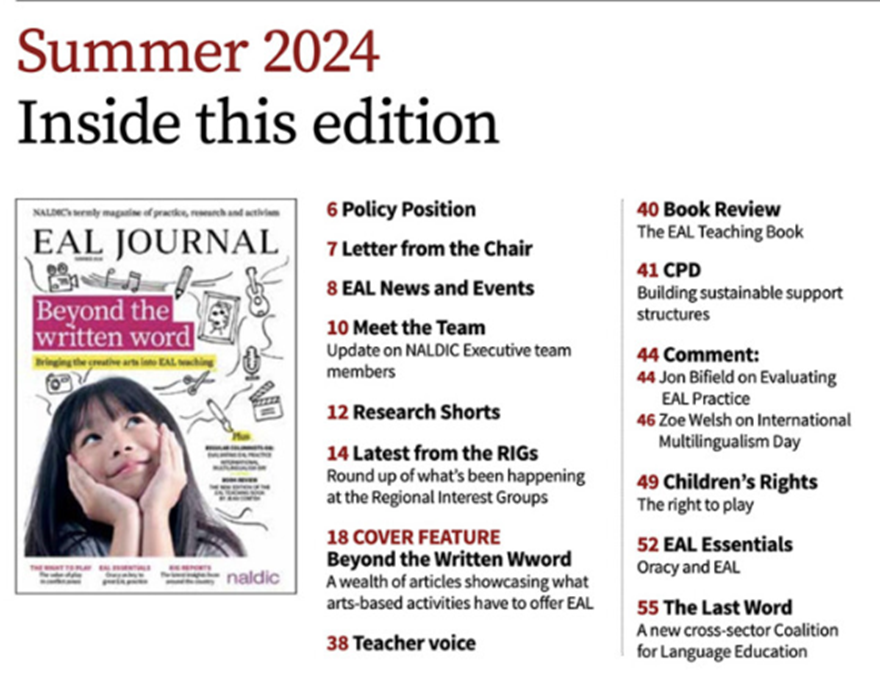
See here for access (members only).
Teacher Talk Radio
Khanh-Duc Kutting has been focusing on EAL practice in international schools on the Morning Break show recently:
‘Literacy in Key Stage 1 EAL – It’s not just phonics work’ (guest: Anna Bejshovcova)
‘Inclusion and why it matters in the EAL classroom’ (guest: Adrienn Szlapak)
‘EAL: What’s it all about?’ (guest: Gemma Donovan)
Dr Sharples’ EAL platform
Dr Robert Sharples has been chatting away with lots of us EALers about creating a learning and development platform for EAL practitioners around the world. A group of us here SE Asia (Tiago, Anna, Adri, me) have been sharing feedback to help get the platform up and running – sounds like it will be an excellent resource for EAL professionals both in the UK and on the international circuit. It’s due to be released this month, and one feature we know will appear is ‘Masterclasses’ – webinars with EAL experts on various areas of practice and provision. Follow Evidence-based EAL on LinkedIn to keep updated.
Eowyn Crisfield’s latest posts
Eowyn is an EAL consultant who has been blog posting a bit this year. I enjoyed the latest one, which was on Tier 3: Intensive EAL provision. It seemed contradictory in parts (e.g. jumping from saying there is no real evidence base yet for withdrawal to mainstream, then outlining what ‘ideal’ withdrawal would look like). Even so, the post ended with some clear guidance:
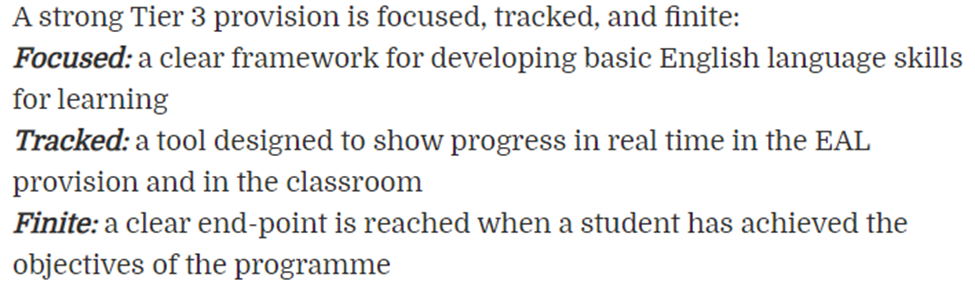
Crisfield’s recent posts are a really good read and often thought-provoking. Check out the latest ones here.
Blog posts
A few good blog posts out there lately:
- Translanguaging as a learning skill? Via EAL Diaries
- How to do disciplinary literacy via Alex Quigley
- In her latest ‘Talking CLIL’ newsletter, Rosie Tanner again shares a free and substantial resource on implementing a CLIL approach. Sure, elements of this older resource may now seem dated (e.g. reference to multiple intelligences), but this is a great resource full of practical techniques that are highly relevant to EAL teaching.
(My recent EAL related takes)
I’ve been going all DogmeELT on EAL at the moment. Here’s a Dogme-related maths activity, and a science-related take too. Here’s a low-prep content review activity as well. For a more substantial rant about CEFR and it’s relevance to EAL, see here. For musings over how to improve the Bell Assessment Framework, see here.
Podcasts
- Talking their Language continues to produce some interesting takes. Seeing as this is the first EAL Digest, I just recommend you look through their back catalogue first (here).
- The TES International Podcast had Chris Woodhams on recently, talking about creating a whole-school approach to EAL provision (here).
Oracy
This isn’t a recent one, but really useful. ‘The development of oracy in school-aged learners’ from Mercer and Dawes (2018). I recently delivered a training session at our school on oracy development, and included this in the follow up reading. A very accessible intro to oracy for new-to-EALers.
Jobs
This may be a tad late now, but EAL Inclusive are hiring. Find out more about EAL Inclusive here.
The TEMC course
I saw that Lexis Education have been advertising the TEMC course recently. There is an upcoming iteration of the course happening in Singapore. This course content looks interesting, and I like the idea that trainees automatically become tutors in their own contexts, so they would be encouraged to share what they learn. That said – wow! The fees were AUD4850 (over 2500 GBP) for the course, totally pricing me out. It also got me thinking – there are 23 total contact hours for the course, with expected self-study taking the course commitment to only around 50 hours. It costs less to complete a DipTESOL, less to get QTS in England via the Assessment Only Route, less to do a CELTA, and you could get plenty of Bell courses for the same price.
I’d still be keen to do the training if I could get part funding from an employer down the line, but that’s one hell of an initial outlay. Fair play to them though – it seems a well-established course. Anyone taken it? Would you recommend it?
Research bites
(In this section I’m not always up-to-date, it’s more about what I’ve been reading lately).
The EAL Coordinator course this academic year (see here for review) put me onto this resource from Evans et al (2020):
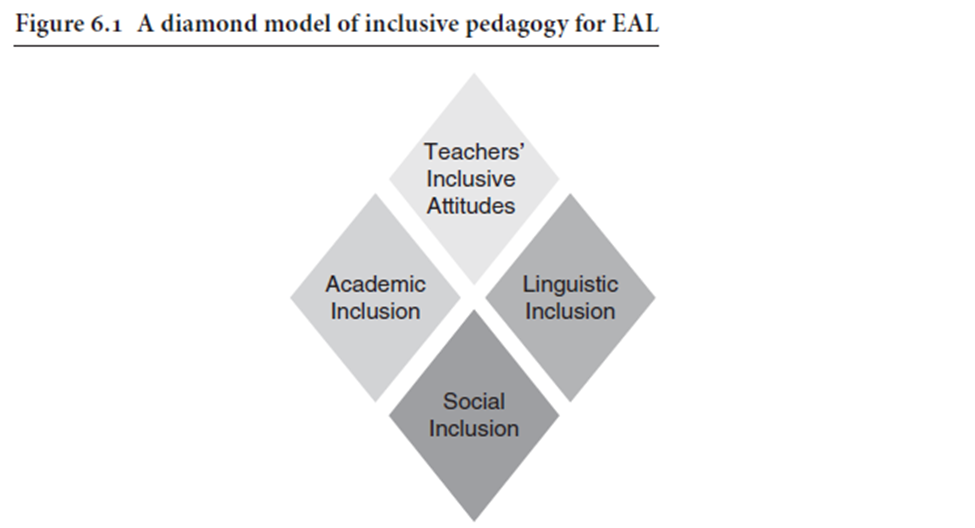
Chapter 6 was the suggested reading from the EAL course: ‘Towards an inclusive pedagogy for EAL in the Multilingual Classroom’. Adri and I mention this quite a bit in our upcoming book, as the diamond model for inclusive pedagogy underpins our approach to the resource in some ways:
My favourite bit in this chapter was when the authors acknowledged the inadequacy of teacher development in various instances (e.g. initial training, continuing development, and learning ‘on the job’), and highlighted the need to develop practice within contextual constraints:
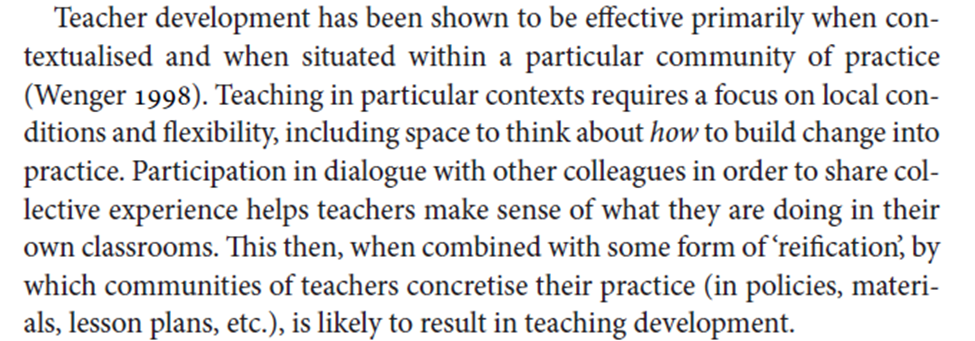
While this may sound obvious, it is perhaps overlooked. Sometimes, the nuance is too much on training only, and less on creating the space for dialogue (e.g. among EAL practitioners and subject teachers) to allow purposeful teacher development to occur. Overall, a worthwhile chapter.
An article I struggled with lately (ish) was Lopez et al (2017): ‘Conceptualizing the Use of Translanguaging in Initial Content Assessments for Newly Arrived Emergent Bilingual Students’ (open access, here). It’s a piece on practically applying translanguaging techniques/approaches for fairer assessments (especially for new-to-English learners), and I’m totally on-board with the overall ethos and approach. I just, for some reason, struggled with the wording:
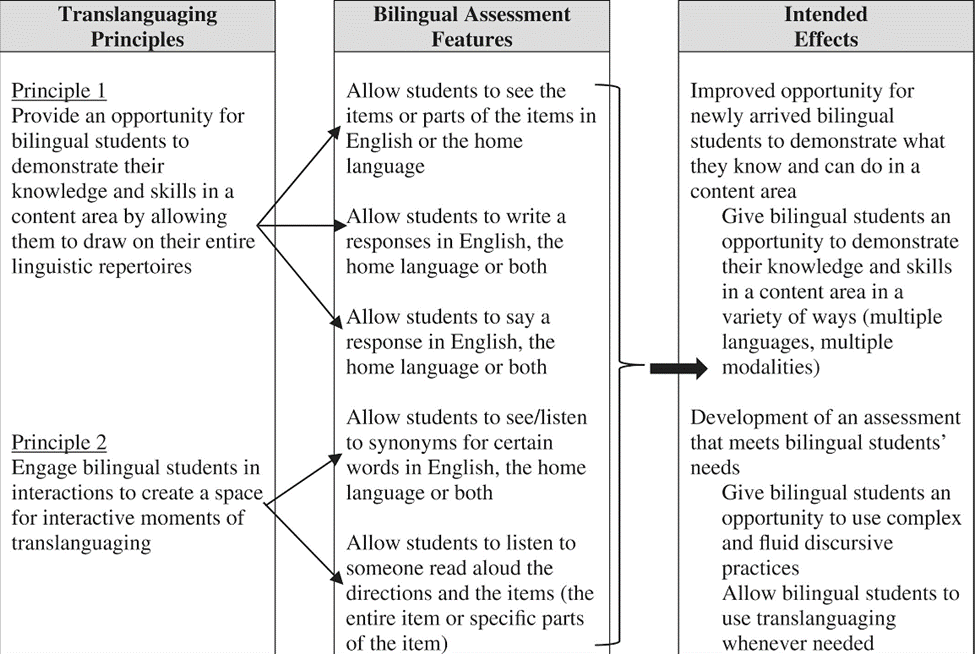
I feel pedantic with this one, but the constant use of the term ‘allow’ with regards to bilingual assessment features seemed a tad problematic. Part of me is like ‘come on, Pete. It’s about assessment, and rules are rules – students are allowed this, or permitted that’. But then I’m also, like, could this wording be more careful? I.e. So it doesn’t read like we as educators have control over the use of home languages here? Can we ‘accept’ (and rephrase), rather than ‘allow’? It’s pedantry, I know. I just think from the perspective of translanguaging as a political stance, and even in the context of assessment, the wording could have been more considered. Ah come on! It’s fiiiiiine as it is. Isn’t it?! Your thoughts are most welcome!
If you only read/view one EAL-related resource this month
It’s the first Digest, so let’s big up an existing resource. Dominic Brassington does loads for the EAL community in general. A while back, he created this really informative thread on how to support EAL learners and their families. It is full of excellent resources, is still updated, and is a must-bookmark.
Image by Gerd Altmann from Pixabay
Categories: General, teacher development
 ELT Planning
Leave a comment