
The assessment for our Year 7 poetry unit was on how Seamus Heaney portrays his relationship with his father in the poem Follower. It didn’t require a super-detailed analysis, mainly recognizing the main themes and the time shift, but some of my more proficient learners would likely delve into the poet’s linguistic choices a bit too.
During the teaching phase, we covered the basics of the poem’s structure, form, and linguistic choices like nautical/farming lexical field, metaphor, imagery. When learners were busy PEE paragraphing about these features, one of my more advanced students huffed ‘I just don’t get this poem at all’. Great feedback, because if they didn’t, I knew I needed to scaffold up!
So, I prepared a review/explore document for the next lesson. Learners completed this in pairs/groups at the own pace, supporting each other, while I monitored and supported certain learners in focus.
We started with some basic checks for understanding, and some prompts for writing a summary paragraph.
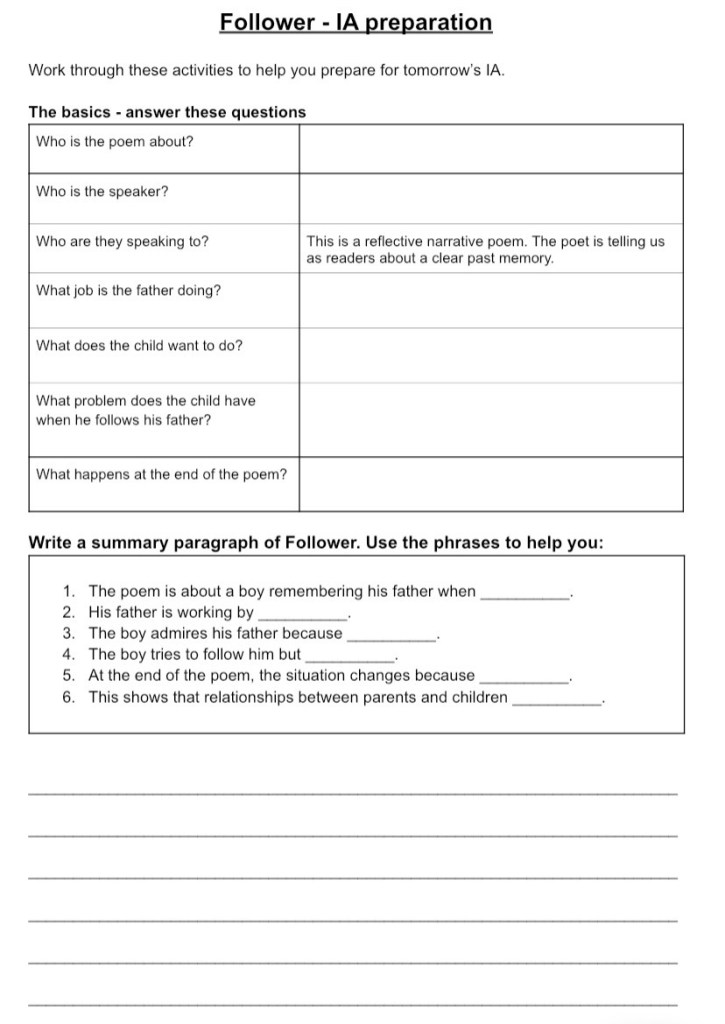
Then a focus on the big themes, providing some ideas to respond to rather than relying solely on learners’ own take. This scaffold definitely helped my ‘I don’t get this’ learner and prompted a good discussion between us:
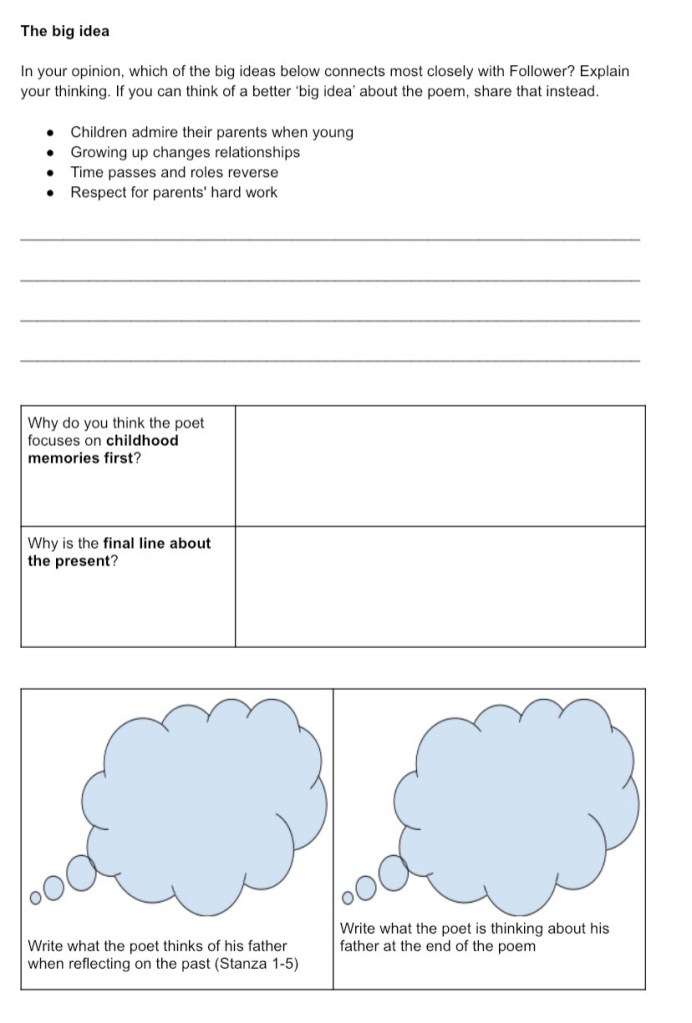
Sometimes, I think it just helps to present the poets thoughts in a different form (like the ‘inner voice’ bit here). It can help the emotions jump out at you!
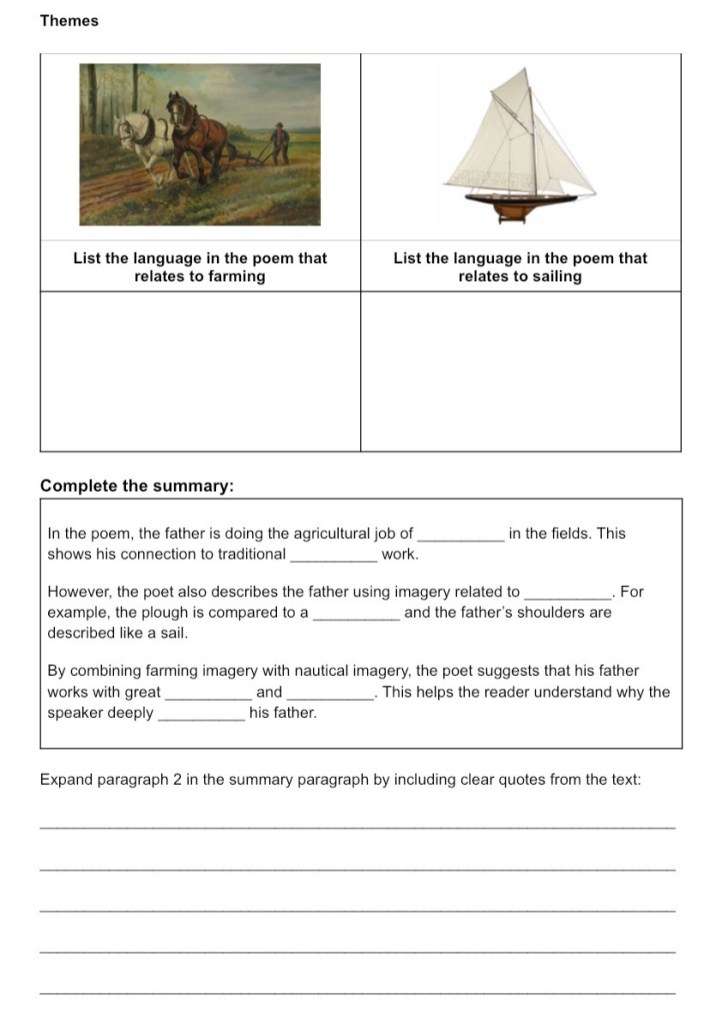
Then we reviewed one of the main linguistic choices – the nautical/farming lexical fields used throughout the poem. Learners had annotated their poems with examples this already, but had struggled to make a clear point regarding the poet’s purpose there. I scaffolded a bit for that, then prompted learners to find evidence from the text:
Some of my advanced learners were going to fly through this early bit, so I added some further drill-down to linguistic choices for them. I added ideas that didn’t necessarily relate to our assessment question, and then asked learners which of the poetic techniques they felt would be most relevant to include…
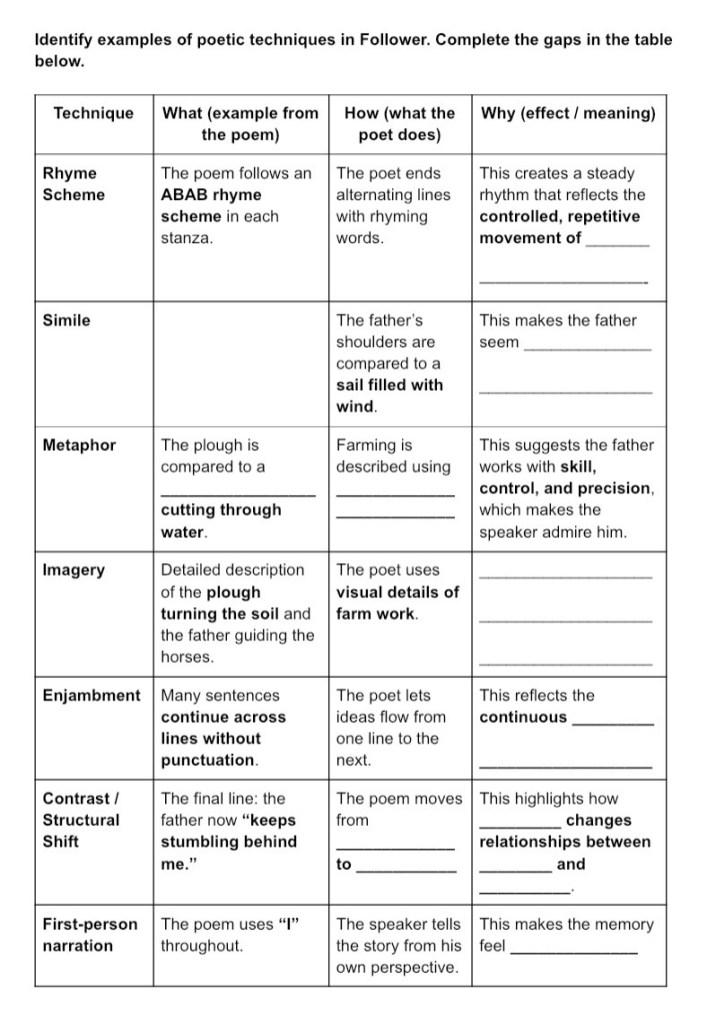
And a chance to shape ideas more independently for some.
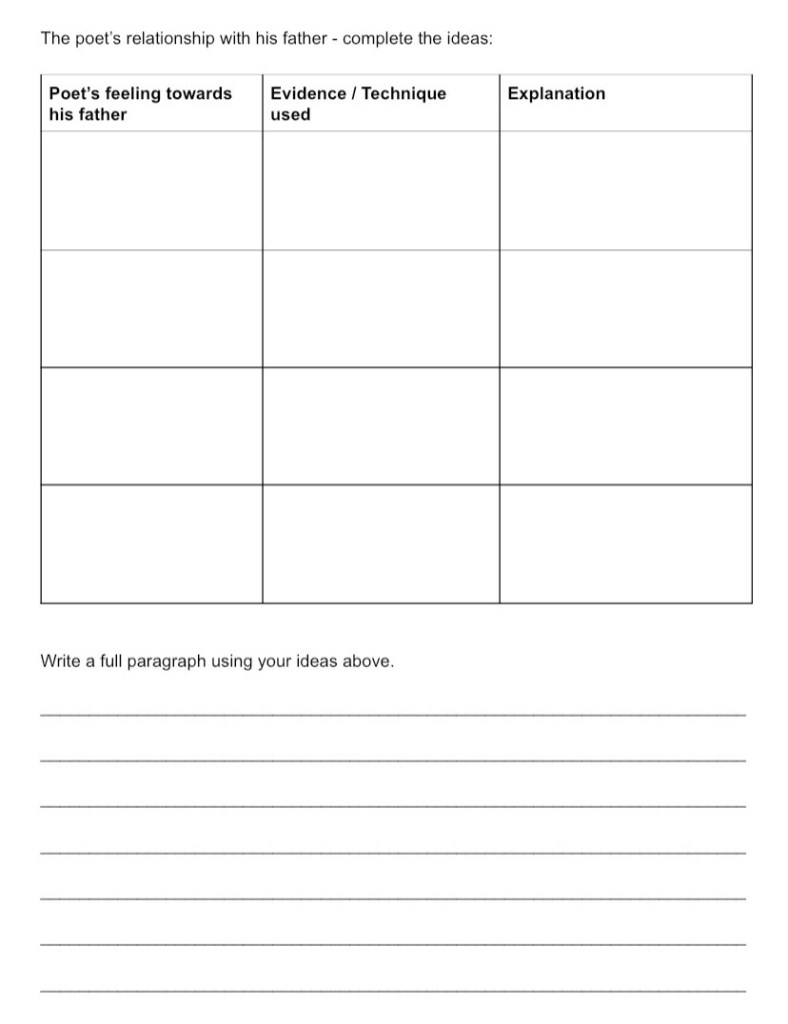
Overall, this pre-assessment scaffold moved most learners forward I think. The more advanced learners were still challenged and could skip bits, and those that were developing/consolidating seemed to have a better grasp of the overall theme/big idea. Time well spent.
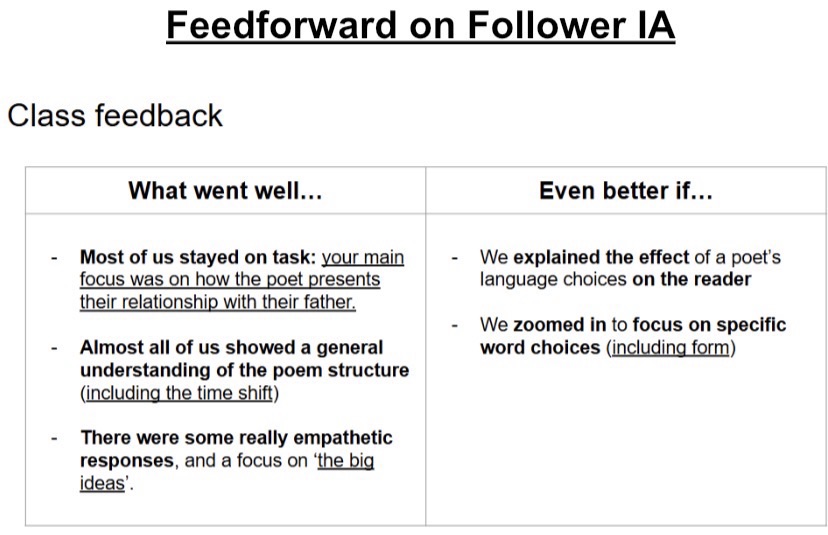
And it showed in their assessments. I felt confident that nearly all learners grasped the poet’s message, and many shared their personal response to this. I liked that we went from a ‘what’s this all about?’ and a slight ‘meh’ regarding the poem overall, to a ‘this guy has lost perspective – how can he be so impatient with his own father?’ type responses. I have a few learners that were capable of that anyway, and they delved deeper into the poetic techniques used and their effect. But I identified a definite +1 there for everyone – the way the poet plays with grammatical form.
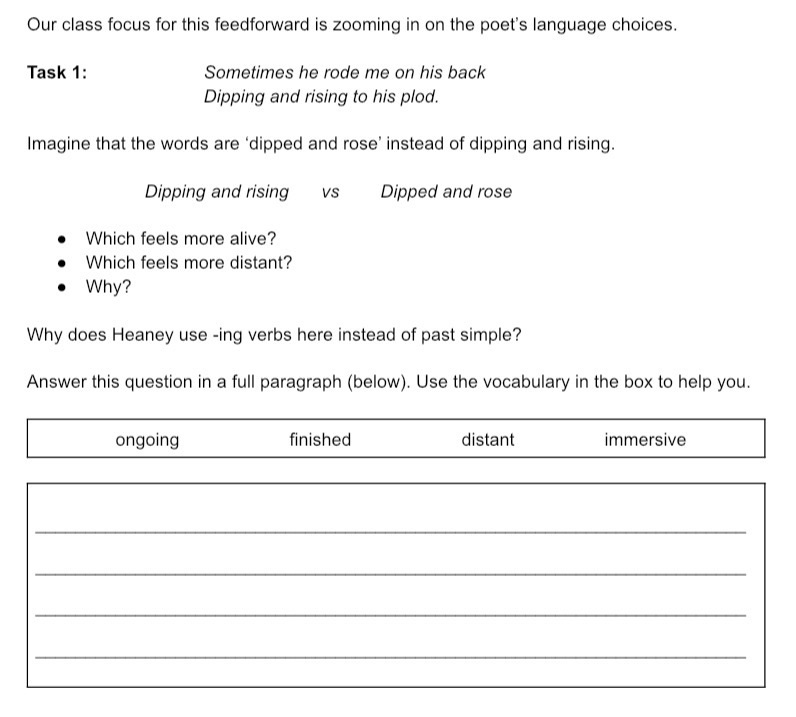
This was a good chance to tap into the more languagey side of things that I’ve been trying to raise awareness of in my mainstream classes. They are generally good at identifying broader techniques (simile, metaphor, repetition), but less so when it comes to subtleties like a change in tense, a short sentence, etc. The main feedforward task focused on Heaney’s use of -ing forms to bring his past experiences to life, putting readers in that moment alongside him:
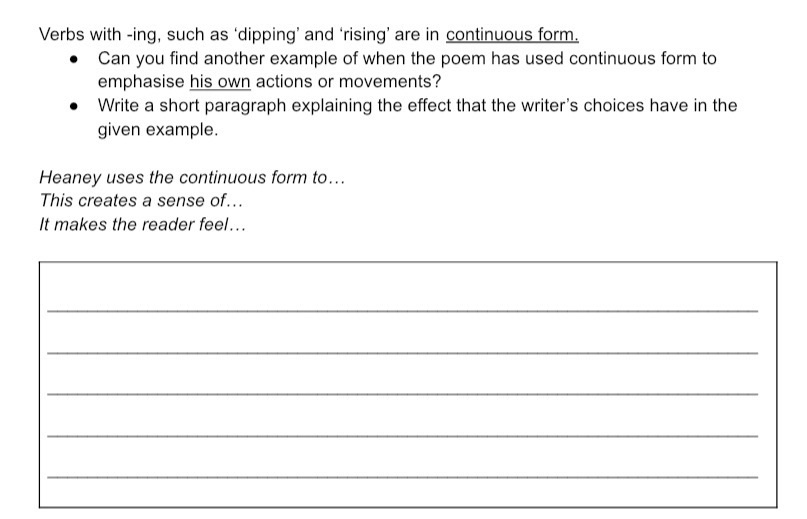
And having learners identify how he does this elsewhere in the poem:
Aside from the +1, there were a couple of things our learners could have tightened up. The first was being more concise. They tended to repeat their ideas a lot when discussing a poetic technique and it’s effect, so we tried to make this a bit more efficient:
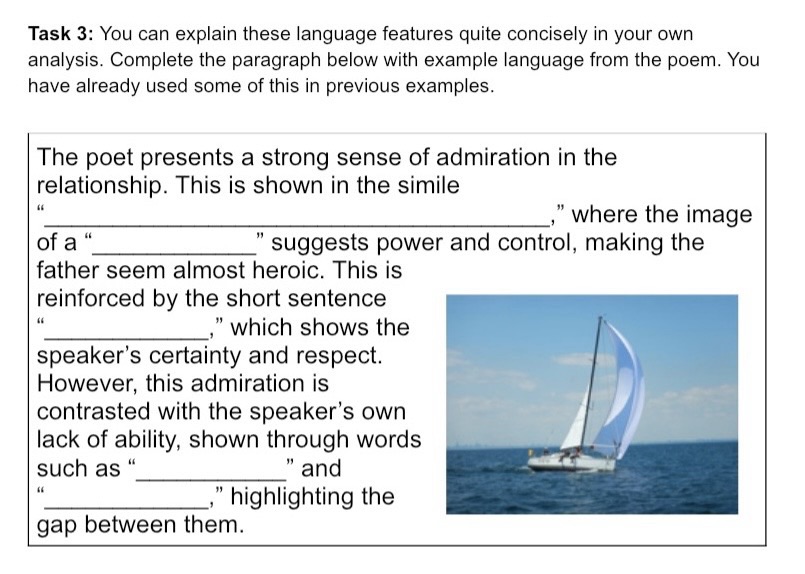
And only some of the students went beyond our analysis as a class to identify further themes and poetic choices. Two students really did – one focused on the theme of masculinity and the other on a lexical field of instability. I thought one student’s idea was great (her name is Nita) so I tapped into it for the feedforward:
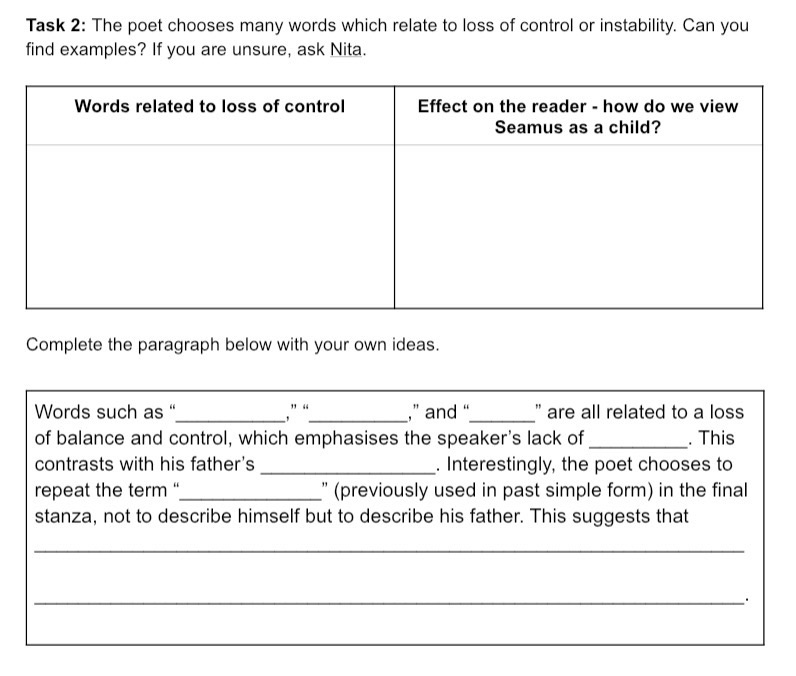
After this, each learner had their own feedforward task to focus on too – rewriting a paragraph, SPaG, etc.
Teaching takeaways from the unit:
- I scaffolded a lot, so the assessment wasn’t so independent. As the unit stood, the learners were expected to do a lot more analysis on their own – maybe I should have had higher expectations
- ‘Higher expectations with appropriate support’ though – they were finding things a challenge. And it’s Year 7, I mean, I felt this was a tough poem…
- I’d rather they gain confidence now and feel like they CAN access these tricky texts and can enjoy them too, rather than keep that ‘I don’t get this’ feeling.
- Serious content, huh? When I was in Year 7 I think we studied Peter Dixon’s ‘Morris – King of the Toilets’. Haha. How times change.
Categories: General, reflections, teacher development
 ELT Planning
Leave a comment