
I’m using more coursebooks in my current practice than I have done in a long time. This has put the importance of coursebook evaluation on my radar again.
Coursebooks and EAL
Adopting coursebook-driven ELT curricula in EAL contexts wouldn’t be my preference – at least not in place of mainstream English lessons or for bespoke pull-out support. However, it is a thing in some schools.
I know of contexts in which general English books like NGL Life take learners through CEFR levels year on year. Others contexts where the Prepare! series takes learners lock-step through the Cambridge Exam Suite. My own context, in which Cambridge Global English is used at Year 9 as a primer for IGCSE ESL.
Some schools opt for more curriculum-connected coursebooks, which *may* be more suited to EAL contexts. Examples include NGL Lift or Cambridge Checkpoint (which a teacher in Malaysia swore by!). Even so, ‘curriculum-connected’ is not fully curriculum-aligned, so may not meet immediate learner needs head on. To do that, you probably need to create bespoke provision rather than follow pre-packaged resources.
But let’s not argue the toss over the efficacy of coursebook-driven EAL/ESL practice in international schools. Let’s say that, for whatever reason, you’ve chosen to build an EAL course of study around coursebooks. How would you know which one to choose?
Creating a coursebook evaluation checklist
Naturally, the most important question to ask when designing learning is ‘what do learners need to be able to do?’ Start by listing the exact needs of your learners in the context:
- Learners need to develop academic language across a range of subject areas
- Learners need to develop strategies which help them quickly get the gist of complex texts (such as those encountered in, say, a humanities class)
- Etc
Then list ways in which the pedagogical approach/resources used should support the learners in meeting those needs. Call upon your experience and knowledge of iSLA to help:
- Academic vocab development: coverage of academic vocab linked to relevant key stage or level; contextualised examples; new language introduced in chunks/collocations where possible; regular reviews; recycling/spiralled approach
- Etc
Remember, you’ve opted for a coursebook anyway. Therefore, consider some of the typical approaches used in such resources, and what might optimize the use of such a resource for both teachers and learners. Call on your experience for that! I’d start with your pet peeves
- coursebooks often opt for a PPP approach to grammar. If we have to go down that route then I’d prefer a resource which offers at least semi-controlled and freer practice activities to accompany new grammar input – not one that’s leaving me without any natural(ish) purpose for using new language
- I hope there’s a minimal prep burden. I don’t wanna spend too long adapting every unit
- I hope the real-world contexts have some local or regional relevance, and that there’s fair representation. I hate it when things are too Eurocentric…
So, then you’ll end up addressing learner needs, ‘principled’ iSLA but within your constraints, and layer in some desirables based on experience. Ideally, your whole EAL team will have been involved in creating the checklist too, so it’s not just a *you* thing.
This is the type of thing you might end up with:
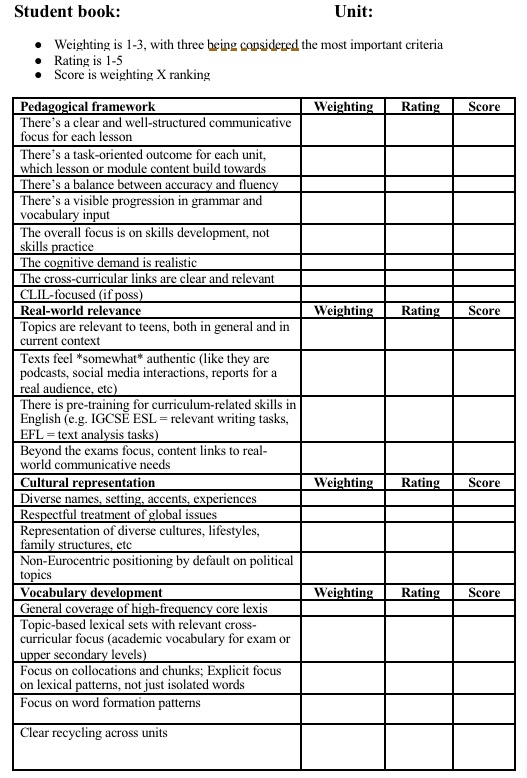
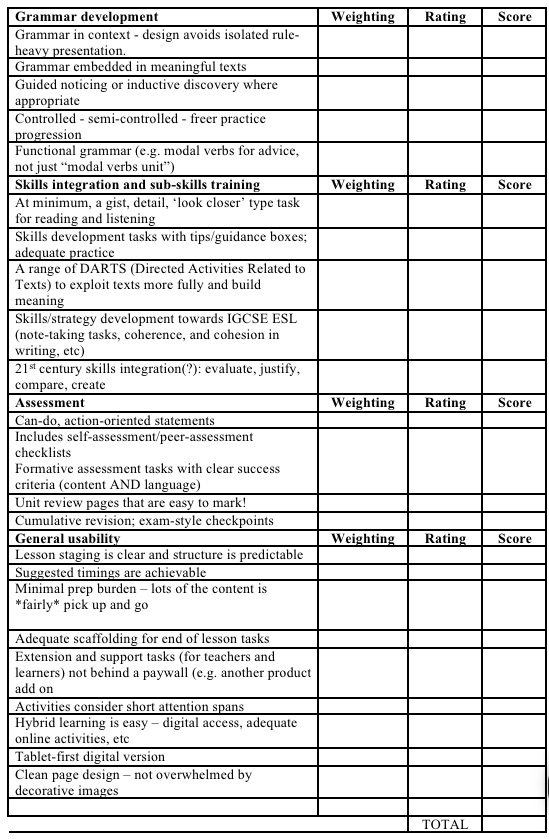
It’s one of my old evaluation checklists but with a few add-ins – just an example of what I mean, not meant for use.
Using your checklist for evaluation
Gather potential coursebooks, one copy of each will suffice. Just contact the publisher for sample copies rather than buy them – they’ll deffo send you one out if they know you’re considering using it for a whole programme.
Get each member of your team to evaluate a unit of each coursebook using the checklist. Collate the findings, and *then* decide which resource would work best.
Evaluation by all
You’ve involved your whole team in this evaluation process – what about your learners? Could you get a student voice on the resource too? Worth considering, as they’re the ones who’ll be gaining from it week-in-week-out. Well, potentially gaining from it.
Why bother with such a rigorous process like this?
Because choosing which coursebook to use can’t be a flippant process. That’s not good for the learners, especially when coursebook-driven EAL may well have its limitations anyway.
A further reason to be more systematic when it comes to coursebook selection is that it’s in the interests of your school. Without processes like this, you could be leaving your EAL provision open to scrutiny.
There are plenty of audits/inspections at international schools: ISQM, BSO, COBIS, etc. They are valuable quality assurance marks, and many look for some kind of alignment to/‘best practice’ in delivering the English National Curriculum. Updates to state-funded inspection criteria in England (Ofsted) get factored into current inspections, and the latest changes show that EAL is finally on the radar!
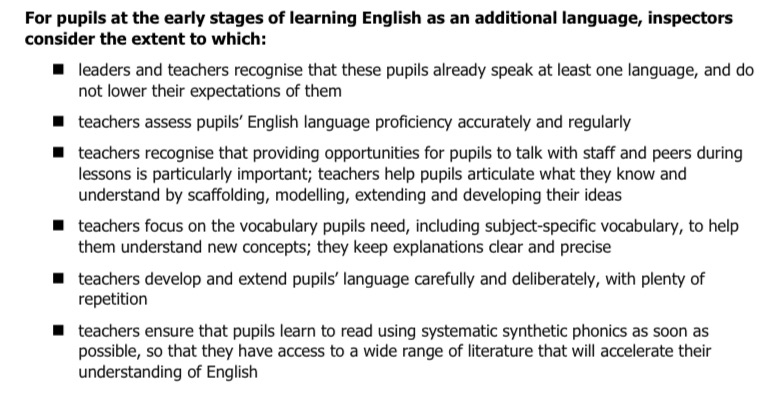
(New Ofsted guidance, thanks Rob Sharples for highlighting)
This may be small progress, but it could be a sign that EAL and ESL provision in international schools is set to be assessed more in upcoming inspections.
Imagine that’s the case.
- How confident would you be in outlining the rationale for using your current coursebook?
- How confident are you that your team would articulate that rationale in the same way?
- How confident are you that there are not better alternatives out there?
- What tangible evidence do you have to prove that?
If you’d struggle to answer those questions, maybe it’s time to evaluate your current curriculum choices. That doesnt necessarily mean ditching the coursebook, but it does mean knowing exactly why you’re using it.
Categories: General, reflections, teacher development
 ELT Planning
Leave a comment