
A few months back, I wrote about the CEFR and the benefits of reading the Companion Volume.
Similarly, the Bell Assessment Framework also has a companion doc – a ‘Guide for International Users’. It’s a concise and accessible resource. Well worth a read.
Here’s a summary of points made in the Bell guide, and their possible implications for EAL provision in our school. My take is subjective – would love to hear your views.
Part 1: Key principles underpinning EAL assessment
Unique learner profiles
I love the opening section of the guide. It highlights that use of the framework is nuanced given the unique profile of EAL learners. The list below (directly from the guide) outlines some factors which should be considered when assessing/supporting EAL learners’ English language development in international contexts:

By forefronting this info, it feels like the authors are guiding us to build more effective learner profiles in order to better apply the tool – but they don’t state that explicitly.
Implications for our school
We don’t do enough in our context to gather info on the prior knowledge and experience of our EAL learners. For example, we could:
- give new joiners some kind of curriculum-related prior knowledge check on entry – one that is accessible (i.e. in their home language maybe)
- create a survey for learners and parents to gather more details on background and prior educational experiences
- learn more about the content of curricula that learners have previously encountered, and map whether it aligns to content in our curriculum at the same grade level
- Not work on assumptions that learners are first-language literate, digitally literate, etc.
The guidance reminds us that being proactive in building learner profiles is essential for effective teaching/assessment.
Part 2: Key features of the Bell Foundation’s EAL Assessment
How was the assessment framework constructed?
At the start of Part 2, there’s a summary of how the Bell Framework was constructed. Here is about half the info in it:

It left me wondering who those 50 teachers were, where they were based, their level of experience, and so on. I’m also wondering whether about 59 judgements per descriptor (there are 200 descriptors) is enough, and whether this process is inclusive of both the primary and secondary assessment tools. This section made me interested in digging out the original research into how the tool was constructed, as I’ve never read it.
Implications for our school
None specifically. Just that the assessment tool we use *may not* have been designed for international contexts. Does that mean we should adapt it? I’ll come to that!
Addressing misconceptions about the tool
This visual from the guide makes it clear that the Bell Bands are not emphasizing lockstep progression through band descriptors.
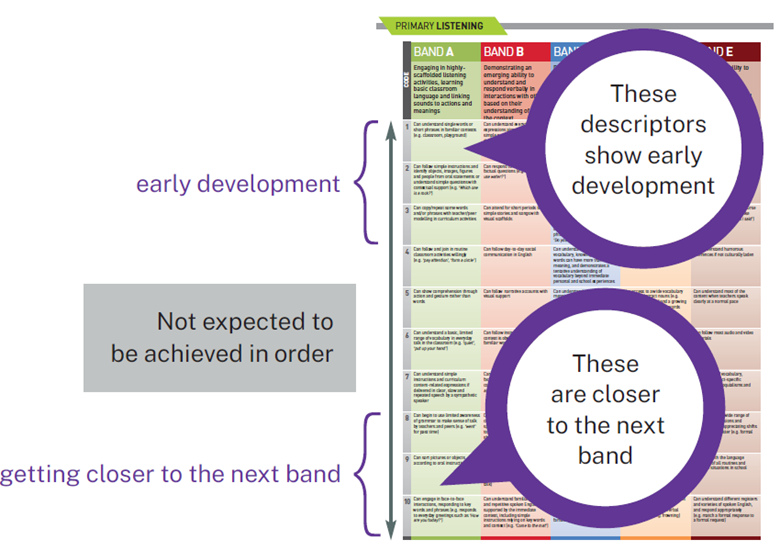
There’s no expectation that descriptors across skills will be demonstrated in a regular order or sequence. We’d expect a jagged profile of learner skills, therefore users of the tool should broaden the scope of their assessments to look beyond a single band.
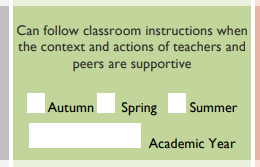
The descriptors below for listening are two bands apart (Band A, Band C), and I wouldn’t say it’s a stretch of the imagination for a learner to demonstrate evidence of both in one learning sequence -yet be ‘at’ a Band A/B overall.

This reminder is useful when using the assessment tool for planning purposes. We don’t need to create opportunities for learners to demonstrate certain skills before moving onto others. Instead, we can lead with a relevant, real-world task, and gather evidence of our learners demonstrating descriptors across bands as they emerge. Ramble over – the assessment doesn’t drive the learning.
This reminder is also relevant for onboarding processes – ensuring parents understand the nature of this assessment tool and don’t assume their child should be moving from demonstrating Descriptor Speaking C1, to C2, to C3, etc.
Implications for our school
- Better onboarding for parents, clearer expectations and clarifying misconceptions
- Be clear about the non-linear nature of descriptors when introducing subject teachers to the Bell Framework.
Bell on teaching and assessment
The section on ‘English as Communication’ has some quotable bits!
‘…Rather than focusing on the attainment of idealized native speaker competence, the Framework tracks linguistic progression in relation to two broad aspects of language communication: social interaction and curricular learning…’
Here, the authors seem to hint at failings of other tools, and emphasise that Bell attempts to assess both BICS and CALP. I wouldn’t have said Bell is particularly unique with regards to addressing social interaction and curricular learning – the CEFR was linked to certain curriculum areas before Bell was launched. It does attempt to be applicable across a whole curriculum though.
‘In both domains language is seen as a tool for cognitive and social purposes. Consequently, the need for opportunities for English language use by the students in relation to these purposes, rather than just studying it as a curriculum subject in its own right, is paramount.’
So, a strong focus on authentic application – classroom learning as a bridge to real-world use. Following on from that, and acknowledgement that certain approaches are not befitting of EMI context:
…learners must have opportunities for using English for communicative purposes rather than exclusively in language practice drills and grammar exercise work.
It’s interesting that this guide is specifically for users of the tool in international (school) contexts. They must have felt the need to address certain misconceptions – I wonder where their original research into the international school market was conducted.
Implications for our school
The Bell assessment tool is designed for use in subject classroom, yet we are also using it formatively within our bespoke syllabus for EAL learners. We need to avoid going down too much of a non-curriculum-aligned-language-practice-drill-and-kill type route, as it would lack relevance and make the Bell assessment tool redundant in our context. Something to keep in mind when planning our new intensive programme.
The tool is meant to be adapted
There’s some discussion about how the descriptors might be interpreted differently in certain contexts, or how certain descriptors may not be evidenced in the same way. Example:

The guide suggests that adaptation is required in such contexts.
Implications for our school
Well, I’ve long wanted to adapt some of the descriptors. I guess we kinda do adapt them, but we just haven’t formalized it. I think it would be worthwhile reviewing the Bell Framework as a team to evaluate the following:
- How relevant is each descriptor to our learners in our context?
- Can less relevant descriptors be adapted?
- How can we quality assure the adaptations we make?
Part 3: Purposes of EAL Assessment
The main point from this section is summed up in this quote:
‘… it is very important that EAL assessment is closely matched to the range of language uses embedded in all school activities’ (underlining added by me!)
This reminds us that the framework is a tool for use in subject classrooms AND in the school context as a whole. The latter is easy to neglect, but our observations and records of learner progress need to be based on interactions outside of classtime too – during break, during ECAs, etc. If we come back the BICS and CALP coverage from before, it’s important to ensure that we’re going beyond assessing only one of these aspects in just one context.
Implications for our school
Could we do more to informally assess our learners’ during social activities around the school? It’s not easy and may happen incidentally, but it should be on our radar at least. Basically, don’t make it all about classroom learning.
Part 4: Recommendations for formative assessment practice
Here is Part 4 in its entirety:

Two things stand out for me. Firstly, encompassing uses of digital technology. I find it hard to assess what has been produced independently when learners use their devices for writing tasks. It’s also hard to assess how well they can navigate digital interfaces in English, as they usually have those set up in another language. Not saying that should change, it’s just an observation.
Secondly, the importance of using cultural references to support learners in accessing English. You can read a bit about how we do that here.
Implications for our school
I try to embed cultural references relevant to learners in our syllabus and assessments. I feel like, while I wouldn’t say it’s a strength, this is something we have tried to address. Digital technology though… Can we find reliable ways to assess independent writing or other skills using tech?
Part 5: Issues for schools based professional development
This is actually a super useful section for EAL leaders. It summarises three areas of focus for school PD related to assessment. These are:
- Teacher assessment literacy
- Recognition and uses of students’ multilingualism: there are recommendation that teachers undertake action-research into home language use in the classroom, translanguaging pedagogy, and so on
- Content and language integration
There is suggested reading on each topic, and this would be a good go-to for leaders looking to direct their team to research.
Implications for our school
In order for teachers in our context to develop assessment literacy, we should give them a thorough, contextually relevant into to the Bell Assessment Framework and how to use it.
So, that’s my take on the Bell guide and what it means in my context. How about you? Do the same sections of the guidance resonate with you, or is there something else you find useful/intriguing/etc?
Categories: General, reflections
 ELT Planning
Leave a comment