
Last term, Heads of Department (‘HoDs’) in our school were given an interesting task! We were instructed to work with our teams to devise a list of criteria for ‘what makes an outstanding [subject] lesson?’ These criteria would then help guide various department processes: planning, drop-in observations, in-dept CPD, etc.
This was a collaborative way to ‘quality assure’ teaching and learning within each subject context. It was particularly useful for our new EAL department, as it was a good opportunity for us to define a big part of our identity.
How did we set about establishing our ‘outstanding’ practices?
I felt that the question of ‘what makes an outstanding [EAL] lesson?’ needed adapting. Firstly, the word ‘outstanding’ sucks. Quality assurance? Okay, fine – necessary. Ofsted jargon? Limited buy-in from me straightaway. Plus… it’s EAL, so I don’t really think in ‘lessons’. Even if I did, there’s a danger that making criteria for a successful lesson could become a performative checklist. I left the British Council for a reason…
So, I told the team that we would define ‘What makes quality EAL teaching?’. Note: not ‘quality provision’ – that’s much more broad-ranging, and I’ll come to that in a later post.
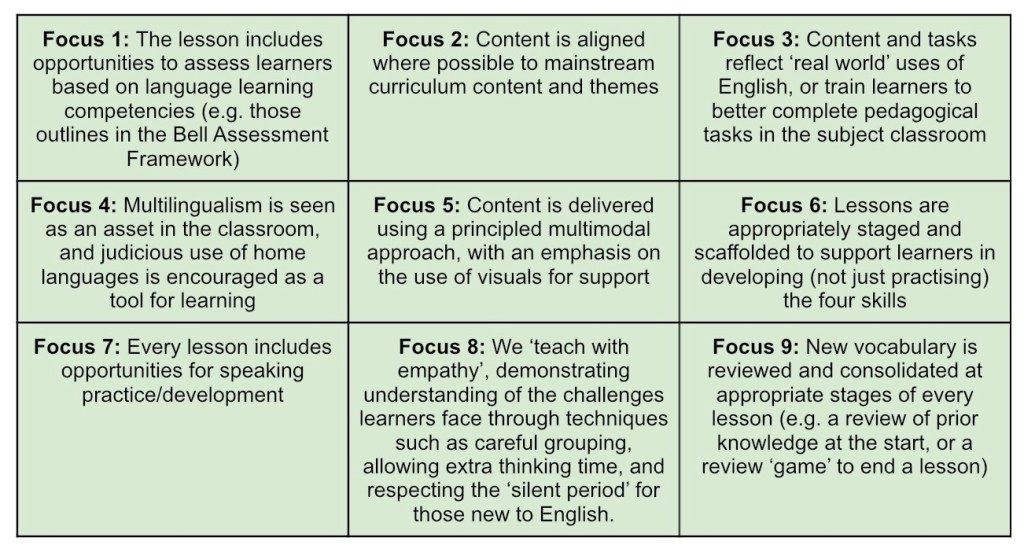
We discussed this question in a couple of our weekly meetings. The team went away and added ideas to our collaborative doc. We didn’t need a set number of criteria or anything – that was up to us. The team came up with five areas of focus, and I added a few more. Here they are:
What’s the rationale behind our choices?
Okay, so I’d say that our foci are built around three key principles (with some crossover):
1. Alignment to established frameworks and curricula
Examples:
⁃ Focus 1 references the Bell Assessment Framework for Secondary EAL. This guides our ongoing assessment.
⁃ Focus 2 stresses that our provision aligns to the mainstream curriculum. Whether it’s reviewing taught content in science, planning a unit of work to extend themes introduced in humanities, etc. We don’t follow a structural syllabus or anything like that, and I’ve made sure this is highlighted in our foci so it is clear to anyone joining our team.
2. Embracing/Embedding culturally sustaining pedagogy
Examples:
⁃ Focus 4: multilingualism as an asset; judicious use of home languages as a tool for learning. What I think is good about having this as one of our dept T+L foci is a) it encourages experimentation re translanguaging techniques, b) its keeps the dialogue open in the dept about what constitutes ‘judicious’ or ‘principled’ L1 use. Our stance on that continues to evolve.
⁃ Focus 8: Teaching with empathy. This was in danger of becoming a catch-all focus (as you can see by the examples – careful grouping, silent period, thinking time… quite broad). Looking back, I’d probably add ‘having high expectations’ to this too (see the Bell Principles) as for me that is inclusive. Oh, and I’d add culturally responsive planning too (personalization, local relevance, etc). Hmmm maybe that’s a ‘Focus 10’.
3. Evidence-based approaches with reference to cognitive science and iSLA.
Examples:
⁃ Focus 6: appropriate staging and scaffolding. Some crossover here to interactional scaffolding (see previous CSP post), but we maybe meant it to be more Rosenshiney. Like we did in Focus 9, with the emphasis on regular reviews.
⁃ Focus 5: multimodal approaches. A nod to the modality effect, but also to CSP again.
⁃ Focus 7: emphasis on oracy development a la Mercer, Alexander, etc
⁃ Focus 3: ‘real world’ tasks, which I then hedged to be pedagogical tasks too. Basically, our ‘EAL curriculum’ (sounds weird, I know. I’ll explain in another post) is skills-based and task-oriented where possible. This is a work in progress though. The focus is a nod to approaches we value, like TBLT and project-based approaches.
Overall, you’ll notice that our areas of focus lean on the Bell principles a bit. Nothing wrong with that – they are great principles!
What do we use our foci for?
Guidance when planning
I encourage our team to refer to these foci when planning. I don’t necessarily mean doing so as gospel, but they do help align our practice and make feedback on planning a bit more specific. When asked to look over planning, it can help to ask questions like:
‘Do you feel we could bring more of an oracy focus into this?’
‘[How] Could we make this more real-world?’
‘Are there enough reviews in this unit?’
Etc.
Documenting our practice
So, the idea from leadership was that these criteria could be used by HoDs during drop-in observations. Sure, when I do my 20 minute drop-ins, I could look out for examples of how teachers demonstrate some areas of focus. But something I really like is how our team are starting to document such evidence themselves. We add examples of our practice to a quality assurance document. We don’t do this just to tick a box. It’s a good space for us to share progress towards our common goals, and areas of focus we need to enhance.
Peer observation
I’m trying to get a peer observation scheme embedded in our department. The best thing about documenting our progress in focus areas is that it highlights team members who demonstrate strong practice. This informs possible peer obs cycles, helping me to choose who to buddy up and why. Note though – this hasn’t happened exactly as planned YET. Our peer obs so far has focused more on core teaching skills, not core *EAL* skills or focus areas. Coming soon!!!!
Ideas!
Our foci can be a great springboard for CPD, teacher communication, parent communication, etc. We had our first whole-school EAL training session last term, and I led with a workshop on reviewing vocabulary (Focus 9). Our foci may help guide the content for upcoming sessions.
Changes we could make to the focus areas
We can always add to these areas of focus, prioritize some over others, remove a focus when it seems secure/established practice, etc.
One change I would make would be to the wording of some foci, which is vague or wordy at times. Hey, we are practicing teachers on full timetables – we gotta get this type of thing done quickly!
Another change would be for our foci to be whole-school, or for at least some of these to be shared areas of focus with our EAL dept in the elementary school. Me and Adri Szlapak just don’t get the time to put our heads together regarding this stuff – maybe in Term 3.
Why make your own department areas of focus?
The thing I most enjoyed about this task is it forces you to drill down a bit – to consider the fundamentals of teaching and learning in your area and context. It isn’t as easy as it seems! It’s a really worthwhile process which helps shape practice within a team. But proceed with caution! Noone likes a performative checklist that they feel will hold them to account. Make sure things aren’t too top-down…
Over to you
How would you answer the question ‘what makes quality EAL teaching?’
If you were outlining key areas of focus for your own EAL department, what would you choose?
Categories: General, reflections, teacher development
 ELT Planning
Leave a comment